Agentic AI vs. AI Copilots in Recruitment: Key Differences

October 29, 2026
Agentic AI vs. AI Copilots in Recruitment: Key Differences
A practical guide to the differences between recruiting copilots, rules-based automation, and agentic AI, including what buyers should verify before choosing a solution.
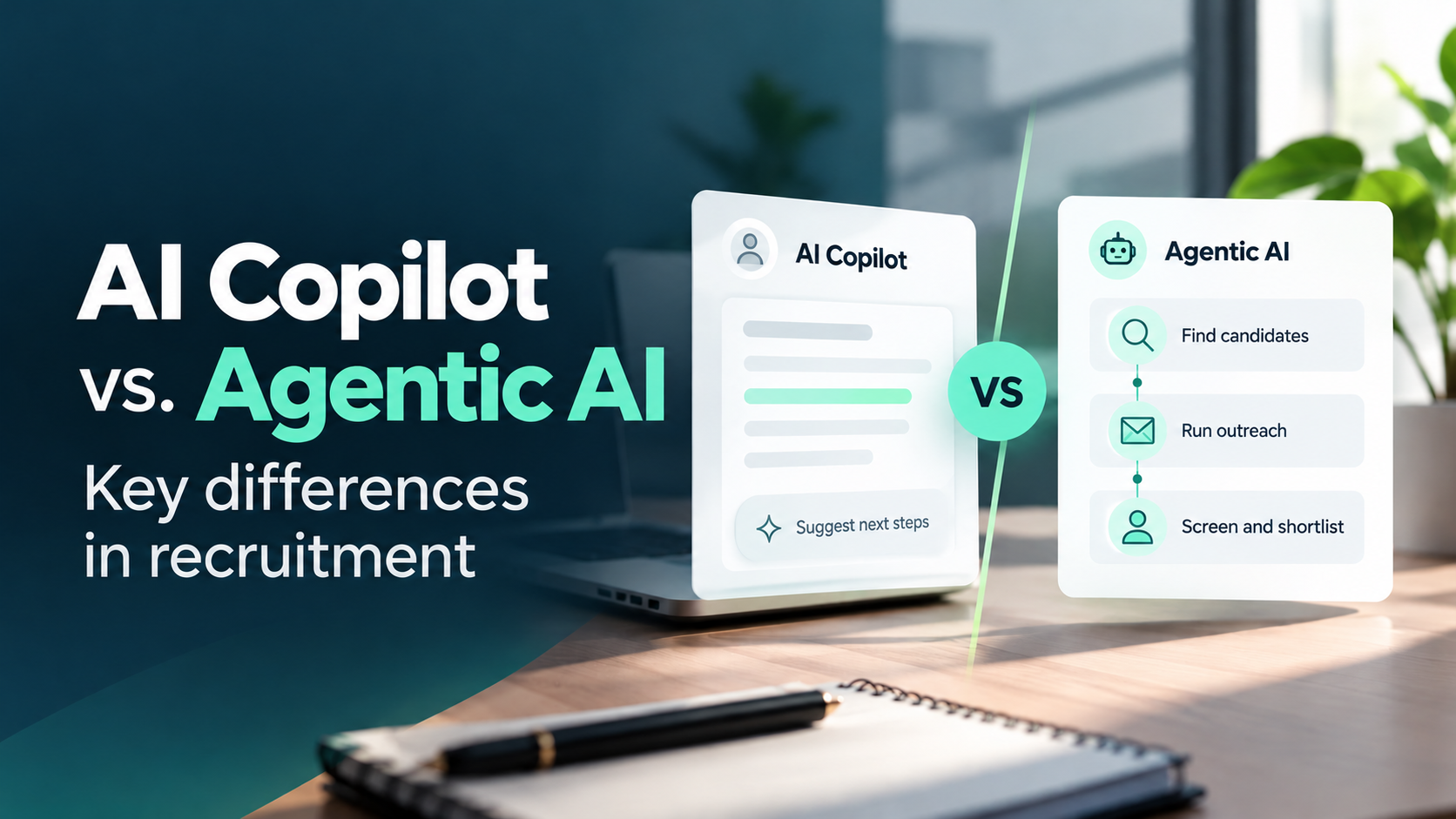
Quick answer An AI copilot helps a recruiter complete tasks they initiate. Rules-based recruiting automation follows predefined triggers. Agentic AI can select and adjust permitted actions toward a delegated goal. The practical difference is who determines the next step, what the system is allowed to do, and when a person must review the outcome.
For talent acquisition teams, this distinction matters across candidate sourcing, outreach, screening, interview coordination, and ATS-connected workflows. A tool that completes several steps is not necessarily agentic. Buyers need to establish whether its next actions are fixed by rules or selected dynamically in response to new information.
This guide compares the three approaches, shows how they may work across the same recruiting assignment, and provides a checklist for evaluating capabilities, integrations, permissions, and human oversight.
Understanding the three levels of recruiting automation
Recruiting automation can be viewed through three operating models: assistance, workflow automation, and agentic execution. This is a practical framework for evaluating products, not an official industry classification. The central question is who determines the next action: the recruiter, a predefined rule, or a system working toward a delegated goal.
Anthropic makes a related distinction between workflows that follow predefined paths and agents that direct their processes and tools dynamically in response to the task. That distinction is more useful than relying on whether a vendor calls its product an agent. Read Anthropic's guide to building effective agents for the underlying technical distinction.
Publisher disclosure: Ninjahire publishes this article. Product capabilities described below are attributed to Ninjahire and should be verified in a product demonstration.
Level 1: AI copilot assistance
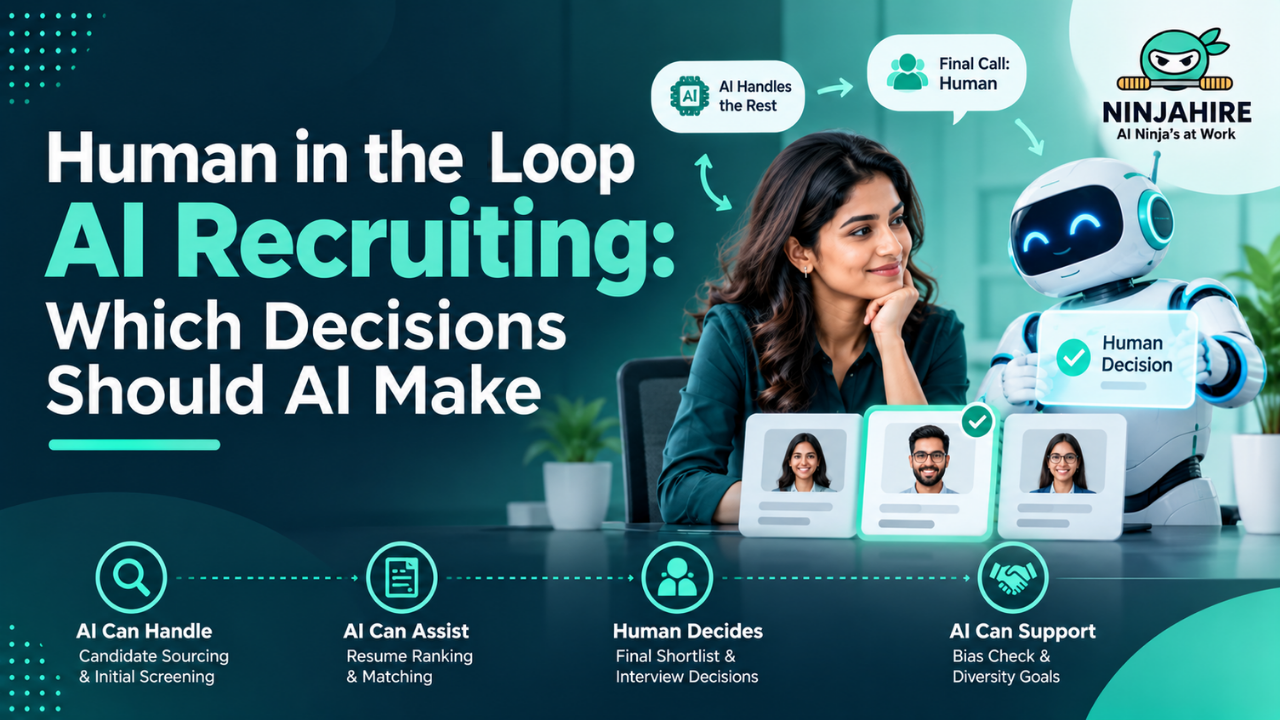
An AI copilot supports individual recruiting tasks, while the recruiter decides when to start a task and what happens next. It may help draft outreach, suggest search terms, summarise candidate information, or prepare interview questions. The recruiter remains responsible for moving the work forward.
Consider a software engineer requisition. A recruiter approves the requirements, asks the copilot for search suggestions, reviews the results, and initiates the search. The recruiter then requests an outreach draft, checks it, and decides whether to send it. Later, the recruiter reviews screening summaries and chooses the next step.
This example is illustrative, not a reported customer result. It shows the defining feature of assistance: the system contributes work, but the recruiter owns the handoffs.
A useful baseline is to review generated content before it is used, control what candidate information the tool can access, and keep a record of important outputs and approvals. The level of review should reflect the possible impact of the task.
Level 2: Rules-based recruiting workflow automation
Rules-based workflow automation connects recruiting steps through configured triggers and conditions. A workflow might start an approved outreach sequence when a candidate meets set criteria, route a reply to a screening queue, or create a scheduling task after a recruiter changes a candidate's status.
The recruiter no longer needs to initiate every transition, but the workflow follows the path defined in advance. When a new situation falls outside its configured rules, it may follow an exception route or wait for a person to intervene.
Completing several steps does not, by itself, prove that a system is agentic. A fixed workflow can coordinate sourcing, outreach, screening, and scheduling without selecting its next step dynamically. The question is whether rules determine the next action or the system can choose among permitted actions based on the situation.
For predictable, repeatable tasks, rules-based automation may be the better choice. Anthropic notes that simpler workflows can be preferable when they meet the need, while more agentic designs can add cost and latency. Buyers should ask what extra flexibility is needed before accepting the additional complexity.
Governance at this level should cover the triggers, conditions, approved message templates, exception paths, and records changed by each workflow. Test what happens when data is missing, a candidate replies unexpectedly, or a connected service fails.
Level 3: Agentic AI in recruiting
Agentic AI is given a defined goal and can select or adjust permitted steps to pursue it. Instead of following only one predefined path, it can use available tools and feedback to decide what to do next within its permissions. The exact level of autonomy varies by product and must be verified.
For example, a recruiting agent might be assigned to prepare a review-ready shortlist for an approved software engineer role. Within the boundaries set by the hiring team, it could choose permitted sourcing actions, respond to candidate information, organise screening steps, and prepare results for recruiter review. It should stop or escalate when the next action is outside its permissions or requires human judgment.
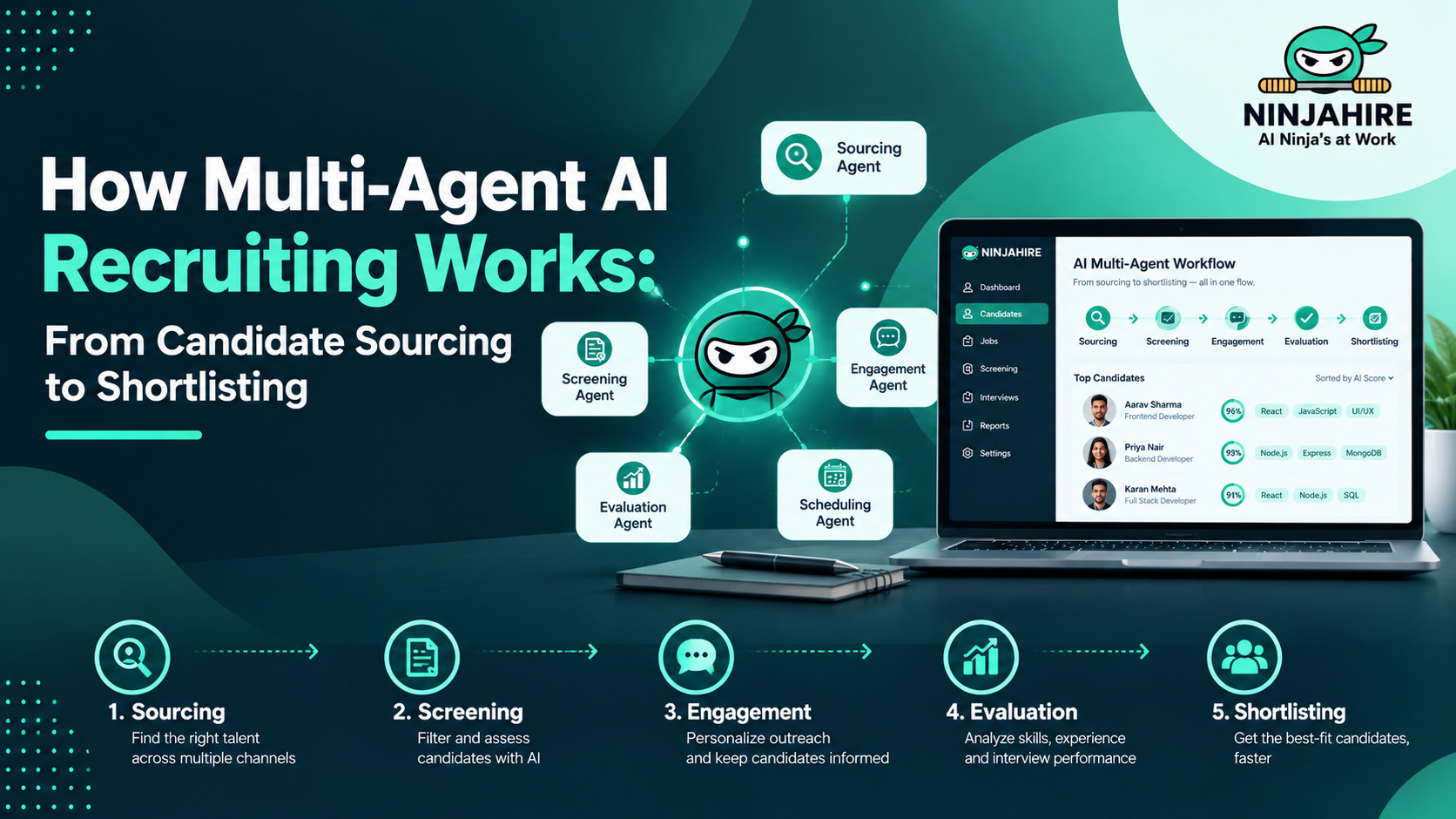
Ninjahire describes its AI Recruiter as connecting job requirements with sourcing from ATS or CRM records and external sources, candidate engagement through email, SMS, and phone, structured initial screening, and ranked shortlists for recruiter review. These are vendor-reported capabilities, not independent proof of dynamic planning. See the Ninjahire AI Recruiter and ask for a demonstration of how it selects next steps in a changing scenario.
Ninjahire also states that teams control requirements, screening criteria, outreach messaging, and hiring decisions. Its product description does not claim that the AI independently makes final hiring decisions. Buyers should verify the current product behaviour, configuration options, and permission boundaries directly with the vendor.
The distinction to test is not simply whether the system can perform multiple tasks. Ask what information changes its next action, which actions it can take without approval, and when it stops for recruiter review.
AI copilot vs. workflow automation vs. agentic AI
The following comparison uses one illustrative software engineer requisition. It is an evaluation framework, not a claim that every product in a category behaves the same way.
| Recruiting activity | AI copilot | Rules-based workflow automation | Agentic AI |
|---|---|---|---|
| Set the assignment | Helps refine a brief supplied by the recruiter | Uses approved criteria and configured conditions | Works toward a delegated goal within approved criteria and permissions |
| Find candidates | Suggests search terms or supports a recruiter-initiated search | Runs predefined searches or steps when a trigger is met | Selects and adjusts permitted sourcing actions based on available information |
| Contact candidates | Drafts messages for recruiter review and sending | Sends approved messages when configured conditions are met | Chooses among permitted engagement steps within its scope and escalation rules |
| Respond to new information | Summarises the reply and suggests a response | Follows a configured branch or exception path | May select another permitted action based on the reply and task goal |
| Prepare screening results | Summarises information when asked | Routes candidates and data according to set rules | Coordinates permitted steps and prepares evidence for recruiter review |
| Handle exceptions | Alerts or advises the recruiter | Uses a predefined exception route or stops | Can adapt within its permissions or escalate when outside its scope |
| Make hiring decisions | Supports human review | May enforce configured process rules, subject to safeguards | Goal-directed execution does not require giving the system hiring authority; consequential decisions should remain with accountable people |
The table describes typical operating models, not guarantees about products. Vendors may combine copilots, workflows, and agentic features in one platform. Evaluate each capability separately.
A practical test: who chooses the next step?
A useful way to evaluate agentic AI recruiting software is to give every vendor the same requisition and an unexpected candidate reply. For example, a candidate may have relevant experience but lack one preferred qualification, or may ask a question that does not fit the standard outreach flow.
Observe what the product does next:
- If it provides a draft or recommendation and waits for the recruiter, that is assistance.
- If it follows a branch that was configured in advance, that is rules-based automation.
- If it selects among permitted actions based on the new information and the delegated goal, it may demonstrate agentic behaviour. Ask the vendor to show the decision path and the boundaries that apply.
- If the situation requires judgment beyond the approved scope, the system should stop or escalate rather than invent authority it does not have.
One demonstration is not enough to establish performance across all situations. Repeat the test with missing data, conflicting information, an unsuccessful tool call, and an action that requires approval. Ask the vendor to explain what happened and provide a trace of the inputs, rules, decisions, tool calls, and approvals involved.
What connected recruiting execution can and cannot prove
A connected workflow may reduce manual handoffs by bringing sourcing, engagement, screening, and shortlist preparation into one process. That can be useful even when some transitions are rules-based. The presence of connected steps does not, on its own, show that a system plans dynamically.
For Ninjahire, the product description covers sourcing across ATS or CRM records and external sources, email, SMS, and phone engagement, structured initial screening, and ranked shortlists for recruiter review. Treat this as the vendor's description of workflow coverage. To assess whether a particular workflow is agentic, ask Ninjahire to demonstrate:
- Which next steps are selected dynamically and which are fixed by configuration.
- What feedback or new information changes the plan.
- Which records the system can read or update.
- Which actions require human approval.
- What happens when a candidate's response does not fit the expected path.
- How the system records decisions, failures, overrides, and escalation.
This approach keeps product capability, autonomy, and business outcomes separate. A product may cover several stages without proving that it improves time to hire, quality of hire, or recruiter productivity. Those outcomes need their own baseline and measurement.
Governance and human oversight in AI recruitment
Governance should reflect what a system is permitted to do and the consequences of its actions, rather than the label on the product. A fixed workflow that rejects a candidate automatically can have a greater impact than an agent restricted to drafting messages. Assess the action, the people affected, and the opportunities to intervene.
The OWASP guidance on excessive agency recommends limiting an AI system's functionality, permissions, and autonomy to what is necessary. Its AI Agent Security Cheat Sheet also provides practical guidance on authorization, logging, and safeguards.
Set controls according to the operating model
For copilot assistance: Define what candidate information the tool may access, review generated content before use, and make clear who approves candidate-facing communication and evaluation material.
For rules-based workflows: Approve triggers, conditions, permitted transitions, message templates, and exception routes. Record which rule initiated an action, what conditions were met, what changed in the connected system, and how an exception was handled.
For agentic execution: Restrict tool permissions to the task, enforce authorization in connected systems, require approval for high-impact actions, and monitor downstream outcomes. The model should not be the sole authority deciding whether its own action is permitted. Log relevant inputs, decisions, tool calls, approvals, outcomes, and overrides.
The UK Information Commissioner's Office guidance on meaningful human involvement is particularly relevant to recruitment. A human approval button is not enough if the reviewer cannot inspect the evidence, challenge a recommendation, or change the outcome.
Keep people accountable for consequential decisions
Hiring teams should retain meaningful responsibility for job-related criteria, contextual candidate evaluation, consequential exceptions, selection, and offers. AI can organise information and carry out approved tasks without taking ownership of these judgments.
Before sourcing begins, an accountable recruiter or hiring manager should confirm which requirements are essential, which are preferences, and what alternative experience may be relevant. During evaluation, reviewers should be able to inspect supporting evidence and challenge recommendations.
A study of recruiting professionals has examined how AI can influence job definitions, evaluation rubrics, and candidate summaries even when a person retains the final decision. This is an important reminder that oversight involves more than the final click. See the research on AI and human judgment in hiring.
The ICO has also highlighted the risk that lower-ranked applicants may receive little substantive review even when a human appears to oversee the process. See its findings on meaningful human involvement in recruitment.
For every consequential recommendation, reviewers should be able to answer four questions:
- Can we inspect candidates who were excluded or ranked lower?
- Can we examine and challenge the evidence behind the recommendation?
- Can we change the progression decision before it takes effect?
- Do we have enough time, training, information, and authority to conduct a real review?
The ICO's guidance for jobseekers on automated recruitment decisions explains the importance of transparency, safeguards, and ways to challenge decisions. Employers should assess the legal requirements that apply in each jurisdiction where they recruit.
How to evaluate agentic AI recruiting software
Use the same requisition, data, permissions, and exception scenarios across vendor demonstrations. The following checklist is a practical buyer evaluation tool, not an industry certification.
1. Establish what chooses the next step
Ask: Which steps are fixed by configuration, which are selected dynamically, and what new information changes the plan?
Verify: Ask the vendor to demonstrate a case where the original path no longer fits. Look for evidence of how the system chooses a permitted alternative, what it records, and when it escalates. Completing several steps in sequence is not enough to prove agentic planning.
2. Compare agentic execution with a simpler workflow
Ask: Could a fixed workflow meet this requirement? What benefit justifies a more flexible system?
Verify: Compare both approaches on the same approved task. Agree in advance how you will measure useful outputs, recruiter review time, exceptions, cost, and completion time. Ask for the baseline and calculation method behind any claimed improvement. Gartner has warned that some agentic AI projects may be cancelled because of cost, unclear value, or inadequate risk controls. Read the Gartner announcement on agentic AI project cancellations for context. Treat this as a forecast, not a statement that every agentic project will fail.
3. Verify the integration at action level
Ask: Which ATS or CRM records can the system read, create, update, or sync?
Verify: Request a demonstration of read and write permissions, synchronization direction, duplicate handling, error recovery, and audit history. For recruitment agencies, also check whether access boundaries can be maintained between clients. An integration listing is a starting point, not proof that every required action is supported. Review Ninjahire integrations and confirm the specific connector behaviour with the vendor.
4. Test permissions and failure handling
Ask: Which actions require approval, and what prevents the system from bypassing that approval?
Verify: Test an unauthorized action, an attempted approval bypass, a paused workflow, missing data, and repeated tool failures. Ask to see retry limits, stop conditions, escalation routes, and how the system is tested after changes to models, prompts, tools, or policies. Record the expected behaviour before the demonstration begins.
5. Inspect the action trail
Ask: Can we reconstruct why a candidate-related action happened?
Verify: Request an export that connects the action to its input, applicable policy, authorization, human approval where required, tool result, and any override or recovery. Inspect both a successful action and an exception. The OWASP AI Agent Security Cheat Sheet provides relevant guidance on logging and authorization.
6. Check whether human review is meaningful
Ask: Can recruiters inspect excluded or lower-ranked candidates, challenge the evidence, and change a progression decision before it takes effect?
Verify: Have a recruiter inspect a low-ranked profile and exercise an override. Assess whether the reviewer has enough information, time, training, discretion, and authority. Do not treat a dashboard or approval button as proof of meaningful oversight.
7. Define a measurable pilot
Ask: What would demonstrate that the system is useful for our recruiting team?
Verify: Set a baseline before the pilot and measure a small number of relevant outcomes. Depending on the workflow, these may include recruiter time spent on manual handoffs, time to prepare a review-ready shortlist, candidate response rates, screening completion, exception rates, data quality, cost per completed workflow, and the proportion of recommendations changed by recruiters.
Do not use a single metric as proof of hiring quality. Faster processing is not necessarily better hiring. Review candidate experience, job relevance, fairness, and recruiter judgment alongside efficiency measures. Compare results with the baseline and document the limitations of the pilot.
Vendor demonstration scorecard
Use this scorecard during each demonstration. Rate every area from 0 to 2, and record evidence rather than relying on a sales explanation.
| Evaluation area | 0: Not demonstrated | 1: Partly demonstrated | 2: Clearly demonstrated |
|---|---|---|---|
| Dynamic next-step selection | Only claims or scripted paths shown | Limited example shown | A changing scenario is demonstrated with a traceable explanation |
| Permission boundaries | Permissions unclear | Some controls shown | Permitted actions and approval gates are tested |
| Exception handling | No clear stop or recovery | Basic exception route | Failure, pause, recovery, and escalation are demonstrated |
| ATS or CRM integration | Listing only | Basic read or write shown | Required actions, sync behaviour, duplicates, and errors are tested |
| Meaningful human review | Approval button only | Reviewer sees some evidence | Reviewer can inspect evidence and change the outcome |
| Audit trail | No usable record | Partial logs | Inputs, actions, approvals, outcomes, and overrides can be reconstructed |
| Measured value | No baseline | Some metrics proposed | Baseline, calculation method, and success criteria are agreed |
How to use the score: A higher total can help compare demonstrations, but it is not a certification or a substitute for security, legal, accessibility, or technical review. Treat any critical gap in permissions, candidate-impacting actions, or human oversight as a follow-up requirement even if the overall score is high.
Frequently asked questions
What is the difference between an AI copilot and agentic AI in recruitment?
An AI copilot helps recruiters complete tasks they initiate. Agentic AI can select and adjust permitted steps toward a delegated goal. The key difference is who determines the next action, not how many tasks the software can perform.
Is recruiting workflow automation the same as agentic AI?
No. Rules-based recruiting automation follows predefined triggers and conditions. Agentic AI may choose among permitted actions based on new information and the goal it has been given. A connected workflow is not automatically agentic.
Can an AI recruiting agent work with an existing ATS?
It depends on the product and connector. Buyers should verify which records the system can access, which actions it can perform, how information synchronizes, how errors are handled, and whether permissions can be restricted. Do not assume every listed integration supports every required workflow.
What should buyers ask during an AI recruiting software demo?
Ask the vendor to show what determines the next action, what happens when new information changes the situation, which actions require approval, how failures are handled, and whether an audit trail can reconstruct the result. Use the same test scenarios across vendors.
How should employers maintain human oversight when using AI in recruitment?
Employers should make sure accountable people can inspect relevant evidence, challenge recommendations, review lower-ranked candidates where appropriate, and change consequential decisions before they take effect. The reviewer needs sufficient information, time, training, and authority. An approval button alone does not establish meaningful oversight.
Does agentic AI make hiring decisions autonomously?
Not necessarily. Agentic execution describes how a system selects and carries out permitted steps toward a goal. It does not automatically mean the system has authority to decide whom to hire. Employers should define and enforce the boundary between operational tasks and consequential hiring decisions.
When to choose each approach
Choose an AI copilot when recruiters need help with individual tasks and want to direct each handoff. Choose rules-based workflow automation when the process is predictable and the conditions can be defined in advance. Consider agentic execution when the work genuinely requires selecting among permitted next steps in response to changing information, and when the organisation can govern that flexibility.
The right choice depends on the workflow, the risks, the evidence available, and the value the team expects to gain. More autonomy is not automatically better. The goal is to use the simplest approach that meets the requirement while preserving accountability and control.
Want to assess this against a real recruiting workflow? Explore Ninjahire's AI Recruiter and request a demonstration using your own job description. Ask to see the decision path, permissions, integration behaviour, and escalation handling rather than relying on the product label alone.