.png)
How to conduct an AI bias audit for your hiring process (step-by-step)

March 15, 2026
What an AI Bias Audit Actually Means
An AI bias audit in hiring is a structured analysis of whether an artificial intelligence tool used in recruitment produces materially different outcomes across demographic groups — including race, gender, age, disability status, and national origin. It measures selection rates, identifies statistical disparities, investigates their causes, and determines whether those disparities can be justified by genuine job-relevance or constitute unlawful adverse impact. The goal is not to find fault with AI as a category but to verify that a specific tool, configured in a specific way, is selecting candidates fairly across all groups it evaluates.
That definition sounds technical, and the mechanics do involve statistics. But the underlying question is straightforward: is your hiring process treating people equitably, regardless of demographic background? An AI bias audit is the systematic way of answering that question with evidence rather than assumption. Organizations that conduct them rigorously are not just managing legal risk — they are building hiring systems that actually work as intended.
Why AI Bias Audits Are Now Mandatory
For most of the last decade, bias audits in AI hiring were considered best practice — something sophisticated organizations did voluntarily, usually after an internal concern surfaced or a procurement team pushed for it. That has changed. Regulatory frameworks in the US have made audits a legal requirement in certain jurisdictions, and the EEOC has signaled clearly that algorithmic hiring tools are within scope of federal anti-discrimination enforcement.
New York City's Local Law 144 is the most concrete requirement in the US. Effective January 2023 for enforcement, it requires employers and employment agencies that use automated employment decision tools to screen candidates for positions in New York City to conduct an annual bias audit by an independent auditor. The audit results must be published on the employer's website, and candidates must receive advance notice that an automated tool is being used. This is not a disclosure requirement with teeth somewhere down the line — it carries enforcement, and the New York City Department of Consumer and Worker Protection has been actively issuing guidance and responding to compliance questions.
At the federal level, the EEOC has confirmed through its 2022 and 2023 technical assistance that the Uniform Guidelines on Employee Selection Procedures apply to AI tools, and that employers are liable for discriminatory outcomes produced by those tools regardless of whether the tool was built in-house or licensed from a vendor. The EEOC's Strategic Enforcement Plan for 2023 to 2027 identifies algorithmic discrimination as a priority area. Enforcement actions against AI hiring practices are a question of when, not if.
Several other states are advancing legislation. Illinois, Maryland, California, and Washington have all passed or are progressing laws that address AI in hiring — covering disclosure requirements, consent for certain data collection, and bias analysis obligations. The regulatory picture is moving in one direction, and organizations that treat bias audits as a compliance exercise they will address eventually are accumulating risk with each hiring cycle that passes without one.
Employer liability is the practical consequence of all of this. If a candidate from a protected class challenges an AI-assisted hiring decision and can demonstrate a pattern of adverse impact, the employer cannot simply point at the vendor and walk away. The EEOC has been explicit: vendor origin does not transfer compliance responsibility. You chose the tool, you configured it, you used its output to make decisions. If those decisions produced discriminatory patterns, the legal exposure is yours.
Understanding Adverse Impact in Hiring
Adverse impact — sometimes called disparate impact — is the legal and statistical concept that sits at the center of AI hiring bias analysis. It describes a situation where a facially neutral selection procedure produces significantly different outcomes for different demographic groups, even without any discriminatory intent on the part of the employer or the tool's designers. In the employment context, adverse impact is unlawful under US federal law when it cannot be justified as job-related and consistent with business necessity.
The critical distinction is between fairness in process and fairness in outcome. A tool can apply the same criteria to every candidate — treating everyone identically in procedural terms — and still produce systematically lower selection rates for certain groups. This happens when the criteria themselves correlate with demographic characteristics, either because of how the training data was constructed or because the features being measured are proxies for protected class membership. Procedural neutrality is not the same as equitable outcome, and employment law evaluates outcomes, not intentions.
The risk exposure this creates is real and quantifiable. When adverse impact is found and the employer cannot demonstrate that the selection procedure is valid and necessary for the role, the procedure is presumptively unlawful under the Griggs v. Duke Power standard, which has been applied to AI tools by the EEOC. Candidates who experienced the adverse impact have standing to file charges, and class action exposure exists where the pattern is systematic. The financial and reputational consequences of defending an adverse impact case are significantly greater than the cost of conducting a bias audit and addressing problems proactively.
Understanding adverse impact also requires understanding what it is not. A lower selection rate for one group compared to another is not automatically adverse impact — it becomes adverse impact when the difference is statistically significant and exceeds defined thresholds. Some differences reflect genuine qualification gaps for a specific role and are explainable through validated job-relatedness. The audit process exists to distinguish between these situations, not to assume the worst in every case.
The Four-Fifths Rule Explained
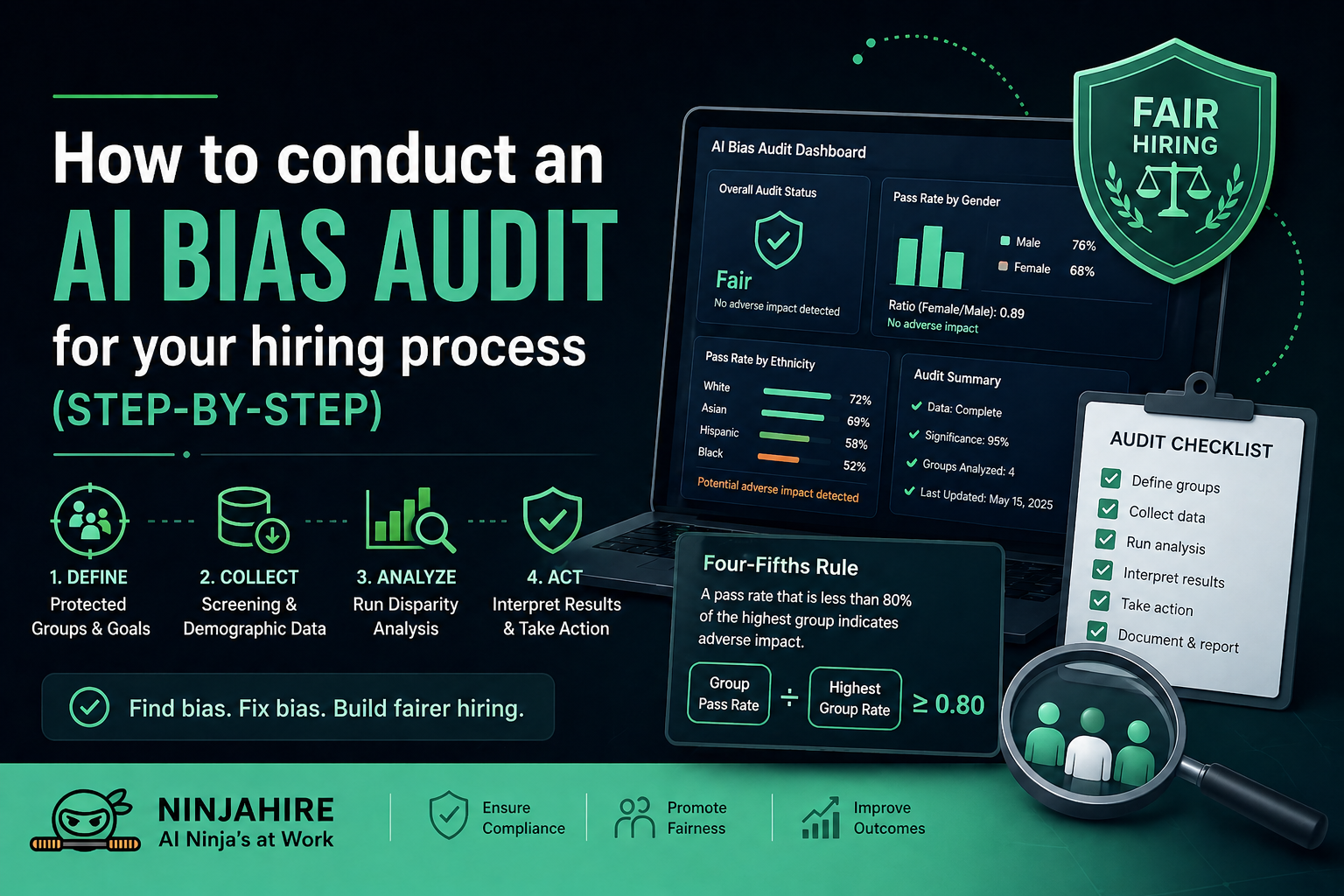
The four-fifths rule — also called the 80 percent rule — is the primary threshold test for adverse impact in the EEOC's Uniform Guidelines on Employee Selection Procedures. It states that if the selection rate for any group is less than four-fifths (80 percent) of the selection rate for the group with the highest selection rate, that is considered evidence of adverse impact. It is not a definitive legal finding — it is a trigger for further scrutiny — but it is the standard benchmark that regulators, courts, and auditors apply first when evaluating hiring data.
The table below illustrates how the rule works in practice.
| Group | Applicants | Selected | Pass Rate | Ratio vs Highest | Adverse Impact? |
|---|---|---|---|---|---|
| Group A | 200 | 100 | 50% | 1.0 (reference) | No — reference group |
| Group B | 200 | 70 | 35% | 0.70 | Yes — below 0.80 |
| Group C | 200 | 85 | 42.5% | 0.85 | No — above 0.80 |
| Group D | 200 | 58 | 29% | 0.58 | Yes — significantly below 0.80 |
In this example, Group A has the highest selection rate at 50 percent, so it becomes the reference point. Group B's selection rate of 35 percent produces a ratio of 0.70, which falls below the 0.80 threshold — adverse impact is flagged. Group C at 42.5 percent produces a ratio of 0.85, which clears the threshold. Group D at 29 percent produces a ratio of 0.58, which is a substantial adverse impact finding that would require serious investigation.
Two important caveats apply. First, the four-fifths rule is a rule of thumb, not a precise legal standard. Courts and regulators also consider statistical significance — whether the difference could plausibly have occurred by chance given the sample size. At small sample sizes, a ratio below 0.80 may not be statistically significant. At large sample sizes, a ratio above 0.80 may still warrant investigation if other indicators suggest systematic disadvantage. The four-fifths threshold triggers analysis; it does not conclude it.
Second, the rule applies at each stage of the selection process independently, and it applies to the overall process as well. A tool can pass the four-fifths threshold at the screening stage and still contribute to adverse impact in the aggregate if smaller disparities compound across multiple hiring stages. Full-funnel analysis, not just stage-level analysis, is necessary for a complete picture.
Step-by-Step AI Bias Audit Process
Understanding the theory of adverse impact is one thing. Running an actual audit is a sequence of specific, ordered steps — and skipping any of them produces results that are incomplete, potentially misleading, and insufficiently defensible if scrutinized. Here is what a well-executed AI bias audit process looks like.
Define the scope and protected groups
Before collecting any data, define clearly what you are auditing. Which AI tools are in scope — résumé screening, assessment scoring, interview ranking, or some combination? Which roles or job families are covered? Which stages of the hiring funnel are included? The scope definition also determines which protected groups will be analyzed: at minimum, this should cover race, sex, and age under federal EEO law, with additional categories depending on jurisdiction (national origin, disability status, religion). Document your scope decisions with justifications — a regulator reviewing your audit will want to understand what was included and why, and what was excluded.
Collect applicant and outcome data
The audit requires two categories of data: AI output data (scores, rankings, pass/fail decisions) and demographic data for the applicants in scope. Applicant outcome data should come directly from your ATS or AI platform, covering every candidate who passed through the tool during the audit period. Demographic data collection is more complex and is addressed in the next section. For the audit itself, you need a dataset that links each applicant record to their AI-generated outcome and their demographic group membership, without that linkage creating privacy or legal issues of its own.
Run the disparity analysis
Calculate selection rates by demographic group and apply the four-fifths rule as a primary threshold test. Supplement this with statistical significance testing — a Z-test or Fisher's exact test is typically appropriate depending on sample size — to determine whether observed differences are likely to reflect systematic patterns or chance variation. Document the methodology used, the confidence intervals, and the specific statistical tests applied. An audit without documented methodology is difficult to defend and difficult to interpret over time.
Interpret the results and investigate causes
Where adverse impact is found, the analysis does not end with the finding. The next step is investigating what is driving the disparity. This requires engagement with your AI vendor: what features is the model weighting most heavily? Are those features correlated with the protected characteristics that show adverse impact? Is there validation evidence that the weighted features are genuinely predictive of job performance? The investigation phase is often where the most important compliance decisions are made — it distinguishes between adverse impact that reflects a model problem and adverse impact that reflects legitimate job-relevant differences in the applicant pool.
Document findings and remediation
Every audit should produce a written report: scope, methodology, data sources, findings by group and stage, root cause investigation results, and remediation actions taken or planned. This documentation is the foundation of your compliance posture. Retain it for a minimum of two years, and ensure it is accessible to your legal team and any external auditor who may need to review it.
How to Collect Demographic Data Safely
Demographic data collection for bias auditing is one of the areas where organizations feel most uncertain, and for understandable reasons. Collecting race and gender data from job applicants feels uncomfortable, and done incorrectly it creates its own legal and ethical problems. Done correctly, it is both lawful and necessary for any meaningful bias analysis.
The standard approach in the US is voluntary self-identification at the point of application. The EEOC and OFCCP have long required federal contractors to collect EEO demographic data through voluntary disclosure, and the established format — separate from the application itself, submitted voluntarily, with clear statements that it will not be used in hiring decisions — is the model to follow. The form should make clear that participation is voluntary, that the data will be used solely for reporting and compliance purposes, and that opting out will not affect the candidate's application. This structure, consistently applied, is legally defensible and produces the data you need for analysis.
The challenge is response rates. Many candidates skip voluntary demographic forms, and low response rates reduce the statistical power of your bias analysis. This is especially acute for smaller applicant pools where you may not have enough data for statistically significant results in any case. Where voluntary disclosure rates are low, two approaches can supplement direct data: aggregate-level analysis using geographic or educational proxies (accepted in some methodological frameworks), or expanding the audit period to increase sample size. Neither is a perfect substitute for direct disclosure, but both are preferable to conducting no analysis at all.
For organizations outside the US, GDPR and equivalent data protection laws add additional complexity. In the EU, demographic categories including racial or ethnic origin are special category data under Article 9, which requires explicit consent or another specifically enumerated legal basis for processing. The audit-related processing of this data needs its own GDPR analysis — typically relying on the substantial public interest basis available in some member states for equality monitoring purposes, or on explicit consent from candidates who understand their data will be used for fairness analysis. The data protection analysis should be completed before demographic data collection begins, not after.
Running the Disparity Analysis
The core calculation in an AI hiring bias audit is the adverse impact ratio: the selection rate for each demographic group divided by the selection rate for the highest-selecting group. This produces a number between 0 and 1 — the closer to 1, the less disparity; below 0.80, the four-fifths threshold is triggered.
Example: Group B Pass Rate 35% ÷ Group A Pass Rate 50% = 0.70
Result: 0.70 < 0.80 → Adverse impact flagged
The formula is simple. The interpretation requires judgment. A ratio of 0.79 in a dataset of 5,000 applicants with statistically significant results is a serious finding. A ratio of 0.75 in a dataset of 30 applicants where the difference involves two or three people is not — the sample is too small to draw reliable conclusions. This is why statistical significance testing accompanies the ratio calculation. A Z-test for difference in proportions produces a p-value that tells you whether the observed disparity is likely to be real or the result of random variation. Most practitioners use p < 0.05 as the threshold for statistical significance in this context, though some jurisdictions and courts accept p < 0.10 for initial adverse impact findings.
Effect size is a third dimension worth considering alongside the ratio and the p-value. Cohen's h is a commonly used effect size measure for comparing proportions. A statistically significant finding with a small effect size may be legally relevant but operationally modest. A statistically significant finding with a large effect size warrants urgent investigation and remediation. Reporting all three measures — ratio, significance, and effect size — gives the fullest picture of what the data shows.
Run the analysis at each stage of the AI-assisted hiring process separately, then also at the aggregate level across all stages. A screening tool that shows no adverse impact in isolation can contribute to adverse impact when its slightly lower pass rates for one group compound with similar patterns at assessment and interview stages. The compounding effect is sometimes called the pipeline problem — individually modest disparities at each stage produce a substantial representational imbalance by the end of the funnel.
Interpreting Audit Results
Audit results fall into three broad categories, and the appropriate response differs significantly depending on which category you are in. Treating a borderline result the same as a confirmed adverse impact finding is as problematic as ignoring a clear finding — both produce compliance decisions that are not calibrated to the evidence.
No adverse impact found
All groups have selection rates above the 0.80 threshold, and no statistically significant disparities are found. This is the outcome you are working toward, but it should not produce complacency. Document the finding thoroughly, retain the audit report, and schedule the next review. Tools change — vendors update models, applicant pools shift, role criteria evolve. A clean result today does not guarantee a clean result in twelve months. The audit is an ongoing process, not a certification.
Borderline results
One or more groups show ratios between 0.75 and 0.80, or ratios below 0.80 that are not statistically significant at your threshold. This is a caution zone. The finding does not confirm adverse impact in a legally actionable sense, but it signals that the tool is worth watching closely. Appropriate responses include increasing monitoring frequency, conducting a deeper feature-level analysis with your vendor, and reviewing whether the criteria being evaluated are well-validated for job relevance. Document the borderline finding and the steps taken. If the pattern persists in the next audit cycle, it strengthens the case for more significant intervention.
Confirmed adverse impact
One or more groups show selection rates below 0.80 with statistically significant results. This requires immediate action. The first step is investigative — understanding what is driving the disparity before deciding how to address it. The second step is legal review — your employment law team needs to assess exposure and guide the response strategy. The third step is remediation — adjusting, replacing, or reconfiguring the tool as described in the next section. A confirmed adverse impact finding that is documented, investigated in good faith, and addressed proactively is a substantially better position than one that is ignored or minimized. Regulators and courts give significant credit to employers who identified a problem and acted on it.
Fixing Bias in AI Hiring Systems
Finding bias in an audit is only useful if you know what to do about it. The remediation options range from minor recalibration to complete tool replacement, and choosing the right response requires understanding what is causing the disparity — which is why the root cause investigation phase is so important.
Adjusting selection criteria and weighting
If the audit reveals that a particular criterion — degree requirement, specific software experience, keyword presence — is driving most of the disparity, the first question is whether that criterion is genuinely necessary and validated for the role. If not, removing it or reducing its weight in the scoring model may resolve the adverse impact without compromising hiring quality. Many organizations discover through bias audits that criteria they assumed were job-relevant were actually proxies for demographic characteristics, retained from historical hiring patterns without deliberate evaluation.
Redesigning screening questions
AI screening tools that evaluate responses to written or spoken questions can show bias through the questions themselves, not just the scoring model. Questions that assume certain cultural communication norms, that use idioms or frames of reference that are not universal, or that reward a particular style of self-presentation will systematically disadvantage candidates from backgrounds where those norms are less common. Reviewing and redesigning the question set — often in consultation with an I/O psychologist — can address bias at the source rather than attempting to correct for it downstream.
Threshold tuning
Some adverse impact in AI scoring results from the pass/fail threshold being set at a point where a small difference in scores produces a large difference in group outcomes. If the score distributions for two groups are similar but one group's scores cluster just below the threshold while the other's cluster just above it, moving the threshold slightly may substantially reduce adverse impact without meaningful reduction in hiring quality. This requires careful analysis — the goal is not to artificially inflate pass rates for disadvantaged groups but to identify whether the threshold is set at a point that is genuinely predictive of job performance.
Vendor accountability
When the root cause investigation points to the model itself rather than how it is configured, the conversation needs to move to the vendor. Ask specifically: what features are driving the disparity we found? What bias mitigation was applied during model development? Can you adjust the model's feature weighting to reduce adverse impact in our applicant pool? What is your timeline for addressing this? If the vendor cannot engage substantively with these questions, that is important information. A vendor who cannot support your adverse impact remediation efforts is not a compliance partner — they are a liability.
Common Bias Risks in AI Hiring Tools
Bias in AI hiring is rarely a single, obvious problem. It tends to accumulate from multiple smaller sources that each look defensible in isolation but combine to produce systematic disadvantage for certain groups. Understanding the specific mechanisms helps you know where to look in an audit and what questions to ask vendors.
Language and vocabulary bias
Résumé screening AI trained on natural language processing can develop strong associations between specific vocabulary patterns and candidate quality scores. If the training data predominantly featured résumés from candidates who were hired — and those candidates skewed toward particular demographics — the model learns to reward the linguistic patterns associated with those demographics. Candidates from different educational backgrounds, native speakers of other languages, or people from regions where professional communication conventions differ may write perfectly qualified résumés that the model systematically underscores. This is one of the most pervasive and hardest-to-detect forms of AI hiring bias because the model is technically evaluating language quality, which sounds legitimate, but what it is actually measuring is cultural familiarity with a particular professional register.
Voice recognition and speech analysis bias
AI interview platforms that evaluate vocal features — clarity, pace, vocabulary diversity, response structure — face a specific and well-documented bias risk: voice recognition and speech analysis systems perform significantly better on accents associated with majority demographics in their training data. A candidate with a strong regional or foreign accent may receive systematically lower scores not because their communication is less effective but because the underlying speech processing model was not trained on sufficiently diverse audio. Several major vendors have acknowledged this problem and removed acoustic analysis features as a result. If your AI interview platform uses any form of speech analysis, ask specifically what accent diversity was represented in the training data and what mitigation was applied.
Cultural norm bias in assessment design
Personality and behavioral assessments used in AI-assisted hiring often embed cultural assumptions in their design — assumptions about what confidence looks like, how assertiveness should be expressed, what responsiveness and engagement signal, or how much eye contact is appropriate. These norms vary significantly across cultures and are associated with demographic groups in ways that produce systematic score differences. A candidate who is highly competent but expresses that competence in ways the assessment was not designed to recognize will be underscored. Validation studies for these tools frequently lack sufficient demographic diversity, meaning the bias goes undetected in the vendor's own testing.
Audit Frequency and Monitoring
One of the most important and most frequently overlooked aspects of AI bias audit compliance is cadence. A single audit conducted at deployment and then shelved is not a compliance program — it is a point-in-time snapshot that becomes less reliable as time passes. AI hiring tools change. The applicant pool shifts. Organizational hiring criteria evolve. Any of these changes can produce adverse impact in a tool that previously showed clean results, and without ongoing monitoring, that adverse impact accumulates undetected.
Continuous monitoring
Between formal audits, track selection rates by demographic group at each AI-assisted stage in real time or near-real time, with an alert trigger when rates fall below defined thresholds. Many ATS platforms support this with configurable reporting. Monitoring is an early warning system — when it flags a potential issue, it triggers deeper investigation rather than replacing a formal audit.
Quarterly checks
Every quarter, review demographic selection data accumulated since the last check. Apply the four-fifths rule, note trends, and compare against the baseline from your most recent full audit. Quarterly checks are also the moment to review any tool changes — model updates, threshold adjustments, new features — that might shift the bias risk profile. Vendor-notified model changes warrant extra scrutiny in the following quarterly review.
Annual full audit and trigger conditions
A full audit — complete methodology, statistical significance testing, root cause investigation, and a written report — should run at least annually. NYC Local Law 144 mandates this for covered employers; elsewhere it remains best practice and strong regulatory defense. Beyond the annual schedule, specific events should trigger an immediate out-of-cycle review: a vendor model update, a discrimination complaint, a material change in applicant pool demographics, or a new business unit beginning to use an AI tool not previously in scope.
Bias in AI hiring is rarely intentional. It is usually the result of unchecked patterns in training data, unexamined assumptions in tool design, and selection criteria that were never rigorously validated for job relevance. The solution is not to distrust AI as a technology but to build the monitoring and accountability infrastructure that catches problems before they become systematic.
Metrics That Matter in AI Bias Auditing
A bias audit program without measurement infrastructure tends to become a compliance document that sits unused. Tracking the right metrics — consistently, over time — is what makes an audit program actionable rather than archival.
| Metric | What it measures | Why it matters |
|---|---|---|
| Adverse impact ratio by group | Selection rate of each group relative to the highest-selecting group | Primary indicator of potential discrimination; triggers four-fifths rule analysis |
| Statistical significance (p-value) | Probability that observed disparity is due to chance | Distinguishes real patterns from random variation; prevents false positives and false negatives |
| Effect size (Cohen's h) | Magnitude of the disparity, independent of sample size | Contextualizes significance findings; a small p-value with a small effect size warrants different action than a large effect size |
| Pass rate consistency across stages | Whether disparity appears at a single stage or compounds across multiple stages | Identifies compounding effects that produce aggregate adverse impact invisible in per-stage analysis |
| Demographic data coverage rate | Percentage of applicant records with usable demographic data | Determines statistical power of the audit; low coverage rates limit the reliability of findings |
| Audit completion rate | Percentage of AI tools in use that have been audited in the current cycle | Ensures no tools are operating outside the compliance program; critical for multi-tool hiring environments |
| Remediation closure rate | Percentage of adverse impact findings from previous audits with documented remediation actions completed | Measures whether the audit program drives real change or produces findings that are never addressed |
A Real Example of Bias Detection and Resolution
Consider a mid-size technology company that deployed an AI résumé screening tool for software engineering roles. The tool was set up to evaluate candidates on years of relevant experience, specific technical skills, educational background, and the presence of certain project types in their work history. It had been running for two hiring cycles before the company conducted its first formal bias audit.
The audit covered 1,200 applications across six roles over an eight-month period. Demographic data had been collected through a voluntary self-identification form appended to the application — response rate was approximately 68 percent, sufficient for statistically meaningful analysis across the major demographic groups.
The adverse impact analysis found that candidates who identified as Black or African American had a selection rate of 22 percent compared to a selection rate of 38 percent for white candidates — an adverse impact ratio of 0.58, substantially below the four-fifths threshold, with a p-value of 0.003 indicating strong statistical significance. Female candidates showed a ratio of 0.76, just below the four-fifths threshold and borderline on statistical significance given the smaller sample size in that group.
The investigation revealed two contributing factors. The educational institution feature had been trained on historical hiring data where certain universities were overrepresented among hired candidates — universities that correlated with demographic characteristics in ways not apparent from the feature name. The model had learned to reward institutional prestige rather than technical skill. The project type feature disproportionately rewarded enterprise software stack experience common at large technology firms — which correlated with candidates from larger, historically less diverse companies, creating a self-reinforcing cycle.
Remediation involved removing the institutional prestige feature and replacing it with specific technical credential evaluation, and broadening the project type category to include open source contributions, startup experience, and independent work. A follow-up audit four months later showed adverse impact ratios of 0.84 for the previously flagged group — above the four-fifths threshold — and statistically non-significant results. The female candidate disparity resolved similarly. The lesson: the bias was not intentional, the fix was not drastic, and the resolution was only possible because the audit was conducted and the vendor could engage substantively with the findings.
Choosing Platforms That Support Bias Audit Compliance
The audit process described in this guide assumes that your AI hiring tools can surface the data you need: per-candidate outcomes, feature importance information, model version details, and demographic-stratified selection rates. Not all platforms provide this. The difference matters enormously when an audit finding requires investigation or a regulatory inquiry arrives.
When comparing platforms — whether evaluating ninjahire vs linkedin recruiter or assessing ninjahire vs hireez — the audit infrastructure questions should be on the evaluation checklist alongside feature comparisons. Can the platform export individual-level outcome data in a format suitable for adverse impact analysis? Can it surface which features contributed most to a given candidate's score? Does it maintain model versioning so past decisions can be traced to a specific model state?
The same applies when looking at newer platforms. Comparing options like ninjahire vs converzai, ninjahire vs tenzo ai, or ninjahire vs heymilo on bias audit support reveals differences that are easy to miss in a standard feature demo. Ask specifically: have you conducted a bias audit on your platform's outputs, and can you share the methodology and findings? What support do you provide when an employer conducts their own adverse impact analysis and finds a disparity? These questions reveal whether compliance was designed into the platform or added as a marketing layer afterward.
Key Takeaway
An AI bias audit is not a one-time compliance check. It is a continuous system — a combination of real-time monitoring, quarterly data reviews, annual formal audits, and trigger-based investigations — that ensures your AI hiring tools remain fair throughout their operational life, not just at the moment of deployment. The organizations that treat it this way will catch problems early, remediate them before they accumulate into legal exposure, and build a recruiting process that genuinely selects on job-relevant criteria across all demographic groups.
The regulatory environment is moving in one direction. The cost of building this infrastructure proactively is a fraction of the cost of addressing an adverse impact finding reactively. Start with a clear scope, collect demographic data carefully, apply the four-fifths rule alongside proper statistical testing, engage your vendors on the findings, and document everything. That is the foundation of AI hiring compliance done right.
Ensure your hiring process is fair, auditable, and compliant
NinjaHire is built for teams that take fair hiring seriously — with transparent AI scoring, audit-ready data exports, and compliance infrastructure designed for real regulatory scrutiny.
Try for free
.jpg)
.png)
