AI Candidate Rediscovery: Find Qualified Talent in Your ATS

October 30, 2026
Ninjahire Research · Talent Sourcing
AI Candidate Rediscovery: Find Qualified Talent in Your ATS
A practical guide to finding overlooked candidates in existing ATS and CRM records, evaluating match quality, checking data freshness and turning relevant profiles into recruiter-reviewed shortlists.
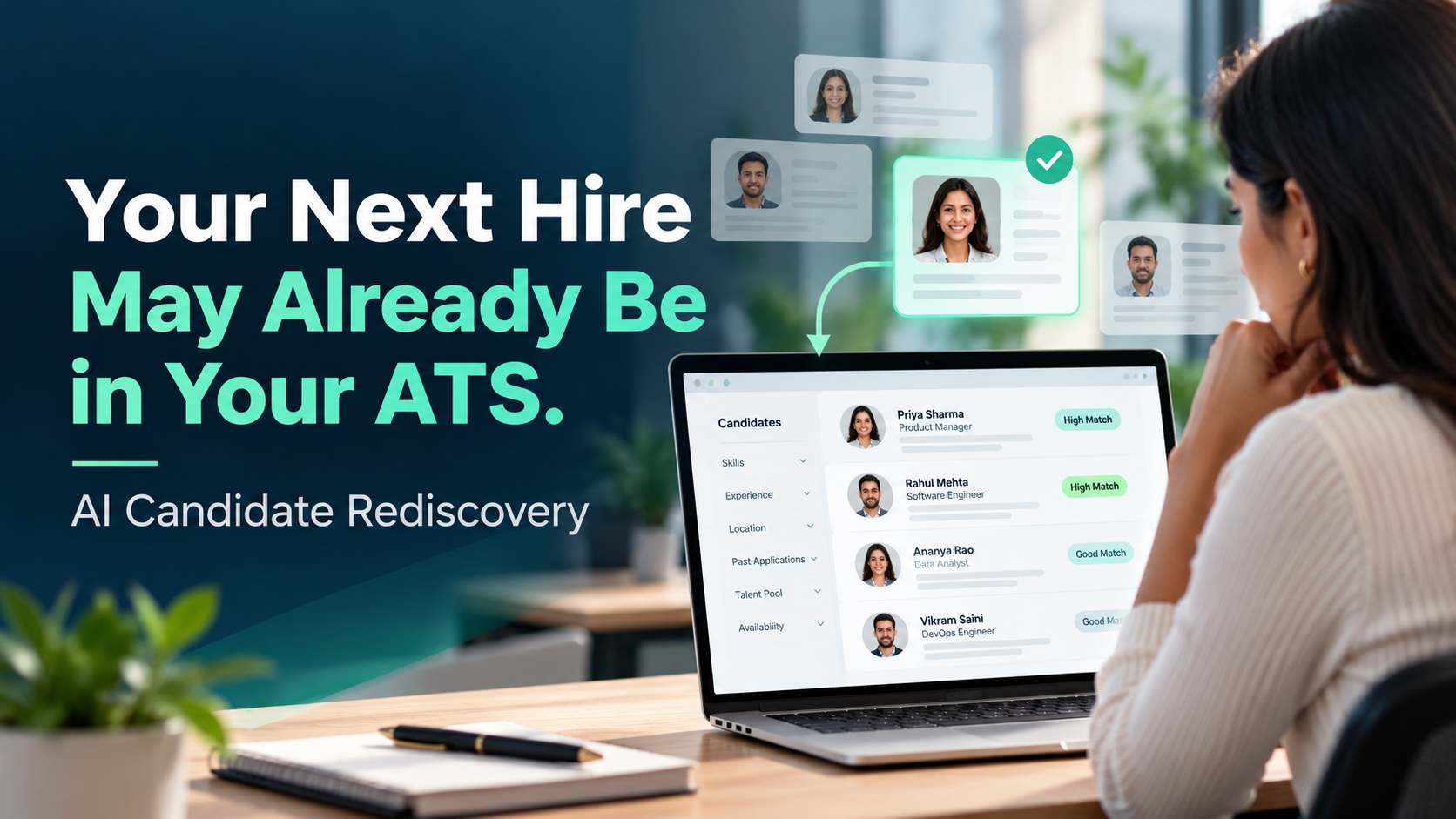
Recruiters often begin a new search with external job boards and sourcing platforms, even when their applicant tracking system already contains people who may fit the role. Previous applicants, silver-medalist candidates, past prospects and people considered for similar vacancies can remain buried in historical records.
AI candidate rediscovery helps recruiters search those existing records against a new role and identify profiles that deserve another look. AI candidate rediscovery software can use skills, experience, role context and related language to surface potential matches that exact keyword searches may miss. Recruiters still need to verify qualifications, current details and permission to make contact before treating a profile as ready for outreach.
This guide explains how ATS candidate rediscovery works, how it differs from traditional database search, what to compare when evaluating candidate rediscovery software, and how to measure whether the process produces useful shortlists.
What Is AI Candidate Rediscovery?
AI candidate rediscovery is the process of finding potentially relevant people in an organisation's existing ATS, CRM or recruitment database for a new or reopened vacancy. Rather than treating every requisition as a completely new search, recruiters use existing candidate information as another source of talent.
A rediscovery search may include previous applicants, candidates who reached later interview stages, people considered for another role, sourced prospects and historical placements. Which records can be searched depends on the ATS, connected data sources, permissions, field mapping and the rediscovery product's integration. For a related breakdown of how recruiters can mine an ATS for candidates they have already engaged, see our candidate rediscovery guide.
In simple terms: candidate rediscovery helps answer a practical recruiting question: have we already spoken to someone who could be a good fit for this role?
AI can make this search more flexible by recognising related skills and experience even when a candidate's resume uses different wording from the job description. It can also rank profiles for review. A match score is a prioritisation aid, not proof that a person meets every requirement or is currently interested in a move.
How AI Candidate Rediscovery Works: A Six-Stage Workflow
A reliable process combines role definition, authorised data access, evidence-based review and a separate contact-eligibility check. The six stages below are a recommended operating framework, not a universal product standard.
1. Define the role before searching
Start with a recruiter-approved role brief. Separate mandatory qualifications from preferences, then standardise the skills, seniority, location, certifications and experience required. For each mandatory criterion, decide what evidence would demonstrate that a candidate meets it.
For example, if a professional certification is essential, related experience should not be treated as an automatic substitute. Record acceptable equivalents explicitly so the search does not quietly change the hiring criteria.
2. Confirm which ATS records are searchable
Identify the records the search is authorised to access. These may include applicants, prospects, resume attachments, recruiter notes and previous process outcomes, but access varies by platform and configuration. Confirm which fields and documents are actually indexed before interpreting a missing result as a lack of talent.
Greenhouse, for example, documents past-candidate matching and explains how past candidates can be surfaced for new roles. Its support documentation is a useful reminder to ask precisely which historical records and fields a system can search. For a practical view of how recruiters can make existing records easier to find, see our guide to searching candidate records in an ATS.
3. Match profiles and rank them for review
Use the approved role criteria to retrieve potential matches. Depending on the product, matching may combine exact filters, keyword expansion, semantic similarity or broader role context. Ask the vendor what information is used and whether recruiters can inspect the evidence behind a result.
Review the strongest matches, but also inspect a sample of lower-ranked and excluded profiles. A shortlist can look accurate while still missing qualified candidates who use less familiar job titles or describe their experience differently.
4. Check whether historical information is still current
An old profile can contain useful evidence of past experience without confirming a candidate's present availability, location, salary expectations or contact details. Treat inactivity as a reason to verify changeable information, not as proof that the person is unsuitable.
Where contact is permitted, invite candidates to update their details through an appropriate channel. Keep unknown information visibly marked as unverified rather than assuming the whole record is current.
5. Verify contact eligibility separately
A relevant profile is not automatically eligible for outreach. Check the applicable legal basis or channel-specific permission, consent scope where relevant, suppression status, withdrawal history and the purpose for which the information will be used. Hold records with unresolved restrictions out of the sending queue.
Keep this check separate from candidate fit. A person can be a strong potential match and still require a permission review before any message is sent.
6. Present a shortlist recruiters can explain
A useful rediscovery shortlist should show why each person surfaced, which mandatory requirements appear supported, what information is missing, when key details were last verified and whether outreach is permitted. Distinguish potential matches from candidates whose interest and availability have been confirmed.
This gives recruiters and hiring managers a basis for review instead of asking them to trust a ranking score without context.
AI Candidate Rediscovery vs Traditional ATS Search
Traditional ATS search remains useful for precise filters and known terms. The limitation appears when a recruiter searches only for the exact words used in a job description. A candidate may have relevant experience but describe it using a different title, skill phrase or responsibility.
| Traditional ATS keyword search | AI-assisted candidate rediscovery |
|---|---|
| Often depends on exact terms, fields and filters. | May identify related skills and experience expressed in different language. |
| Recruiters may need to build and refine multiple queries. | Can help retrieve and rank profiles against broader role context. |
| Results depend on which candidate fields and documents are indexed. | Still depends on accessible, indexed data and integration configuration. |
| Usually returns records matching the chosen search conditions. | Can prioritise potential matches for a recruiter to inspect. |
| Does not establish whether historical details remain current. | Also requires freshness checks and candidate confirmation. |
Consider a role that requires team leadership. A resume may describe supervising colleagues, managing shift handovers or coaching a team rather than using the exact phrase team leadership. Semantic matching may surface that profile for review. The recruiter must still establish the scale, duration and relevance of the experience.
AI rediscovery is not automatically more accurate than keyword search. Results depend on data coverage, role criteria, matching configuration and the quality of human review. The strongest approach combines precise mandatory filters with broader retrieval and evidence-based assessment.
For a closer look at how role requirements can be compared with candidate profiles, read our guide to ATS candidate matching.
Best AI Candidate Rediscovery Software: Features to Compare
When evaluating candidate rediscovery software, compare the actual workflow rather than relying on a feature label. A platform may offer search inside its own ATS, connect to an external ATS, enrich historical profiles or combine rediscovery with broader talent sourcing. Those are different capabilities.
Buyer evaluation checklist
- Searchable record coverage: Can it search applicants, prospects, resume attachments, notes and historical placements, or only selected profile fields?
- Matching approach: Does it support exact filters, keyword expansion, semantic matching or natural-language role criteria?
- Evidence visibility: Can recruiters see which experience or qualifications caused a profile to rank?
- Data freshness: Does it show when details were last updated and distinguish historical facts from current information?
- Duplicate handling: How does it identify duplicate profiles and avoid overwriting the wrong candidate record?
- Recruiter control: Can recruiters review, reject, shortlist and correct results before downstream actions?
- Re-engagement workflow: Does it support approved outreach, suppression checks and a record of candidate responses?
- Integration depth: Which ATS and CRM systems are supported, what data can be read, and can approved updates be written back?
- Security and governance: What access controls, retention settings, audit trails and data-processing terms are available?
- Measurement: Can the team report on qualified shortlist rate, missed matches, review time and downstream outcomes?
Examples of platforms and approaches in the market
The following examples illustrate different product approaches. They are not a ranked list, and the capabilities available to a buyer should be verified directly with each vendor.
| Platform | Documented area to investigate | Questions for a buyer |
|---|---|---|
| Greenhouse | Past candidates in Talent Matching. | Which past candidate records are included, and what matching controls are available in your plan? |
| Ashby | Recruiting platform and candidate search capabilities. | How does rediscovery work across existing records, and what evidence is shown to recruiters? |
| hireEZ | AI sourcing, ATS connectivity and candidate rediscovery use cases. | Which ATS fields are searched, enriched or synchronised? |
| SeekOut | Talent intelligence and ATS-connected sourcing. | How are historical records refreshed, and what data sources are included? |
| Bullhorn | Staffing CRM, automation and candidate database workflows. | Which search, re-engagement and automation functions are native or require additional products? |
| Ninjahire | AI sourcing workflow that includes ATS/CRM rediscovery alongside other sourcing channels. | Confirm supported integrations, searchable fields, plan availability and configuration for your environment. |
For a fair evaluation, run the same requisition and an authorised historical data sample through each shortlisted product. Compare the profiles retrieved, recruiter-confirmed qualification, missing relevant candidates, data freshness, permission controls and time required to reach an accepted shortlist. You can also review this ATS candidate reuse case study for an example of how rediscovery can be built into a recruiting workflow.
Do not assume that a platform searches every attachment, note or historical interaction simply because it connects to an ATS. Ask for a documented field-level integration map and test it with representative records.
How to Improve Candidate Database Quality for Rediscovery
Candidate data does not need to be perfectly clean before a rediscovery pilot can begin. It does need to be sufficiently accessible and trustworthy for the specific role and workflow. Separate three questions: does the record contain relevant qualification evidence, are its changeable details current, and is the proposed use permitted?
Use a practical record review
- Qualification evidence: relevant skills, experience, certifications and supporting resume or interview notes.
- Freshness: last meaningful interaction and verification status for availability, location and contact details.
- Contact eligibility: applicable permission assessment, suppression status and withdrawal history.
- Record integrity: duplicate profiles, missing fields, inconsistent formatting and attachment access.
- Review context: prior process outcomes, material gaps and unresolved questions.
Flag inactivity without rejecting candidates automatically
Use inactivity to trigger a check, not an automatic rejection. Bullhorn documents specific automation examples that use inactivity periods to trigger candidate re-engagement or identify dormant records. Its time thresholds are examples of particular workflows, not universal expiry rules for candidate records.
Choose a review threshold that fits your recruitment cycle and retention policy. A label such as availability unverified is more useful than a generic stale status because it tells the recruiter what needs to be checked.
Refresh records carefully
Before bulk updates, test how the integration maps candidate names, email addresses, resumes and other identifiers. Confirm how duplicates are handled and whether updates reach the intended record. A poorly configured refresh process can create duplicate profiles or overwrite useful historical information.
Archiving is not a substitute for a documented retention policy. Define what information is retained, for how long, for which purpose and under what legal basis. Apply deletion, restriction and retention controls consistently.
Candidate Re-engagement and Contact Permissions
Candidate rediscovery and candidate re-engagement are related but distinct. Rediscovery identifies a person who may fit a role. Re-engagement involves deciding whether and how the organisation may contact that person. A strong match does not remove the need for a separate permission check.
Review the intended purpose and applicable rules
Before reusing historical candidate information, assess whether the new recruitment purpose is compatible with the original collection and whether an appropriate legal basis applies. Requirements vary by jurisdiction, candidate location, data type, communication channel and the organisation's role in processing.
The UK Information Commissioner's Office has highlighted recruitment-AI risks including excessive data collection, indefinite retention, transparency gaps and insufficient assessment of privacy and bias. Its guidance is useful for governance planning, but it is not a substitute for legal advice in every jurisdiction.
Keep consent and suppression records reviewable
Where consent is the basis for processing, retain evidence of who consented, when, how, what they were told and whether consent was withdrawn. Review whether the purpose or circumstances have changed. Do not use a new recruitment opportunity as a reason to ignore a withdrawal or an applicable suppression request.
Check communication-specific requirements
For commercial email covered by the US CAN-SPAM Act, the Federal Trade Commission explains requirements that include accurate sender information, a working opt-out mechanism and timely handling of opt-out requests. Organisations using vendors remain responsible for ensuring their campaigns comply.
New York City Local Law 144 may apply to certain automated employment decision tools used for hiring or promotion. Its requirements include a bias audit, public information and candidate or employee notices. Applicability depends on the tool and use case, so assess it separately from email permission.
This section is an operational overview, not legal advice. Have qualified counsel review the rules that apply to your organisation, candidate locations, data sources and communication channels.
How to Measure AI Candidate Rediscovery Performance
Measure the quality of the shortlist, not just the number of profiles returned. A search that retrieves hundreds of records may create more recruiter work without improving hiring outcomes. Agree on role criteria, review depth and outcome windows before the pilot begins.
Start with precision at a fixed shortlist size
Precision at k measures the proportion of candidates in the top k reviewed results who recruiters confirm as qualified for the role.
Precision at k = Confirmed qualified candidates in the top k ÷ Total candidates reviewed in the top k
Illustrative example: a search retrieves 100 profiles. Recruiters review the top 30 and confirm 12 as meeting the agreed role criteria.
12 ÷ 30 = 40% precision at 30
These figures are illustrative only, not Ninjahire performance claims.
Keep unverified cases separate from confirmed successes. Record why a candidate was judged qualified, not qualified or unresolved. Use the same mandatory criteria for every reviewed profile.
Track outcomes and recruiter effort
- Shortlist-to-interview conversion: shortlisted candidate and requisition pairs that progress to interview divided by all shortlisted pairs.
- Shortlist-to-placement conversion: shortlisted pairs resulting in a placement divided by all shortlisted pairs.
- Time to accepted shortlist: elapsed time from the agreed search start to recruiter acceptance of the shortlist.
- Recruiter review time: time spent assessing the rediscovered profiles.
- Missed-match review: qualified candidates found in a sample of lower-ranked or excluded records.
Deduplicate candidate and requisition pairs, define the measurement window and record the starting point consistently. A faster shortlist is useful only if it maintains the required quality and does not hide missed candidates.
Review who the ranking may be overlooking
High precision among the top results does not prove that the search found every qualified person. Review a blinded sample of lower-ranked and excluded records against the same criteria. Investigate whether certain job titles, career paths, locations or experience descriptions are systematically overlooked.
The ICO's work on meaningful human involvement in recruitment is a reminder that a human approval step should involve genuine assessment. Recruiters should be able to inspect evidence, challenge a result and identify candidates the system may have ranked poorly.
How Ninjahire Helps Recruiters Rediscover Candidates from Their ATS
Ninjahire positions ATS/CRM talent rediscovery as one layer of its AI sourcing workflow, alongside Ninjagraph and external job-board sourcing. The aim is to make existing candidate relationships part of the search process rather than relying only on new external profiles.
For a new requisition, recruiters can begin with the role requirements, search connected sourcing channels and review ranked candidate profiles. The exact records, fields and enrichment available depend on the connected system, plan and integration configuration. Confirm those details for your environment before evaluating coverage.
What recruiters should validate in a Ninjahire pilot
- Role setup: confirm mandatory requirements and preferences before the search begins.
- Connected data: verify which ATS or CRM records, resume fields and attachments are accessible.
- Match review: inspect why profiles are returned and whether the evidence supports the role criteria.
- Candidate freshness: identify information that needs confirmation before a recruiter relies on it.
- Outreach controls: check how the team applies permission, suppression and withdrawal rules before contact.
- Outcome measurement: compare recruiter-confirmed shortlist quality and review time with the existing process.
Rediscovery should be evaluated as part of the wider sourcing process. A candidate who is not found in the ATS may still be available through another sourcing channel, while an old ATS record may be useful even if the person is not currently ready to move.
Candidate rediscovery is one part of a broader AI sourcing workflow, where existing ATS and CRM records can be considered before recruiters expand the search to external talent sources. The wider workflow is useful when a team needs to move from internal rediscovery to external sourcing without treating them as separate processes.
Frequently Asked Questions
What is AI candidate rediscovery?
AI candidate rediscovery is the use of AI-assisted search and matching to find potentially relevant people in existing ATS, CRM or recruitment database records for a new vacancy. Recruiters review the results and verify qualifications, freshness and contact eligibility.
How does AI candidate rediscovery software work?
It compares role requirements with accessible historical candidate information, retrieves potential matches and may rank profiles for recruiter review. The method and data coverage vary by product and integration. Recruiters should be able to inspect supporting evidence rather than relying only on a score.
Can AI find candidates already stored in an ATS?
Yes, when the product is connected to the relevant ATS data and has permission to search the required fields or documents. Buyers should confirm whether applicants, prospects, attachments and recruiter notes are included instead of assuming every record is searchable.
What is the difference between candidate rediscovery and candidate sourcing?
Candidate rediscovery searches existing candidate records for people who may fit a new role. Candidate sourcing is broader and can include finding new people through external databases, job boards, professional networks and other channels. Many recruiting workflows use both.
How do recruiters verify whether old candidate profiles are still relevant?
Recruiters check the evidence for mandatory qualifications, identify fields that may have changed, review the last meaningful interaction and request updated information through an appropriate channel. Historical availability or interest should not be treated as current confirmation.
Which ATS platforms support candidate rediscovery?
Capabilities vary by platform and product configuration. Greenhouse documents past-candidate matching, while other recruiting platforms offer different forms of search, matching or ATS-connected sourcing. Confirm supported integrations, searchable fields and plan requirements directly with each vendor.
Does AI candidate rediscovery replace recruiters?
No. It can help retrieve and prioritise profiles, but recruiters remain responsible for evaluating evidence, interpreting role context, checking unresolved information and making human hiring decisions.
How can staffing agencies measure candidate rediscovery success?
Start with recruiter-confirmed qualified candidates in a fixed shortlist size. Also track shortlist-to-interview and placement conversion, time to an accepted shortlist, recruiter review time and qualified candidates missed in lower-ranked results.
Sources and Further Reading
The following Ninjahire resources provide additional context on ATS search, candidate matching and rediscovery workflows:
- Candidate Rediscovery: How to Find and Hire from Your ATS — a related guide to searching and re-engaging candidates already in your database.
- How Recruiters Rediscovered 12,000 Qualified Candidates Already Sitting Inside Their ATS — a case study focused on candidate rediscovery operations.
Make your existing candidate database work harder
Start with one live requisition and a permitted sample of historical ATS records. Compare the quality of rediscovered candidates with your current sourcing process, then review freshness, contact eligibility and recruiter effort.
Explore Ninjahire AI Sourcing