.png)
Cybersecurity hiring with AI: verifying hard-to-test skills at scale

March 15, 2026
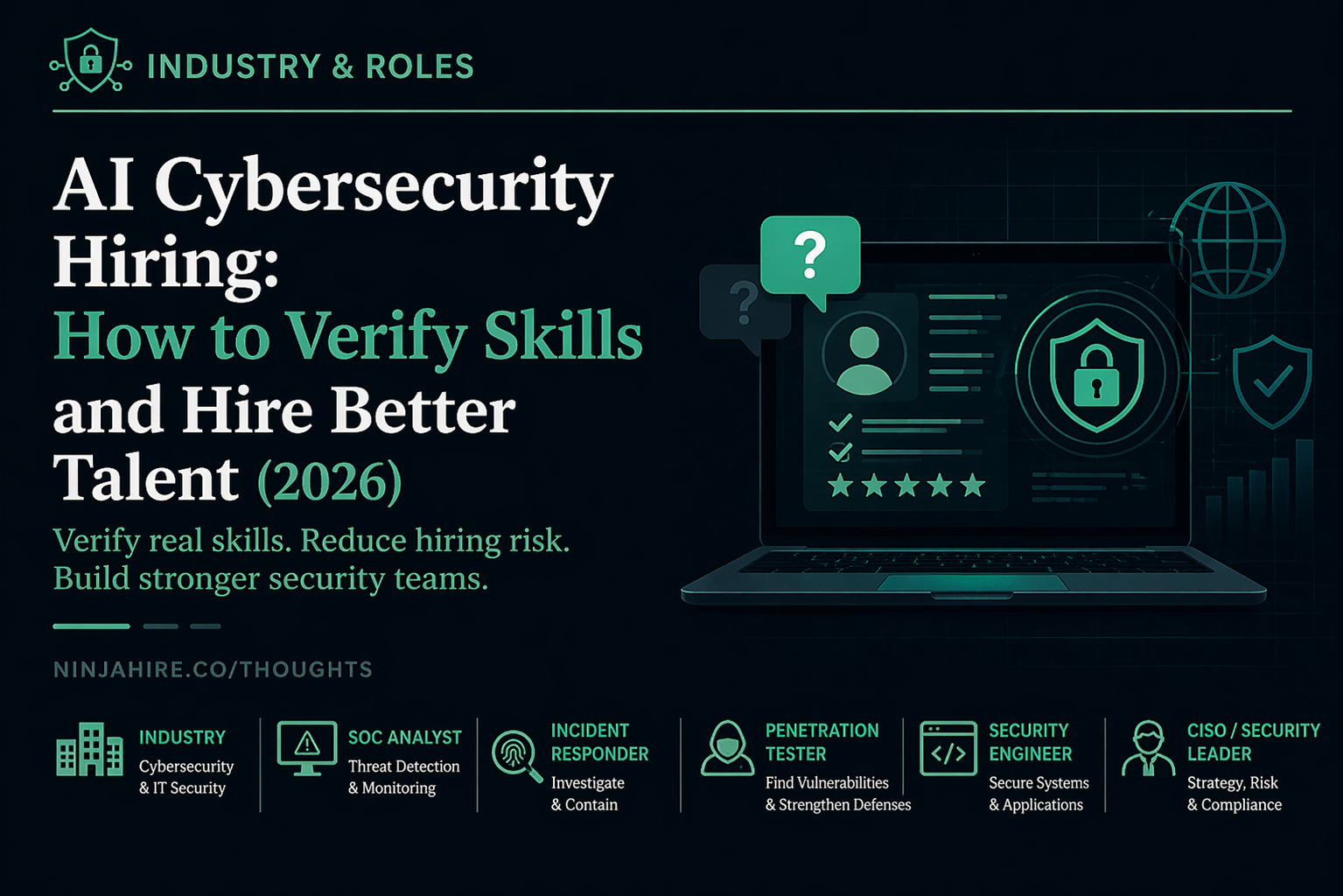
What Is AI Cybersecurity Hiring
AI cybersecurity hiring is the use of artificial intelligence to evaluate, verify, and qualify security professionals by testing real-world problem-solving ability, domain knowledge, and analytical thinking — rather than relying on certifications or keyword-matched resumes. It brings structured skill verification to a field where traditional hiring methods consistently fail to surface genuine capability.
AI cybersecurity hiring uses intelligent assessment tools to verify whether a candidate can actually perform security tasks — not just whether they have listed the right certifications. It tests scenario-based reasoning, incident response thinking, and technical depth at scale, making it possible to screen large candidate pools without sacrificing quality or accuracy.
Why Cybersecurity Hiring Is Broken
Ask any CISO or head of talent who has tried to hire a senior security analyst and they will tell you the same story. The funnel looks healthy. Applications come in. Resumes check all the right boxes. But somewhere between the shortlist and the first ninety days, the picture starts to fall apart.
The cybersecurity industry has a problem that most sectors would kill to have: extraordinary demand. But it also has a problem those sectors do not have: an almost complete breakdown in how skills are signalled and verified. The three forces driving that breakdown are worth understanding clearly.
The Talent Gap That Does Not Actually Exist
The global cybersecurity workforce gap is frequently cited at 3.4 million unfilled positions. But this number is misleading. The real gap is not a shortage of people who want security jobs. It is a shortage of people who can pass the verification bar at the level the role demands. The gap is not headcount. It is verified capability.
Certification Inflation
The certification market for cybersecurity professionals is enormous and largely divorced from operational reality. A CISSP certifies that someone has spent time studying security governance frameworks and passed an exam that tests memory, not judgment. Neither certification tells you whether that person can stare at a live SIEM alert at 11pm and make the right call about whether to escalate.
Resume Inflation
Cybersecurity resumes are among the most difficult in any industry to validate at the screening stage. A candidate can legitimately list tool familiarity for every major platform from Splunk to CrowdStrike without ever having used any of them in a production environment. AI closes this gap by testing rather than reading.
The Skills Verification Problem
Here is the core paradox of cybersecurity hiring. The skills that matter most are the hardest to test. And the skills that are easiest to test are often the least predictive of actual performance.
Memorisation of security frameworks and terminology
Ability to pass a standardised multiple-choice exam
Familiarity with the correct vocabulary for each domain
Completion of structured training programmes
Time investment in study, not operational experience
Rapid pattern recognition under pressure and ambiguity
Sound judgment when evidence is incomplete or conflicting
Ability to communicate risk clearly to non-technical stakeholders
Creative thinking about how attackers think and adapt
Experience with real failure and what it taught them
The most dangerous security hire is not the candidate with no experience. It is the candidate with inflated credentials and no self-awareness about the gap between what they have studied and what they can actually do under fire.
AI-driven assessment changes the verification dynamic by creating conditions where theory alone cannot produce a correct response. When you give a candidate a realistic incident scenario with partial information and time pressure, the gap between the person who has read about threat hunting and the person who has actually done it becomes immediately visible.
Why Traditional Hiring Fails in Cybersecurity
Traditional hiring workflows were not designed for a discipline where the skills are technical, contextual, and partially invisible to non-practitioners. The standard process breaks down at almost every stage when applied to security roles.
CV Screening Limitations
When a recruiter or ATS scans a security CV for keywords, the signal extracted is almost worthless. What keyword scanning cannot tell you is whether the candidate used Splunk to build a custom correlation rule that caught a lateral movement pattern, or just watched a colleague do it once. The text looks identical. The capability is completely different.
Interview Limitations
Technical interviews in security typically fall into two failure modes. The first is the knowledge quiz — questions that test recall of security concepts. The second is the vague scenario discussion where the candidate tells a story the interviewer has no reliable way to verify.
A motivated candidate with moderate skills and strong communication can consistently outperform a genuinely expert practitioner in a traditional interview format. This results in security teams staffed with confident presenters rather than skilled defenders.
How AI Verifies Cyber Skills
The mechanism by which AI improves cybersecurity skill verification is not magic. It is structure. AI-powered assessment tools replace the subjective and gameable elements of traditional screening with structured evaluations that test actual decision-making patterns under conditions that resemble real work.
Testing Analytical Thinking
When presented with ambiguous evidence, does the candidate jump to a conclusion or systematically eliminate alternatives? Do they ask clarifying questions or proceed with incomplete data? AI-driven interviews can present candidates with deliberately ambiguous scenarios and evaluate the quality of their reasoning process — not just the correctness of their final answer.
Probing Domain Knowledge Depth
AI evaluation tests for depth by asking layered follow-up questions that require candidates to reason through implications rather than recite definitions. A candidate who genuinely understands network segmentation can explain why it matters in a breach scenario, what its limitations are, and how it interacts with other controls.
Uncovering Real Experience
Real experience leaves specific fingerprints. Practitioners mention the unexpected complications. They describe what did not work before what did. They reference stakeholder dynamics, not just technical steps. They speak with calibrated confidence rather than uniform certainty. AI systems can identify these signals at scale with a consistency that human interviewers cannot sustain.
What AI Can Actually Test
The practical scope of AI-driven cybersecurity assessment is broader than most hiring teams realise. It extends well beyond technical trivia and into judgment, process, and communication.
- Incident triage reasoning. Presenting a candidate with a realistic alert queue and asking them to prioritise, explain their logic, and identify signals they would act on versus defer.
- Threat model construction. Asking a candidate to identify the most likely attack vectors for a described system and explain how they would approach each one.
- Risk communication. Presenting a complex technical vulnerability and asking the candidate to explain its business impact to a non-technical executive.
- Process design under constraints. Asking how a candidate would implement a detection capability with limited tooling, budget, and a lean team.
- Post-incident analysis thinking. Walking through a described breach scenario and asking what went wrong and what would change in the programme as a result.
- Tool-independent problem solving. Deliberately removing specific tool context to distinguish people who understand underlying methodology from those who can only operate within familiar platforms.
Role-Based Assessment Framework
Different security roles require fundamentally different skill profiles. The following framework maps each major security role to the specific capabilities AI should test and the signals that distinguish top performers from average candidates.
| Role | Core Skills to Test | AI Assessment Approach | Top Performer Signal |
|---|---|---|---|
| SOC Analyst | Alert triage speed and accuracy. False positive management. Escalation judgment. | Simulated alert queue scenarios with time-pressure elements and deliberately noisy data. | Asks clarifying questions before acting. Recognises pattern anomalies, not just signature matches. |
| Incident Responder | Containment decision-making. Evidence preservation. Communication under pressure. | Multi-stage breach scenario with evolving information and stakeholder pressure injected at key points. | Maintains documentation discipline while executing. Communicates assumptions explicitly. |
| Pentester | Creative attack path thinking. Scope management. Client communication. | Target environment description with objective. Candidate maps attack surface and explains methodology. | Identifies non-obvious attack vectors. Flags scope ambiguities proactively before acting. |
| Security Engineer | Control design reasoning. Defence-in-depth thinking. Technical debt awareness. | System architecture with known weaknesses. Candidate designs detection and hardening approach within realistic constraints. | Balances security with operational feasibility. Understands that over-control creates bypass behaviour. |
| CISO | Risk translation. Programme prioritisation. Board-level communication. | Strategic scenario with competing priorities, limited budget, and a sceptical board audience. | Frames security investment in business outcome language. Knows when to escalate versus absorb risk. |
Red Flags AI Catches Early
One of the most consistent benefits teams report from AI-assisted cybersecurity hiring is how reliably it surfaces candidates who have constructed a credible surface without genuine depth underneath.
- FLAGVague process answers. When asked how they would approach a specific scenario, the candidate describes a generic framework without any operational specificity. Real practitioners describe what they would actually look for, not what the textbook says.
- FLAGNo detail on what went wrong. Experienced security professionals have war stories that include failures, complications, and moments of genuine uncertainty. Candidates who only describe successful clean outcomes have either been very lucky or have sanitised their experience.
- FLAGTool name dropping without depth. Mentioning every major platform by name while being unable to describe a specific use case, problem, or limitation they encountered with any of them.
- FLAGCertainty where uncertainty is appropriate. Security work is characterised by ambiguity. Candidates who express high confidence in scenarios that should produce calibrated uncertainty are either inexperienced or unaware of the domain's complexity.
- FLAGCommunication breakdown under follow-up. A candidate who answers the first question confidently but struggles to defend or extend their answer under follow-up questioning is likely operating at the edge of their actual knowledge.
- FLAGNo stakeholder awareness. Candidates who never reference the organisational context of their decisions — the business systems affected, team dynamics, communication challenges — are not yet operating at a level of genuine professional maturity.
Case Study: Real Results from AI-Driven Cyber Hiring
The following is a composite case built from patterns observed across multiple mid-size enterprise security hiring engagements.
A Series C SaaS company needed to scale its SOC from 2 to 12 analysts in 90 days following a compliance audit. Previous hires made through traditional screening had produced two analysts who left within six months and one who required significant remedial coaching.
The talent acquisition team had no security expertise in-house. Time-to-hire was running at 67 days. Hiring managers were spending 8 to 12 hours per hire on technical interviews alone.
The team implemented AI-led cybersecurity assessment as the primary screening layer. All applicants completed a 45-minute AI-driven evaluation covering triage reasoning, threat pattern recognition, and communication scenarios designed for a cloud-first environment.
The AI produced ranked shortlists with structured capability summaries and specific follow-up questions based on gaps identified during assessment.
Ten analysts hired in 58 days. All ten reached full operational productivity within 60 days of joining. None required remedial coaching in the first 12 months.
Hiring manager time in the technical interview stage dropped from 10 hours per hire to under 3. Candidate experience scores improved significantly.
The Hybrid Hiring Model: AI Plus Human
The most effective cybersecurity hiring processes in 2026 are not AI-only or human-only. They are carefully designed hybrids that assign each stage of the process to the component best equipped to handle it.
Application intake and initial scoring (AI). All applications enter an AI screening layer that evaluates baseline technical vocabulary, experience markers, and structural patterns associated with genuine operational experience versus certification-only backgrounds.
Role-specific scenario assessment (AI). Qualified candidates complete a structured AI-led interview with scenario-based questions calibrated to the specific role level and technical domain. This stage replaces the phone screen and initial technical quiz.
Capability brief generation (AI). The AI produces a structured assessment summary for each passing candidate covering strengths, identified gaps, and suggested focus areas for the human interview stage.
Targeted human interview (Human). A senior security practitioner conducts a focused interview that builds on the AI assessment — going deeper on specific areas the AI flagged as ambiguous or worth exploring further.
Reference and background verification (AI + Human). Automated reference check processes combined with human judgment on anything that requires interpretation or follow-up conversation.
Final decision and offer (Human). The hiring decision is always made by a human. AI provides structured input. It never makes the call. The relational and cultural dimensions of a hire require human judgment that no AI assessment currently captures reliably.
The hybrid model does not make the human step optional. It makes the human step better. When hiring managers arrive at the interview with an AI-generated capability brief, they ask more precise questions and make more confident decisions because they are working with structured evidence, not a first impression formed in the opening three minutes of conversation.
Measuring What Actually Matters
Most talent acquisition teams track time-to-hire and cost-per-hire as their primary metrics. For cybersecurity hiring specifically, these tell you very little about whether the process is working.
| Metric | What It Measures | Target Range | Red Zone |
|---|---|---|---|
| Time to shortlist | Speed from application close to qualified shortlist delivered to hiring manager | Under 7 working days | Over 14 days — candidates in security move fast |
| Assessment completion rate | Percentage of invited candidates who complete AI-led assessment | Above 72% | Below 50% — assessment likely too long or poorly framed |
| Shortlist-to-offer ratio | How many shortlisted candidates receive offers | 1 in 3 to 1 in 5 | 1 in 10 or worse — shortlist quality is low |
| 90-day performance match | Hiring manager rating of new hire against expected capability at 90 days | Above 80% meet or exceed expectation | Below 60% — screening is not predicting real performance |
| 12-month retention | Percentage of security hires still in role at one year | Above 80% | Below 65% — role design or culture issues emerging post-hire |
| Hiring manager time per hire | Total hours a hiring manager invests in each successful hire | Under 6 hours total | Over 12 hours — process is inefficient and creates stakeholder friction |
Tools That Actually Work
The market for AI recruitment software with cybersecurity-specific capability has matured significantly. The categories below cover the functional landscape with honest notes on where each category delivers and where it falls short.
AI Application Scoring
Analyses applications for signals beyond keyword matching including career progression indicators and experience depth markers.
Best for reducing manual review time at high application volumes.
Limitation: Can encode past bias if trained on historical hire dataScenario-Based AI Interviews
Structured asynchronous or real-time AI-led interviews with role-specific cybersecurity scenarios that test reasoning, not recall.
Best for replacing phone screens and initial technical quizzes at scale.
Limitation: Scenario quality requires security domain expertise to configureSkills Verification Platforms
Technical lab environments where candidates complete controlled tasks with observable methodology. Captures how they work, not just what they answer.
Best for mid-to-senior technical roles where operational depth is critical.
Limitation: High candidate time investment — best used post initial AI screenCandidate Insight Tools
Aggregates assessment data into structured capability summaries and interview briefs for hiring managers. Converts AI output into actionable human guidance.
Best for enabling non-specialist recruiters to run technically credible processes.
Limitation: Output is only as good as the assessment data feeding itCommon Mistakes That Kill Hiring Quality
Even teams that invest in the right tools and frameworks consistently make the same set of mistakes that undermine the quality of their cybersecurity hires. These are not failures of technology — they are failures of process and judgment.
Treating Certifications as a Proxy for Capability
This is the most pervasive and costly mistake in cybersecurity hiring. When a job specification lists CISSP or CISM as a requirement, it signals to the market that the organisation believes certifications predict job performance. They do not — not reliably and not at the level of specificity that actually matters.
Weak First-Stage Screening
Many organisations invest in sophisticated technical interview stages while continuing to run their initial screening through keyword-matched ATS filters. By the time a candidate reaches the rigorous stage, the pool may already have been contaminated with unqualified applicants who gamed the earlier filter.
Front-loading assessment quality produces a compounding return. Every improvement at the screening stage saves disproportionate time and budget at every downstream stage. The cost of running ten candidates through a rigorous final interview because the initial filter was weak is an order of magnitude higher than the cost of running a proper first-stage assessment.
Key Takeaway
Cybersecurity hiring is failing organisations not because the talent does not exist but because the verification mechanisms are broken. Certifications measure study. Resumes measure self-promotion. Traditional interviews measure performance in interviews. None of these reliably predict whether someone can defend your infrastructure, make good decisions under pressure, or earn the trust of the rest of your security team.
AI changes the verification equation by making it possible to test judgment, reasoning, and depth at scale without requiring a senior security practitioner to interview every applicant personally. The organisations using it well are hiring faster, getting better retention, and building security teams that can actually do the work.
The ones still screening for certifications are filling the same roles every eighteen months.
Ready to Hire Security Talent That Actually Performs?
NinjaHire's AI-powered assessment verifies real cybersecurity skills — not certifications. Start building a security team you can trust.
Start Hiring Smarter →
.jpg)
.png)
