.png)
How fintech companies are using AI to screen for risk-aware candidates

March 15, 2026
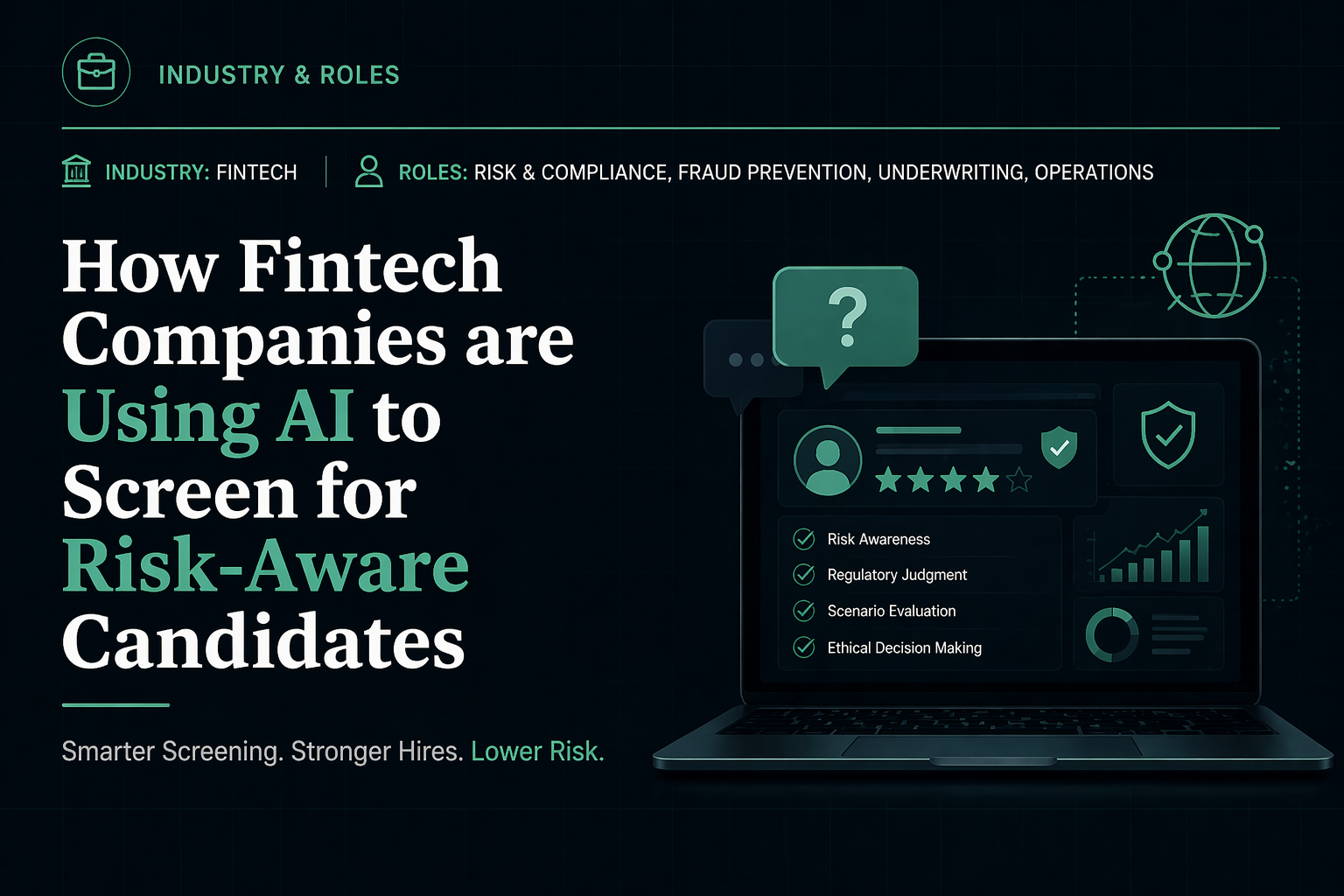
What Is AI Screening in Fintech Hiring
AI screening in fintech hiring is the use of structured, role-specific questions and response analysis to evaluate candidates before a human interview. Instead of relying on CV keywords or first impressions, it looks at how a candidate thinks through risk, handles ambiguity, and explains decisions in a regulated context.
In fintech, this matters more than in most industries. You are not just hiring someone who can build or sell a product. You are hiring someone who will operate in an environment where small mistakes can have regulatory, financial, and reputational consequences.
A well-designed AI screen does not try to replace technical assessment or human judgment. It focuses on the first layer of evaluation where most mistakes happen. It checks whether the candidate’s experience has real depth, whether they naturally consider risk in their thinking, and whether they communicate with the level of clarity expected in financial services.
For example, when a candidate is asked to walk through a product decision or a past incident, the AI is not just listening for the right answer. It is looking for how they approach the problem. Do they identify potential risks early? Do they think about customer impact? Do they consider compliance implications before moving forward? Do they explain their reasoning clearly?
This is what makes AI screening in fintech different from generic hiring automation. The goal is not speed alone. The goal is a better signal. It helps hiring teams move away from surface-level indicators like polished resumes and toward deeper indicators like judgment, discipline, and awareness.
In simple terms, AI screening in fintech is a way to ask every candidate the right questions, evaluate them against the same standard, and surface the ones who are most likely to operate responsibly in a high-stakes environment.
Why Fintech Hiring Is Different
Fintech hiring looks similar to tech hiring on the surface, but the underlying expectations are very different. You are not just building products. You are building systems that move money, handle sensitive data, and operate under regulatory scrutiny. That changes what good looks like in a candidate.
First, every role carries some level of risk exposure. An engineer writing a payments feature, a product manager defining a lending flow, or a compliance analyst reviewing transactions all influence outcomes that regulators and customers care about. This means hiring decisions are not only about capability, but also about judgment and responsibility.
Second, the cost of a bad hire is higher. In many industries, a weak hire slows down delivery. In fintech, a weak hire can lead to compliance breaches, financial loss, or reputational damage. The impact is not always immediate, but when it shows up, it is expensive.
Third, the signal problem is worse. Certifications and resumes often look strong, especially with better tooling available to candidates. It is easy to present knowledge of regulations or frameworks on paper. It is much harder to demonstrate how that knowledge is applied in real situations. This gap between what is claimed and what is real is where most hiring mistakes happen.
Fourth, hiring needs to move fast without lowering standards. Fintech companies operate in competitive markets where speed matters. At the same time, they cannot afford to compromise on compliance or risk awareness. This creates a tension that traditional hiring processes struggle to handle.
Finally, roles are hybrid by nature. A single role may require technical skill, product thinking, and an understanding of regulatory constraints. Candidates who are strong in one area but unaware of the others often struggle once they join.
This is why fintech hiring cannot rely only on resumes, unstructured interviews, or generic screening questions. The process needs to surface how candidates think about risk, how they make decisions under constraints, and how they balance speed with responsibility. AI screening becomes useful here because it introduces structure and consistency in evaluating exactly these qualities.
The Risk Awareness Competency
Risk awareness in fintech is often misunderstood. It is not about being overly cautious or slowing everything down. It is about making informed decisions while understanding what could go wrong and how to manage it.
Strong candidates do not avoid risk. They recognise it early, evaluate its impact, and act with clarity. They know when to proceed, when to escalate, and when to pause. This balance is what separates someone who can operate in fintech from someone who simply understands the domain.
In practice, risk awareness shows up in small but important ways. A product manager might question a data source before approving a feature. An engineer might flag a potential security gap during implementation rather than after deployment. A compliance analyst might escalate a borderline case instead of letting it pass to avoid friction.
These behaviours are difficult to detect in traditional interviews because candidates can describe the right approach without having applied it. This is where structured screening becomes useful.
Instead of asking general questions, you ask candidates to walk through real situations. For example, you can ask them to describe a time they identified a potential issue before it became a problem. The strength of the answer is not in the story itself but in the details.
Strong signals include proactive identification of risk, clear explanation of impact, and thoughtful escalation. Weak signals include vague descriptions, reactive behaviour, or minimising the importance of the issue.
Another useful approach is to present a scenario and observe how the candidate thinks through it. For instance, if a feature is ready to launch but has an unresolved edge case, what would they do? Candidates with strong risk awareness will not jump straight to a decision. They will ask questions, consider consequences, and outline options.
Over time, patterns emerge. Candidates who consistently demonstrate structured thinking, ownership, and clarity tend to perform better in regulated environments. Those who rely on general statements or avoid specifics tend to struggle once real responsibility is assigned.
This is why risk awareness should be treated as a core competency in fintech hiring. It is not a soft trait. It is a practical capability that influences day to day decisions and long term outcomes. AI screening helps surface this capability early by focusing on how candidates think rather than how they present themselves.
How to Test Risk Awareness in Practice
Testing risk awareness in fintech hiring requires moving beyond surface-level questioning and into structured, decision-focused evaluation. The core challenge is that most candidates know what a “good answer” sounds like when asked about risk. They can talk about compliance, mention best practices, and describe ideal processes. But in real roles, risk awareness is not about knowing the right language. It is about how someone thinks, how they prioritise under pressure, and how they act when information is incomplete.
The most effective way to test this is through carefully designed scenarios that resemble real situations the candidate is likely to face. These scenarios should not be overly complex or technical. Their purpose is to reveal thinking patterns, not to test memory. When a candidate is placed in a realistic situation, their response naturally exposes whether they approach problems with structure, awareness, and accountability, or whether they rely on general statements and reactive thinking.
A strong scenario question introduces ambiguity. It does not provide all the information upfront. This forces the candidate to ask clarifying questions, identify what is missing, and define how they would proceed. For example, presenting a situation where a product is ready for launch but has an unresolved compliance concern creates a natural tension between speed and responsibility. What matters is not whether the candidate says they would delay the launch. What matters is how they arrive at that conclusion. Do they consider customer impact. Do they think about regulatory exposure. Do they explore alternative actions such as partial rollout or additional validation. These layers of thinking are what distinguish a candidate with genuine risk awareness.
Another important dimension is how candidates prioritise different types of risk. In fintech, risk is rarely singular. A decision may involve tradeoffs between regulatory compliance, customer experience, operational efficiency, and business timelines. Strong candidates demonstrate an ability to recognise multiple dimensions of risk and weigh them appropriately. They do not treat all risks as equal, nor do they ignore less visible ones. Instead, they show an understanding of which risks carry the highest consequence and why. This ability to prioritise is critical because most real-world decisions do not offer perfect options.
Retrospective questioning is equally valuable in assessing risk awareness. Asking candidates to describe a past situation where something almost went wrong or did go wrong provides insight into how they behave outside of ideal conditions. The depth of detail in these answers is often revealing. Candidates with real experience tend to recall specific actions, timelines, and outcomes. They can explain what they noticed, what signals triggered concern, and how they responded. More importantly, they are able to reflect on their own decisions. They acknowledge what they could have done differently and how that experience influenced their future approach. This level of reflection indicates not only awareness but also growth.
In contrast, weaker responses often remain at a high level. They describe situations in general terms, avoid specifics, or shift focus away from their own role. There is often little evidence of structured thinking or learning. This does not necessarily mean the candidate lacks ability, but it does suggest that their exposure to real risk situations may be limited or that they have not internalised those experiences.
Decision-making under constraint is another powerful lens for evaluation. Fintech roles frequently require balancing competing priorities such as speed of delivery and regulatory compliance. Presenting candidates with two imperfect options and asking how they would decide helps reveal their underlying judgment. Strong candidates do not rush to a binary answer. They explore the context, identify dependencies, and outline a decision-making process. They consider who needs to be involved, what additional information is required, and what the consequences of each option might be. This structured approach is far more important than the final decision itself.
Consistency across responses is what ultimately builds confidence in a candidate’s risk awareness. A single strong answer may reflect preparation. Repeated patterns across multiple scenarios indicate genuine capability. Candidates who consistently demonstrate clarity, ownership, and structured thinking are far more likely to perform well in a regulated environment. Those who rely on broad statements or avoid engaging deeply with the scenario tend to struggle when faced with real responsibility.
AI screening becomes particularly useful in this context because it ensures that every candidate is evaluated against the same set of scenarios and criteria. This removes variability in questioning and allows hiring teams to compare responses more objectively. Over time, it also creates a dataset of what strong and weak answers look like, enabling continuous refinement of the screening process.
The goal is not to replace human judgment but to enhance it. By the time a candidate reaches a human interview, there is already a clear understanding of how they think about risk, how they approach decisions, and how they communicate under uncertainty. This allows the interview to focus on deeper validation rather than basic filtering, leading to better hiring outcomes and reduced risk for the organisation.
Regulatory Knowledge Screening in Fintech Roles
Regulatory knowledge in fintech hiring sits in an awkward space. It is clearly important, but it is also easy to overestimate based on surface signals. Candidates often come in with familiarity of terms, frameworks, or regulations, but that does not always translate into the ability to apply those concepts in real decisions. This is where many hiring processes fall short. They test for awareness of regulation rather than the ability to operate within it.
The key shift is to treat regulatory knowledge not as static information but as applied thinking. In most fintech roles, especially those touching product, compliance, risk, or data, the question is not whether a candidate can name a regulation. The question is whether they naturally incorporate regulatory considerations into their decision-making process.
Scenario-based screening works particularly well here because it mirrors how regulation shows up in actual work. Instead of asking direct questions about laws or frameworks, you present a situation that requires regulatory awareness to navigate correctly. For example, when a candidate is asked to evaluate a product feature that uses new data sources, the goal is not to test their knowledge of a specific rule. The goal is to see whether they instinctively raise the right concerns. Do they think about data consent. Do they consider fairness and bias. Do they question how the data is sourced and whether it can be used in that context. These signals indicate whether regulatory thinking is embedded in how they approach problems.
Strong candidates tend to approach these scenarios with structured curiosity. They do not jump straight into approval or rejection. They ask what needs to be validated. They identify areas where more information is required. They consider the potential downstream impact of the decision, including customer outcomes and regulatory exposure. Even if they do not name specific regulations, their thinking aligns with how those regulations are meant to be applied.
Weaker candidates often treat regulatory considerations as an afterthought. Their responses may focus heavily on product or technical feasibility while overlooking compliance implications. In some cases, they assume that regulatory checks will happen elsewhere or later in the process. This separation of responsibility is a risk in fintech environments where decisions are interconnected and delays in identifying compliance issues can be costly.
Another important dimension is how candidates communicate regulatory concerns. In many fintech roles, especially at senior levels, it is not enough to identify a risk. The candidate must be able to explain it clearly to non-technical stakeholders such as product teams, leadership, or external partners. Screening for this capability involves asking candidates to translate complex regulatory considerations into simple, actionable language. Candidates who can do this effectively are far more likely to drive alignment and prevent issues before they escalate.
It is also important to calibrate regulatory screening based on role type. A compliance specialist is expected to demonstrate deeper and more explicit regulatory knowledge than a software engineer. However, even technical roles should show baseline awareness of the environment they operate in. An engineer working on payments infrastructure, for example, should demonstrate an understanding of why certain controls exist and how their work could impact compliance outcomes. This does not require legal expertise, but it does require awareness and responsibility.
Consistency in evaluation is critical. When different candidates are asked different questions or assessed against unclear standards, it becomes difficult to compare their capabilities. Structured AI screening helps address this by ensuring that every candidate is evaluated through the same lens. It captures not just what candidates say but how they approach the problem, allowing hiring teams to identify patterns across responses.
Over time, this creates a more reliable signal. Instead of relying on credentials or self-reported experience, teams can assess whether candidates consistently demonstrate regulatory awareness in their thinking. This reduces the risk of hiring individuals who understand compliance in theory but struggle to apply it in practice.
In fintech, where regulatory missteps can have significant consequences, this distinction matters. Hiring for regulatory knowledge is not about finding candidates who know the most. It is about finding candidates who think in a way that aligns with the environment they will operate in. AI screening, when designed with this goal in mind, becomes a practical tool for surfacing that alignment early in the hiring process.
Background Checks and Verification in Fintech Hiring
Background verification in fintech hiring is not a final administrative step. It is a core part of risk management. Unlike many other industries, fintech roles often involve direct or indirect access to sensitive financial data, payment systems, or regulated processes. This means that verifying a candidate’s identity, history, and reliability is not optional. It is essential.
The complexity comes from the fact that background checks alone do not guarantee suitability. A candidate can pass all standard verification steps and still lack the judgment or discipline required for a regulated environment. This is why background checks need to be viewed as one layer in a broader evaluation system rather than a standalone safeguard.
The depth of verification required varies significantly by role. For positions with access to customer financial data, checks typically go beyond basic identity and employment verification. They may include criminal record checks related to financial misconduct, credit checks where legally permitted, and validation of past roles that involved handling sensitive systems. For licensed roles, verification extends into regulatory databases and professional registrations. Senior roles often require even deeper due diligence, including checks for conflicts of interest or exposure to politically sensitive networks.
What is important is not just the presence of these checks, but how they are integrated into the hiring process. Many companies treat background verification as a final gate after all decisions have been made. This creates a risk of late-stage surprises. If an issue surfaces after the candidate has been selected, the process resets, timelines extend, and hiring confidence is affected.
A more effective approach is to align verification with earlier stages of evaluation. For example, once a candidate passes initial screening and shows strong potential, verification processes can begin in parallel rather than sequentially. This ensures that by the time a final decision is made, there is already a high level of confidence in both capability and integrity.
AI screening supports this alignment by strengthening the earlier stages of evaluation. When candidates reach the verification phase, there is already structured insight into how they think, how they handle risk, and how they describe their experience. This makes verification more targeted. Instead of broadly checking everything, hiring teams can focus on validating specific claims or areas of concern identified during screening.
Another important aspect is consistency. In regulated environments, hiring decisions must be defensible. This means having clear documentation of how candidates were evaluated and why decisions were made. AI-driven screening naturally creates this documentation through structured responses and scoring. When combined with background verification records, it provides a comprehensive audit trail that can stand up to internal review or external scrutiny.
There is also a trust dimension to consider. Candidates in fintech roles are often aware that verification processes are rigorous. When handled transparently and professionally, these processes reinforce the seriousness of the organisation’s standards. When handled poorly or inconsistently, they can create friction and reduce candidate confidence.
Ultimately, background checks in fintech are not just about confirming who the candidate is. They are about reinforcing a hiring approach that prioritises reliability, accountability, and alignment with a regulated environment. When combined with structured screening and thoughtful evaluation, they form a system that reduces risk not just at the point of hire, but throughout the employee lifecycle.
How AI Enables Consistent and Defensible Fintech Hiring
One of the less obvious advantages of AI screening in fintech hiring is not speed or scale, but consistency. In a regulated environment, consistency is not just a process improvement. It is a requirement. Hiring decisions need to be explainable, repeatable, and defensible under scrutiny. This is where traditional hiring methods often fall short.
In most organisations, early-stage evaluation varies significantly depending on who is conducting it. Different recruiters ask different questions. They prioritise different signals. They interpret answers differently. Even when guidelines exist, they are applied unevenly. Over time, this creates a fragmented process where decisions are based on individual judgment rather than a shared standard.
AI screening addresses this by introducing structure at the point where variability is highest. Every candidate is asked the same set of questions. Every response is evaluated against the same criteria. This does not remove human judgment. It ensures that judgment is applied to comparable inputs.
This consistency has several practical effects. First, it improves the quality of comparison. When candidates are evaluated using the same framework, it becomes easier to identify who truly stands out. Differences in performance are clearer because they are measured against the same baseline. This reduces reliance on subjective impressions and increases confidence in decisions.
Second, it creates a documented rationale for every outcome. In regulated industries, it is not enough to make the right decision. You need to show how that decision was made. AI screening generates structured data that explains why a candidate was advanced or rejected. This includes their responses, the evaluation criteria, and the resulting score. This level of documentation is difficult to achieve with informal interviews or manual screening.
Third, it supports audit readiness. Fintech companies are often required to demonstrate that their processes are fair, consistent, and compliant. Being able to produce a clear record of how candidates were evaluated, what criteria were used, and how decisions were reached is a significant advantage. It reduces risk not just in hiring, but in how the organisation is perceived by regulators and stakeholders.
Another important benefit is the ability to learn from outcomes. When evaluation is structured, it becomes possible to analyse patterns over time. Hiring teams can identify which screening signals correlate with strong performance and which do not. This allows continuous improvement of the hiring process. Without consistent data, this kind of learning is difficult.
It is also worth noting that consistency does not mean rigidity. The screening framework can and should be adapted based on role requirements. What remains constant is the principle that within a given role, every candidate is evaluated in the same way. This balance between structure and flexibility is what makes the system effective.
From a candidate perspective, consistency also improves fairness. Candidates are evaluated on their responses rather than on how well they connect with a particular interviewer. This reduces the impact of bias and creates a more transparent experience.
In fintech, where hiring decisions carry both operational and regulatory consequences, this level of consistency is critical. AI screening provides a way to embed it into the process without increasing workload. It turns what is often an informal and variable stage into a structured and reliable foundation for decision-making.
Case Study: Scaling Compliance Hiring Without Compromising Risk Standards
A mid-stage fintech company expanding into new product lines faced a familiar challenge. Regulatory requirements had increased, and the business needed to hire a large number of compliance analysts in a short period. The target was ambitious: build a team of 50 within three months. Their existing hiring process was not designed for that scale.
The traditional approach relied heavily on agency sourcing and manual screening. Recruiters reviewed CVs, conducted initial calls, and passed candidates to hiring managers for further evaluation. On paper, the process worked. In practice, it was slow, inconsistent, and heavily dependent on individual judgment. Each hire took several weeks, and the quality of shortlisted candidates varied widely. Hiring managers often spent time interviewing candidates who looked strong on paper but lacked depth in real scenarios.
The company introduced a structured AI screening layer at the start of the process. The goal was not to replace interviews or technical assessments, but to improve the quality of candidates entering those stages. They designed a role-specific question set focused on compliance thinking, attention to detail, and risk awareness.
The screening included scenario-based questions that reflected real compliance situations. Candidates were asked how they would respond to potential issues in transaction monitoring, how they would document decisions, and how they would escalate concerns. The questions were short but deliberately structured to surface how candidates think rather than what they claim.
The impact was immediate. Within the first week, the system processed hundreds of applications and produced a manageable shortlist. Instead of spending time on initial calls, recruiters reviewed structured responses and focused on candidates who demonstrated clear and consistent thinking patterns. Hiring managers reported that interviews became more productive because candidates already showed baseline capability.
Over the full hiring cycle, several changes became clear. Screening time reduced significantly because repetitive tasks were removed. Recruiters spent less time filtering and more time evaluating. The consistency of shortlists improved because every candidate was assessed using the same criteria. Most importantly, the quality of hires increased. Candidates who advanced through the process demonstrated stronger performance during onboarding and required less corrective training.
Retention data reinforced this shift. The new cohort showed higher completion rates during early training and fewer performance-related exits. This suggested that the screening process was not only faster but also more accurate in identifying candidates suited to the role.
The company also benefited from improved process visibility. Every candidate interaction was documented through structured responses, creating a clear record of how decisions were made. This proved valuable during internal reviews and external audits, where transparency and consistency were critical.
What made this approach effective was not the technology alone, but how it was applied. The screening was tailored to the role, focused on real-world scenarios, and integrated into the broader hiring workflow. It did not attempt to evaluate everything. It focused on the signals that mattered most at the first stage.
This case illustrates a broader point. In fintech hiring, scale and quality are often seen as competing priorities. With the right structure, they can reinforce each other. By improving the first stage of evaluation, the entire process becomes more efficient and more reliable. AI screening, when designed with this intent, becomes a practical tool for achieving both.
AI driven fintech hiring improves decision quality
Building a Fintech Specific Screening Rubric
A screening rubric is where most of the real impact happens. Without it AI screening becomes generic. With it the process becomes aligned to how fintech roles actually operate. The goal is not to create a complex scoring system. The goal is to define what good looks like in a structured way so every candidate is evaluated against the same standard.
In fintech hiring the rubric needs to go beyond technical capability. It must capture how candidates think about risk how they operate within constraints and how they communicate decisions. These are not abstract traits. They show up clearly when candidates are asked to respond to realistic situations.
The first dimension to define is risk awareness. This should be treated as a core capability rather than a secondary attribute. Candidates should be evaluated on how early they identify potential issues how clearly they explain impact and how they decide what action to take. Strong candidates demonstrate proactive thinking. They do not wait for problems to surface. They anticipate them. They also show balance. They do not overreact to every possible risk but they do not ignore early signals either. This balance is what makes their judgment reliable.
The second dimension is regulatory alignment. This does not mean testing candidates on specific rules or frameworks. It means assessing whether their thinking naturally incorporates compliance considerations. When presented with a scenario candidates should raise questions about data usage customer impact and approval processes without being prompted. This indicates that regulatory awareness is part of how they approach decisions rather than something they apply only when required.
The third dimension is attention to detail. In fintech environments small oversights can lead to larger issues. Candidates should demonstrate an ability to notice inconsistencies gaps or edge cases in the scenarios presented to them. This often shows up in how they ask questions. Strong candidates seek clarity before acting. They identify missing information and avoid making assumptions. This behaviour is a strong predictor of reliability in operational roles.
The fourth dimension is communication clarity. Fintech roles frequently require translating complex ideas into clear actions. Candidates should be able to explain their reasoning in a way that is structured and easy to follow. This is not about polished language. It is about clarity of thought. When a candidate can break down a problem into steps explain their approach and justify their decisions it becomes easier to trust their judgment.
The fifth dimension is ownership and accountability. Candidates should demonstrate that they take responsibility for outcomes. This is visible in how they describe past experiences and how they respond to hypothetical situations. Strong candidates position themselves as active decision makers. They explain what they did and why. They also acknowledge uncertainty and describe how they would manage it. This level of ownership is critical in environments where decisions carry real consequences.
Once these dimensions are defined the next step is calibration. Not every role requires the same depth across all areas. A compliance analyst may need stronger emphasis on regulatory alignment and detail orientation. A product manager may require a balance between risk awareness and decision making speed. An engineer may need to demonstrate how their technical decisions interact with compliance requirements. The rubric should reflect these differences while maintaining a consistent structure.
Scoring should remain simple. Each dimension can be rated based on the presence and strength of signals rather than precise numerical values. The objective is to create a clear picture of the candidate’s profile rather than reduce it to a single score. Over time patterns will emerge. Certain combinations of signals will correlate with strong performance while others will highlight risk.
AI screening supports this process by applying the rubric consistently across all candidates. It captures responses in a structured format and highlights where strong or weak signals appear. This allows recruiters and hiring managers to focus their attention where it matters most. Instead of starting from scratch with each candidate they begin with a clear understanding of how the candidate aligns with the defined criteria.
The value of a well designed rubric extends beyond screening. It creates alignment across the hiring team. Everyone involved in the process understands what is being evaluated and why. This reduces ambiguity and improves decision quality. It also makes it easier to refine the process over time because changes can be made at the level of the rubric rather than individual interviews.
In fintech hiring where the cost of error is high this level of structure is not optional. It is what allows teams to scale hiring without losing control over quality. A strong rubric turns AI screening from a generic tool into a targeted system that reflects the realities of the roles being filled.
Metrics That Matter in Fintech Hiring
Improving fintech hiring requires more than refining the process. It requires measuring whether the process is actually working. Many teams track activity metrics such as number of applications or time spent interviewing, but these do not tell you whether you are hiring the right people. In a regulated environment, the focus needs to shift toward outcome-based metrics that reflect both performance and risk.
The first metric to track is quality of hire. In fintech this is not just about performance targets. It includes how reliably a new hire operates within compliance expectations. Early indicators can include onboarding assessment scores, error rates in initial tasks, and the level of supervision required during the first few months. Candidates who demonstrate strong risk awareness during screening tend to show more consistency during onboarding, which makes this a valuable feedback loop for refining your evaluation criteria.
Time to hire is also important, but it needs to be interpreted carefully. Reducing time without improving quality does not solve the underlying problem. The goal is to shorten the hiring cycle while maintaining or improving the standard of candidates entering the organisation. AI screening contributes here by compressing the first stage of evaluation, allowing teams to move faster without skipping critical assessment steps.
Another key metric is shortlist accuracy. This measures how often candidates who pass the initial screening go on to perform well in later stages such as technical interviews or practical assessments. A high drop-off rate after screening indicates that the initial filter is not aligned with role requirements. When screening is well calibrated, the majority of shortlisted candidates should demonstrate baseline capability, making later stages more focused and efficient.
Retention is a critical long-term indicator. In fintech roles, early attrition often signals a mismatch between the candidate’s expectations or capabilities and the realities of the role. Tracking retention at 90 days and beyond provides insight into whether hiring decisions are sustainable. When screening processes are aligned with actual job demands, retention rates tend to improve because candidates are better prepared for what the role involves.
Compliance-related metrics should also be part of the evaluation. This can include the number of issues identified during audits, adherence to internal processes, and the frequency of escalations required. While these metrics are influenced by multiple factors, patterns over time can highlight whether hiring decisions are contributing to operational risk or reducing it.
Candidate experience is another dimension that should not be overlooked. Structured screening can improve clarity and fairness in the process, but it must also remain engaging and respectful of the candidate’s time. Monitoring completion rates and feedback helps ensure that the process remains effective without becoming overly rigid or impersonal.
What ties these metrics together is the ability to connect them back to the screening process. When evaluation is structured, it becomes possible to analyse which signals observed during screening correlate with strong outcomes later. This creates a continuous improvement loop. The hiring process evolves based on evidence rather than assumption.
In fintech, where hiring decisions have both operational and regulatory implications, this level of measurement is essential. It shifts the focus from activity to impact and ensures that improvements in speed are matched by improvements in quality. AI screening provides the structure needed to make this analysis possible, but the value comes from how teams use the data to refine their approach over time.
Tools That Support Fintech Hiring at Scale
Fintech hiring today is not limited by access to candidates. It is limited by how effectively teams can evaluate them. The right set of tools does not replace judgment. It creates a system where judgment can be applied more accurately and consistently. The key is understanding what each category of tool is designed to solve and where its limitations lie.
The first category is structured screening platforms. These tools are designed to handle the earliest stage of evaluation where volume is highest and signal quality is lowest. Instead of relying on CV filtering or unstructured calls, they introduce a consistent set of questions tailored to the role. In fintech, the most effective platforms allow customization around risk awareness, compliance thinking, and scenario-based responses. Their value comes from standardization. Every candidate is assessed against the same criteria, which makes comparison meaningful. The limitation is that they require thoughtful configuration. Generic templates produce generic results. Without role-specific design, the tool adds speed but not accuracy.
The second category is applicant tracking systems with embedded automation. These systems manage the flow of candidates through the hiring process and increasingly include AI features for ranking or filtering. Their strength lies in process organization. They ensure that candidates move through defined stages and that data is captured consistently. In fintech environments, they also support documentation requirements by maintaining a clear record of decisions. The limitation is that most of these systems are not designed for deep evaluation. They are effective for managing pipelines but less effective for assessing nuanced capabilities like risk awareness or decision making.
The third category is technical assessment platforms. These are used to evaluate specific skills such as coding ability, system design, or security knowledge. In cybersecurity or engineering roles within fintech, these tools play an important role in validating capability. Their strength is precision. They can test whether a candidate can perform a specific task. The limitation is timing. When used too early, they can create friction in the candidate experience. When used too late, they fail to filter effectively. The most effective use is after initial screening has established that the candidate has the right thinking patterns and baseline understanding.
The fourth category is background verification and compliance tools. These are critical in fintech because of the regulatory environment. They handle identity verification, employment checks, and in some cases financial or legal screening depending on the role. Their strength is in reducing risk at the final stage of hiring. They provide assurance that the candidate’s history aligns with the responsibilities of the role. The limitation is that they are reactive. They confirm information after decisions have largely been made. This is why they need to be integrated earlier in the process where possible.
The fifth category is analytics and reporting tools. These tools aggregate data from across the hiring process and provide insight into performance. They help teams understand where candidates drop off, which sources produce strong hires, and how long each stage takes. In fintech, they also support audit readiness by providing visibility into how decisions are made. The limitation is that they depend on the quality of input data. Without structured screening and consistent evaluation, the insights they generate are limited.
The most effective fintech hiring setups do not rely on a single tool. They combine these categories into a connected workflow. Structured screening establishes early signal. The tracking system manages flow and documentation. Technical assessments validate capability. Verification tools confirm integrity. Analytics tools close the loop by measuring outcomes.
AI plays a role across several of these layers, but its value is highest at the beginning of the process where variability is greatest. By improving the quality of candidates entering the pipeline, it reduces the burden on every subsequent stage. Recruiters spend less time filtering. Hiring managers spend more time evaluating relevant candidates. The overall process becomes more efficient without sacrificing control.
It is also important to recognise that tools alone do not solve hiring challenges. Their effectiveness depends on how well they are aligned with the realities of the roles being filled. In fintech, this means prioritising risk awareness, compliance alignment, and decision-making ability alongside technical skills. Tools that are configured with these priorities in mind create a system that supports better hiring decisions. Those that are used without this alignment tend to add complexity without improving outcomes.
Common Mistakes in Fintech Hiring with AI
The introduction of AI into fintech hiring creates opportunity, but it also exposes weaknesses in how hiring processes are designed. Many companies adopt new tools expecting immediate improvement, only to find that outcomes remain unchanged or become harder to interpret. The issue is rarely the technology itself. It is how it is applied.
One of the most common mistakes is using generic screening frameworks. Fintech roles require a specific mix of technical ability, risk awareness, and regulatory thinking. When companies use broad or template-based question sets, they end up selecting candidates who are good at interviews rather than those who can operate effectively in a regulated environment. The screening process becomes faster, but not more accurate. Without tailoring questions to real scenarios the role will encounter, the most important signals never surface.
Another frequent mistake is over-reliance on credentials. Certifications and past company names continue to carry weight in many hiring decisions, even when better evaluation methods are available. While these signals can indicate exposure, they do not guarantee capability. In fintech, this gap is particularly risky because decisions have downstream consequences. When hiring teams do not actively test how candidates apply their knowledge, they risk bringing in individuals who understand theory but struggle in execution.
A related issue is treating AI as a replacement rather than an enhancement. When teams expect AI to make hiring decisions independently, they remove the human judgment that is still essential in later stages. This often leads to either blind trust in automated outputs or complete rejection of them when results do not match expectations. The more effective approach is to use AI to structure and improve the early stages, then apply human evaluation where nuance and context matter most.
Poor integration into the hiring workflow is another challenge. AI screening is sometimes added as an isolated step without adjusting the rest of the process. Recruiters may still conduct the same initial calls or rely on CV reviews even after structured screening has been introduced. This duplication reduces efficiency and creates confusion about which signals should guide decisions. For AI to deliver value, it needs to replace or reshape existing steps rather than sit alongside them.
Ignoring candidate experience is also a common oversight. While structured screening improves consistency, it can feel impersonal if not designed thoughtfully. Candidates should understand why they are being asked certain questions and how their responses will be used. When the process is transparent and relevant to the role, it builds trust. When it feels generic or disconnected, it can reduce engagement and completion rates.
Another mistake is failing to calibrate and evolve the screening process. Hiring needs change over time as roles evolve and business priorities shift. If the screening rubric remains static, it gradually becomes less effective. Teams that do not review outcomes and adjust their criteria risk drifting away from what the role actually requires. Continuous feedback from hiring managers and performance data from new hires should inform regular updates.
There is also a tendency to delay technical or practical assessment until too late in the process. While AI screening improves early evaluation, it should not replace deeper validation of skills. When technical assessment is postponed until final stages, it increases the risk of late-stage drop-offs and wasted time. A balanced approach introduces technical validation after initial screening, ensuring that both thinking patterns and execution ability are assessed in sequence.
Finally, many organisations underestimate the importance of internal alignment. If recruiters, hiring managers, and compliance teams are not aligned on what good looks like, even the best tools will produce inconsistent outcomes. A shared understanding of evaluation criteria, supported by a clear screening rubric, is essential for making reliable decisions.
Avoiding these mistakes requires a shift in mindset. AI should be seen as a way to strengthen the foundation of the hiring process, not as a shortcut. When used thoughtfully, it brings structure, consistency, and better signal into early-stage evaluation. When used without alignment or customization, it simply accelerates existing problems.
Key Takeaway
Fintech hiring is not just a talent acquisition challenge. It is a risk management challenge. The difficulty is not only finding candidates with the right technical skills, but identifying those who can operate responsibly in a regulated environment where decisions carry real consequences.
Most hiring failures in fintech do not happen because candidates lack knowledge. They happen because hiring processes fail to assess how that knowledge is applied. Resumes and certifications create an impression of capability, but they rarely reveal how a candidate thinks under pressure, how they handle ambiguity, or how they balance speed with compliance.
AI screening becomes valuable in this context because it strengthens the earliest stage of evaluation where most errors occur. By introducing structured, scenario-based assessment, it shifts the focus from what candidates claim to how they think. It surfaces signals such as risk awareness, decision-making clarity, and communication precision that are difficult to identify through traditional methods.
The impact is not limited to speed or efficiency. It changes the quality of decisions. Hiring teams gain a more consistent and comparable view of candidates. Recruiters spend less time filtering and more time evaluating. Hiring managers engage with candidates who already demonstrate baseline alignment with the role. The overall process becomes more reliable without becoming more complex.
However, the value of AI depends on how it is applied. Generic screening approaches do not work in fintech. The process must be tailored to reflect the realities of regulated environments. This includes designing role-specific questions, defining clear evaluation criteria, and continuously refining the approach based on outcomes.
The most effective hiring systems combine structured AI screening with human judgment. AI creates consistency and surfaces signal. Humans validate nuance and make final decisions. Together, they form a process that is both scalable and controlled.
In the end, the goal is not to automate hiring. It is to improve it. Fintech companies that treat hiring as a structured, data-informed process are better positioned to build teams that can move fast without compromising on risk.
Ready to Build a Fintech Hiring Process That Actually Reduces Risk
If you are hiring in fintech, the question is not whether you will use AI in your process. The question is whether you will use it in a way that improves decision quality or simply increases speed without improving outcomes.
The difference comes down to how your screening is designed and how well it reflects the realities of your roles.
A structured approach can change the way your team hires. Instead of relying on CVs and unstructured conversations, you can evaluate candidates on how they think, how they handle risk, and how they make decisions in situations that mirror real work. This creates a stronger foundation for every stage that follows.
If you want to move in that direction, there are a few practical next steps.
You can start by reviewing your current hiring process and identifying where most of your time is spent and where most hiring mistakes occur. In many cases, this will point to the earliest stages of evaluation where signal is weakest and volume is highest.
You can then define what good looks like for your key roles. This includes the specific behaviours and thinking patterns that indicate success in your environment. Once this is clear, it becomes possible to design screening questions and evaluation criteria that align with those expectations.
You can also introduce structured screening in a controlled way. Start with one role or one team, measure outcomes, and refine the approach based on real data. This allows you to build confidence internally while improving results.
If you want a faster path, you can work with a team that has already built fintech-specific screening frameworks. This can help you avoid common mistakes and accelerate implementation.
If you would like to explore this in more detail, you can book a strategy session.
In that session, you can walk through your current hiring challenges, map out a role-specific screening approach, and identify where structured evaluation can improve both speed and quality.
Fintech hiring will always involve complexity. The goal is not to remove that complexity, but to manage it more effectively. A well-designed screening process is one of the most practical ways to do that.

.jpg)
.png)
