.png)

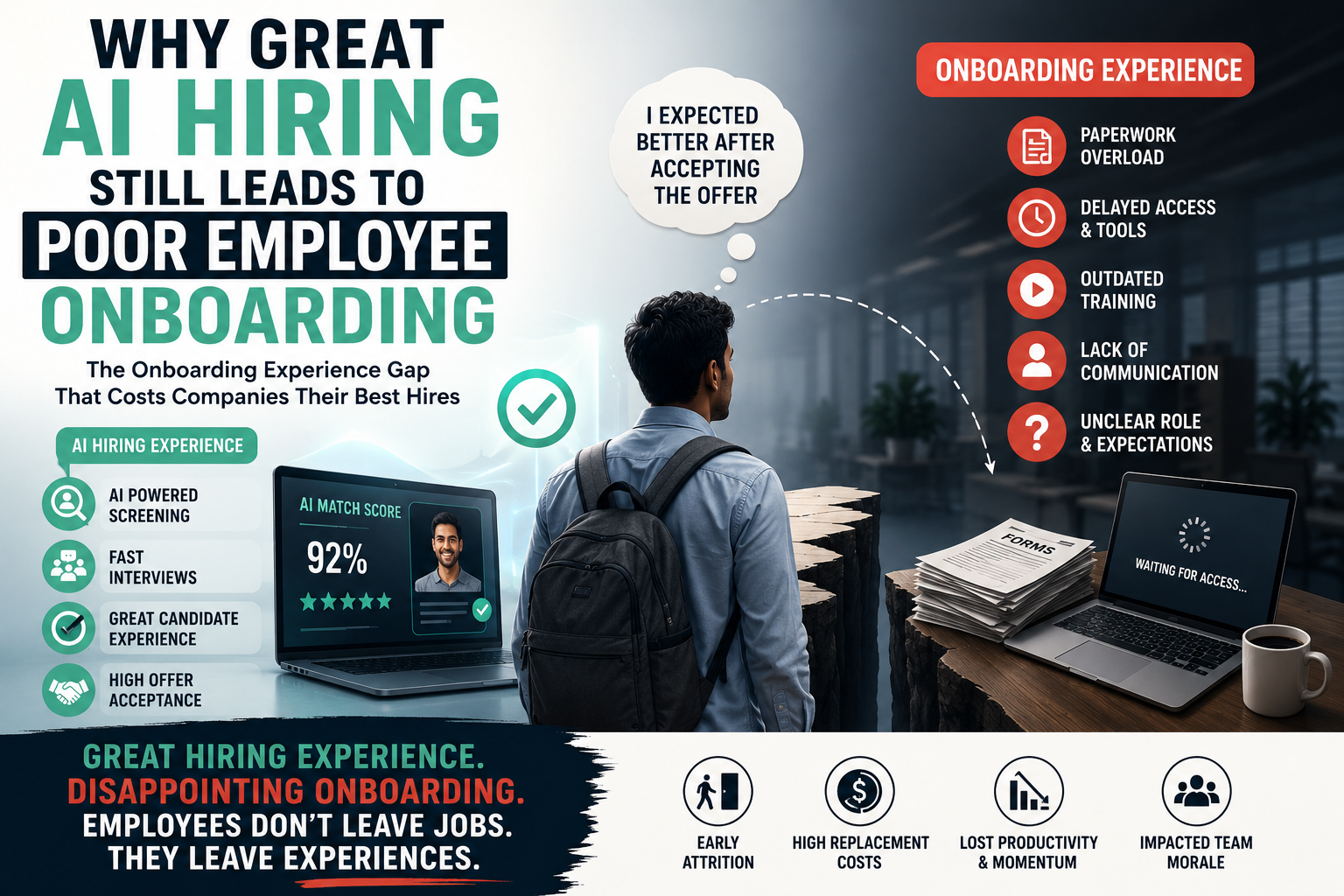
Why Great AI Hiring Still Leads to Poor Employee Onboarding
She went through seven touchpoints before she even had the job. A recruiter call that was warm and well-prepared. An AI screening process that was fast and frictionless. An interview panel where the hiring manager spoke candidly about the team's direction. An offer that arrived within 48 hours, with a clear breakdown of compensation and benefits. Every stage felt considered. She accepted immediately.
Her first day looked different. A laptop that took three hours to configure. A welcome email from HR with a link to a 200-page policy document. A manager who apologized because he had back-to-back calls all week. A team Slack channel where nobody introduced her. By Friday, she was already privately wondering whether she had made the right call.
The hiring experience and the employee onboarding experience came from two entirely different organizations with two entirely different definitions of what she was worth. This gap is one of the most expensive problems in talent management — and one of the least honestly examined.
The Onboarding Experience Gap
The onboarding experience gap is the disconnect between the quality of the hiring process a candidate goes through and the quality of the experience they receive as a new employee. When recruiting is well-designed and onboarding is not, the expectation collapse that follows is one of the primary drivers of early employee attrition and first-year disengagement.
Most companies have invested meaningfully in recruitment over the past several years. Candidate experience frameworks, employer branding, recruiter training, structured interviews, and AI hiring software have all improved the pre-hire journey significantly. The process of attracting and assessing candidates has become more deliberate, faster, and in many cases more data-driven than it has ever been.
The onboarding process, for most organizations, has not kept pace. It is still largely treated as an administrative handover rather than the continuation of a relationship that began during hiring. The candidate who was evaluated, considered, and selected with care is handed off to a checklist. The emotional momentum of a well-run hiring process does not carry through. It simply stops.
This is the onboarding experience gap: not just that onboarding is poorly executed, but that its quality so often sits in direct contrast to the quality of what came before it. That contrast is what makes the damage acute. A candidate who had a mediocre hiring experience and a mediocre onboarding experience feels consistent disappointment. A candidate who had an exceptional hiring experience and a mediocre onboarding experience feels something much closer to betrayal.
Why Recruiting and Onboarding Have Always Been Disconnected
The structural reason for this disconnect is straightforward: recruiting and onboarding are almost universally owned by different people, measured by different metrics, and operated through different systems. A recruiter's job is, in most definitions, complete when the candidate signs an offer. From that moment, accountability shifts to HR operations, the hiring manager, and a mix of IT, facilities, and administrative functions depending on the organization.
What does not shift is the candidate's sense of continuity. They do not know or care that an org chart determines who is responsible for their experience at each stage. They experience it as a single relationship with a single employer. When the quality of that relationship changes sharply at the point of offer acceptance, the new hire draws conclusions about what the company actually values.
In large IT services firms in India, where onboarding volumes can run into thousands of new hires per quarter, this disconnect is structural and deeply embedded. Recruiting teams are optimized for throughput. Onboarding teams are optimized for compliance. The candidate arrives having been sold a compelling picture of career growth and organizational culture, and is processed through a system designed to issue access credentials and collect signed forms. The mismatch is predictable and pervasive.
In the US, hybrid and remote onboarding has added an additional layer of complexity. A candidate who was hired through a thoughtful, human-centered virtual process often finds themselves starting remotely with limited guidance, inadequate access to tools, and a manager who is physically elsewhere and operationally stretched. The structural warmth of the hiring process does not survive the logistics of distributed work without deliberate effort to maintain it.
How AI Recruiting Improves Hiring But Creates Onboarding Risk
AI recruiting improves hiring by speeding up screening, reducing unconscious bias, and improving candidate communication. But it also creates onboarding risk by generating detailed candidate profiles that are rarely transferred to onboarding teams, and by setting speed and communication expectations that the slower, more manual onboarding process cannot meet.
AI hiring software has genuinely improved candidate experience at the front end of the process. Automated screening reduces wait times dramatically. Intelligent scheduling tools eliminate the back-and-forth of interview booking. Natural language tools help recruiters communicate more consistently and at greater volume than they could manually. In BPO hiring at scale, where a single recruiter might manage a pipeline of several hundred candidates simultaneously, AI recruitment platforms have made the difference between a functional process and an unmanageable one.
But there is an underappreciated consequence of raising the bar on hiring experience so dramatically. When AI tools make the pre-hire journey fast, communicative, and responsive, they set an expectation in the candidate's mind that the organization operates this way. That expectation is often false. The AI-powered hiring funnel is an optimized surface experience. The onboarding behind it may be running on spreadsheets, manual email chains, and a shared folder that someone last updated two years ago.
The candidate does not see the infrastructure. They see the experience. And when that experience changes sharply at the point of acceptance, the conclusion they draw is about the company's integrity, not its technology stack.
There is also a specific problem with how AI recruiting systems handle candidate data. During the hiring process, a recruiter — sometimes with AI assistance — gathers genuinely valuable information about a new hire: their motivations, their stated career goals, their preferred working style, the concerns they raised during the interview, the things that excited them about the role. This information is typically stored in an ATS in a format that is never transferred to the onboarding team or the hiring manager in any usable way. The human context that was gathered during recruiting is lost at the handoff, and onboarding begins with a blank slate.
Where the Candidate Journey Breaks After Offer Acceptance
The period between offer acceptance and first day is one of the most neglected stretches in the entire employee lifecycle. For the candidate, it is a window of high emotional investment and genuine anxiety. They have made a significant life decision. They may have resigned from another job. They are forming impressions about what they have chosen, and they are doing it largely in a vacuum of information from their new employer.
For most companies, this period is almost entirely silent. A welcome email arrives. Sometimes a document checklist. Occasionally a calendar invite for an orientation session. And then, unless the candidate proactively reaches out, nothing until day one.
This silence is not neutral. In the absence of communication, candidates fill the gap with assumption — and the assumptions are often not favorable. They wonder whether the role has changed. They question whether anyone is expecting them. They may field competing approaches from other employers during this window and, without a compelling reason to stay committed, some will accept. This is why why new hires leave within 90 days so often traces back to something that started before the first day had even arrived.
In UK graduate hiring programs, where candidates may wait months between offer and start date, this problem is particularly acute. A graduate who accepted an offer in February but does not start until September is essentially in a holding pattern for seven months. The companies that maintain regular, meaningful touchpoints during this period — not mass emails, but personalized check-ins tied to what the candidate actually told you during the hiring process — see dramatically lower pre-start attrition than those that go silent after the offer letter is countersigned.
The Emotional Impact of Expectation Collapse
Organizational psychologists use the term psychological contract to describe the unwritten expectations that employees hold about their relationship with an employer. Some of these are explicit — the salary, the title, the stated benefits. Many are implicit — the sense of what the culture will be like, how supported they will feel, what day-to-day life will look like in practice.
Hiring processes, particularly when they are well-designed and candidate-centric, create psychological contract expectations. A recruiter who is warm and responsive implies a workplace that values communication. An interview process that treats the candidate as an intelligent adult implies a management culture that will do the same. These are reasonable inferences. They are also frequently wrong.
When a new hire's first-week experience contradicts the implicit promises of the hiring process, the psychological contract fractures. The employee does not necessarily resign immediately, but their engagement drops. They invest less discretionary effort. They keep an eye on other opportunities. They are physically present and functionally functional, but the emotional commitment that would have made them a genuinely high-performing contributor is already damaged.
This is the invisible cost of poor employee onboarding — not the visible attrition of the employee who resigns in week three, but the much larger population of employees who stay and underperform because their initial experience told them not to fully commit.
Why the First Week Shapes Everything That Follows
Research on employee retention consistently points to the first 90 days as the critical window for establishing the habits, relationships, and expectations that determine long-term engagement. Within that window, the first week is disproportionately influential. The impressions formed in the first five working days are harder to revise than almost any subsequent experience. A bad first week does not automatically produce an early resignation, but it creates a baseline of skepticism that requires sustained positive experience to overcome.
The mechanics of this are well understood. New hires arrive in a state of heightened social attention — they are reading every signal about how the organization works, what the culture actually is beneath the surface, and whether they made a good decision. In this state, small things carry large meaning. A manager who makes time for a proper introduction signals that new hires matter. A manager who delegates the welcome to a twenty-minute HR orientation and then disappears signals the opposite, regardless of what the company career site says about its people-first values.
The practical problem is that hiring managers are almost universally under-invested in as onboarding participants. They are told the person is starting on Monday. They are not given structured guidance on what to prioritize in that first week, what information the recruiter gathered during the hiring process that might be relevant, or what the new hire's stated goals and concerns were. The candidate to employee transition happens without any meaningful transfer of relational knowledge.
The Hidden Cost of Onboarding Failure
Poor onboarding costs organizations significantly more than it appears on the surface. Beyond the direct cost of replacing an early attrition — typically estimated at between half and twice the annual salary of the role — there are productivity losses during the replacement search, disruption to team output, and the compounding effect of repeatedly onboarding candidates into the same broken experience. Early employee attrition is expensive precisely because it is so preventable.
The calculation most talent leaders apply to onboarding failure is incomplete. They measure voluntary resignation rates within the first year and calculate replacement cost. This is a real cost, and for roles where recruiting fees, relocation support, or extended interview processes were involved, it can be substantial. But it captures only the most visible outcome of poor onboarding.
The subtler costs are harder to see. A new hire who does not feel properly embedded in their team for the first three months is not contributing at the level they were hired to contribute. A manager who spends two weeks re-onboarding a replacement is not spending those weeks on the work they were meant to be doing. A team that watches colleagues cycle through in the first few months forms its own view of what the organization values, and that view shapes their own retention decisions.
In IT services firms in India, where margins are tight and project staffing is continuous, first-90-day attrition creates genuine business risk. A developer hired onto a client project who leaves in week eight forces a resourcing scramble that can affect delivery timelines and client relationships. The cost of the exit is rarely calculated at the project level, but it is very real there.
For distributed teams running US remote and hybrid models, the hidden cost includes the social isolation that new hires experience when onboarding does not actively counteract the default impersonality of remote work. An employee who completes their first month without a single meaningful informal interaction with a colleague has not been successfully onboarded, regardless of whether they completed their compliance training and set up their benefits enrollment.
How Recruiting and Onboarding Teams Operate in Silos
The organizational separation between recruitment and onboarding is not a design decision most companies made consciously. It emerged from the historical structure of HR functions, where talent acquisition was one team, HR operations was another, and learning and development was a third. Each team developed its own systems, its own metrics, and its own definition of success. The fact that these functions are adjacent stages in a single employee experience was rarely the primary organizing principle.
What this means in practice is that an ATS used by recruiting does not typically talk to the HR onboarding platform used by HR operations. The information collected during the hiring process — assessments, interview notes, candidate-stated preferences, compensation negotiation history — sits in one system, while the onboarding workflow runs entirely separately, often starting from scratch with nothing more than the offer letter details.
A hiring manager who interviews a candidate five times, learns a great deal about their technical approach, their development goals, and their working preferences, is rarely asked to transfer any of that knowledge to the onboarding plan. The interview intelligence dissolves. Onboarding begins without it, and the new hire often spends their first weeks answering questions they already answered during the hiring process — which communicates, not subtly, that nobody was paying attention the first time.
What AI Hiring Systems Miss About the Human Handoff
AI recruiting and onboarding systems excel at processing structured information at scale. They are less equipped to manage the relational continuity that makes onboarding feel human. The context that matters most for onboarding — why the candidate was excited about the role, what they said they were nervous about, what the hiring manager noticed in the final interview — is qualitative, conversational, and rarely captured in a way that is transferable through an automated system.
AI hiring software that generates a ranked candidate profile can tell a hiring manager that a new hire scored in the 85th percentile on a structured competency assessment. It cannot tell them that this person mentioned they had never worked in a remote-first environment and was hoping for explicit guidance on how to navigate it. That piece of information, if transferred, would meaningfully change how a thoughtful manager structures the first few weeks. Without it, the manager defaults to their standard onboarding pattern — which may or may not account for that concern.
This is not a failure of AI specifically. It is a failure of handoff design. The question companies should be asking is not whether their AI recruiting tool is sophisticated enough, but whether the information it surfaces during recruiting is actually being used to shape the onboarding experience that follows.
Communication Gaps After Offer Acceptance
Onboarding communication in most organizations is an afterthought. It defaults to a sequence of automated emails: confirmation of start date, reminder to submit personal details, link to benefits enrollment, information about parking or building access. These emails are functional. They are not engaging. They do not build the relationship that recruiting spent weeks building. They confirm, in their own way, that the candidate's value to the organization was primarily in being available for assessment — and now that they have accepted, the relationship looks different.
The companies that do pre-boarding communication well treat the window between offer acceptance and day one as an extension of the recruiting relationship. Not an aggressive series of touchpoints, but deliberate, personally relevant contact that signals ongoing attention. A message from the hiring manager introducing the team by name and personality. A short note about what the first week will look like so the new hire can prepare mentally. A connection with a buddy or peer who can answer informal questions before the formal start date.
In practice, this kind of pre-boarding engagement requires effort and coordination that most organizations do not have built into their workflows. The recruiter who would be best placed to drive it has, in most org structures, already closed their role and moved on to the next position. Nobody owns the pre-start experience because it falls in the gap between recruiting's accountability and HR operations' mandate.
Operational Causes of Onboarding Breakdown
The Hiring Manager Handoff Problem
The recruiter-to-manager handoff is arguably the highest-leverage transition in the entire employee lifecycle, and it is almost universally under-designed. In most organizations, this handoff consists of an email with the offer details attached. The hiring manager is expected to pick up from there. They typically do not receive a structured briefing on what the candidate expressed during interviews, what motivated their decision to accept, or what concerns might need to be addressed proactively in the first few weeks.
Hiring managers are not naturally onboarding experts. Their skills were assessed and developed around their functional domain. If the organization does not give them a clear framework for the first 30 days of a new hire's experience, they will default to their own instincts — which may be excellent or may be deeply inadequate depending on the individual. The variance in new hire experience within a single organization, driven purely by which manager they report to, is often enormous. Onboarding quality should not be determined by manager personality. It should be structured enough to be consistent regardless of who is leading the team.
Role Expectation Misalignment
One of the most consistent causes of first-90-day attrition is the discovery that the role is materially different from how it was described during hiring. This is not always deliberate misrepresentation. Job descriptions are often written for the ideal candidate rather than the actual role. Recruiters, motivated to close positions, may emphasize the most attractive elements of an opportunity without adequately surfacing the more challenging realities. Hiring managers may not communicate clearly enough about what the early months in a role actually look like.
AI recruiting tools can unintentionally amplify this problem. An AI system optimizing job descriptions for applicant attraction may produce language that is more compelling than accurate. Candidates self-select into a role based on this description, and then discover during onboarding that the day-to-day reality looks quite different. This gap between recruited expectation and onboarding reality is one of the most reliable predictors of early voluntary resignation.
Realistic job previews — where candidates are given honest, unfiltered insight into what the role actually involves before they accept — significantly reduce this kind of attrition. They also tend to reduce offers accepted, which is why organizations resist them. The short-term fill metric suffers. The long-term retention metric improves dramatically. Most companies are still optimizing for the wrong number.
IT and Access Failures
This sounds operational and minor. It is neither. A new hire who cannot access their systems on day one — or whose systems are incorrectly provisioned, or whose email is not set up, or who spends their first morning waiting for an IT ticket to resolve — is forming a real impression about how the organization functions. In IT services firms and tech companies especially, where the new hire is often a technical professional who will make their own assessment of organizational competence, a failed IT setup is more damaging than it appears.
The root cause is almost always a coordination failure between the recruiter who confirmed the start date and the IT provisioning team that needs three or four days of lead time to prepare a setup correctly. Without a handoff system that automatically triggers IT workflow at the point of offer acceptance, this coordination depends on manual processes and human memory. It fails frequently, and the cost lands entirely on the new hire's first-day experience.
Where AI Actually Helps Onboarding
The case against AI in the onboarding context is not that it does not work. It is that it is being applied in the wrong places. Onboarding automation software that handles the purely administrative elements of the process — compliance document collection, benefits enrollment, payroll setup, equipment requests — is genuinely useful. It frees up HR time for the relational elements of onboarding that actually matter and that cannot be automated without losing their value.
AI-powered HR onboarding platforms that surface intelligent prompts to hiring managers — reminders to schedule a week-two check-in, suggestions for team introductions based on the new hire's role, flags when a new hire's engagement signals have gone quiet — extend the intelligence of the hiring process into the post-hire experience in a useful way.
Where AI genuinely transforms onboarding is when it closes the information gap between recruiting and post-hire management. A system that carries the context from the hiring stage forward — not just data, but the qualitative signals that indicate what this specific person needs to succeed early — turns onboarding from a generic process into something that can flex to the individual. That personalization is where retention outcomes improve.
Practical Frameworks for Onboarding Continuity
The Pre-Start Engagement Model
The best new hire onboarding experience programs treat the period between offer acceptance and start date as the first phase of onboarding, not a waiting room. This means structured communication that is relevant and personal, not administrative. It means connecting the new hire with their future team before they arrive, so day one involves recognized faces rather than introductions to strangers. It means sending information about what their first week will look like so the cognitive load of uncertainty is removed before it arrives.
In UK graduate onboarding programs, where the gap between acceptance and start can be substantial, some of the most effective approaches include online community access before the start date, pre-reading assignments that are intellectually engaging rather than policy-heavy, and peer buddy assignments where a current employee at a similar career stage is designated as an informal contact. These approaches maintain engagement and signal that the organization values the relationship they were building during the hiring process.
The Recruiter-to-Manager Knowledge Transfer
A structured handoff brief — not a long document, but a focused two-page summary of what the recruiter learned during the hiring process — can significantly change how a hiring manager approaches the first 30 days. The brief should include what the candidate said motivated their decision to join, what concerns they raised and how those were addressed, what their stated development goals are, and any context about their working style that emerged during assessment or conversation.
This brief has to be mandated as part of the closing process, not left as optional. If it is optional, it will not happen consistently. The recruiter who is most likely to produce a thorough brief is also the recruiter who is most likely to be closing multiple roles simultaneously. Without a workflow that builds the brief into the close process, the knowledge transfer happens irregularly at best.
The 30-60-90 Check-In System
Thirty-day, sixty-day, and ninety-day check-ins are not a new idea. They exist in many organizations on paper. What makes the difference is whether they are structured conversations designed to surface problems early or informal catch-ups that default to surface-level reassurance. A 30-day check-in that asks whether the role matches what was described, whether the new hire has the resources they need, and whether there is anything about the experience so far that concerns them, provides genuinely useful data. It also communicates that the organization is still paying attention — which matters more than the practical information gathered.
For distributed teams running across US, UK, and India-based operations, maintaining check-in cadences requires more structural discipline than it does for co-located teams. A manager in a different time zone who does not have a standing reminder to check in with a new hire in their team may simply let weeks pass without meaningful contact. The check-in system needs to be embedded in the manager's workflow, not delegated to their memory.
How Leading Companies Create Continuity from Screen to Start
The companies that perform best on new hire retention in the first year share a common design principle: they treat onboarding as the final stage of recruiting, not the first stage of employment. This reframe changes where accountability sits, what metrics are tracked, and how the handoff is managed.
When recruiting teams own the candidate experience through the first 90 days — or at minimum are accountable for the quality of the handoff to the team that does — the incentive structure changes. A recruiter who is measured only on filled positions has no operational reason to invest in what happens after signing. A recruiter who is also measured on 90-day retention has every reason to build a handoff that sets the new hire up properly.
Some organizations have begun embedding onboarding coordinators within talent acquisition rather than HR operations. This structural move keeps the relational thread continuous and ensures that the knowledge generated during recruiting is not lost at the functional boundary. It is not the only model that works, but it reflects the underlying principle: continuity of care, not handoff and reset.
In BPO environments in India where scale makes personalization seem impossible, digital onboarding tools that segment cohorts and deliver relevant content based on role type, location, and career level can approximate personalization at volume. The key is whether the content reflects what was promised during hiring. If the values, culture, and expectations communicated during onboarding are consistent with what the recruiter described, the experience feels coherent even when it is delivered through technology rather than personal contact.
The Future of AI-Powered Onboarding and Employee Experience
The next generation of AI recruitment and onboarding platforms will, over time, close the information gap that currently exists at the offer-acceptance boundary. Systems that maintain a continuous candidate and employee record — capturing context from the first application through to the 90-day review — will make the current fragmentation less inevitable. But the technology alone will not fix the organizational design problem. A company that does not treat onboarding as a strategic priority will not be saved by a better platform.
What is changing, and will continue to change, is the candidate's information environment. New hires increasingly arrive with detailed research on the company culture, team reputation, and realistic salary benchmarks. They have read exit interview summaries on review platforms. They have spoken to current and former employees through professional networks. The psychological contract they enter the relationship with is more informed than it has ever been — which means the gap between that contract and the actual onboarding experience, when it exists, is more immediately apparent and more damaging.
The onboarding experience gap is going to become harder to conceal and more costly to ignore. Companies that are still treating post-hire onboarding as an administrative process are running a risk that will compound as information access continues to improve and candidate options continue to expand. The organizations that close the gap — not by improving the hiring experience alone, but by genuinely connecting what happens before the start date to what happens after it — will see a measurable difference in who stays and how well they perform.
The Practical Takeaway for HR and Talent Leaders
Improving the employee onboarding experience does not require a complete organizational restructure. It requires honest diagnosis of where the continuity breaks and deliberate design to fix those specific breaks. For most organizations, the highest-impact interventions are not complex: a structured recruiter-to-manager handoff brief, a pre-start engagement sequence that maintains momentum in the gap before day one, a 30-day check-in that asks real questions rather than soft ones, and a first-week plan that the hiring manager is given and expected to execute.
These are not expensive. They require coordination and accountability, not budget. The companies getting them right are not necessarily the ones with the largest HR teams or the most sophisticated onboarding automation software. They are the ones that decided, at a leadership level, that the onboarding experience is not the end of the hiring process. It is the beginning of the retention strategy. And it starts the moment a candidate says yes.
From First Impression to Long-Term Retention
The companies improving retention fastest are not treating onboarding as a paperwork process. They are treating it as the final stage of recruiting and the beginning of long-term employee experience — using AI to create continuity from the first screening call to the first 90-day review.
Try AI-powered hiring and onboarding workflows for free
.jpg)
.png)
