.png)
Drop-off in AI interviews: 7 reasons candidates quit and how to fix it
.jpeg)
March 15, 2026
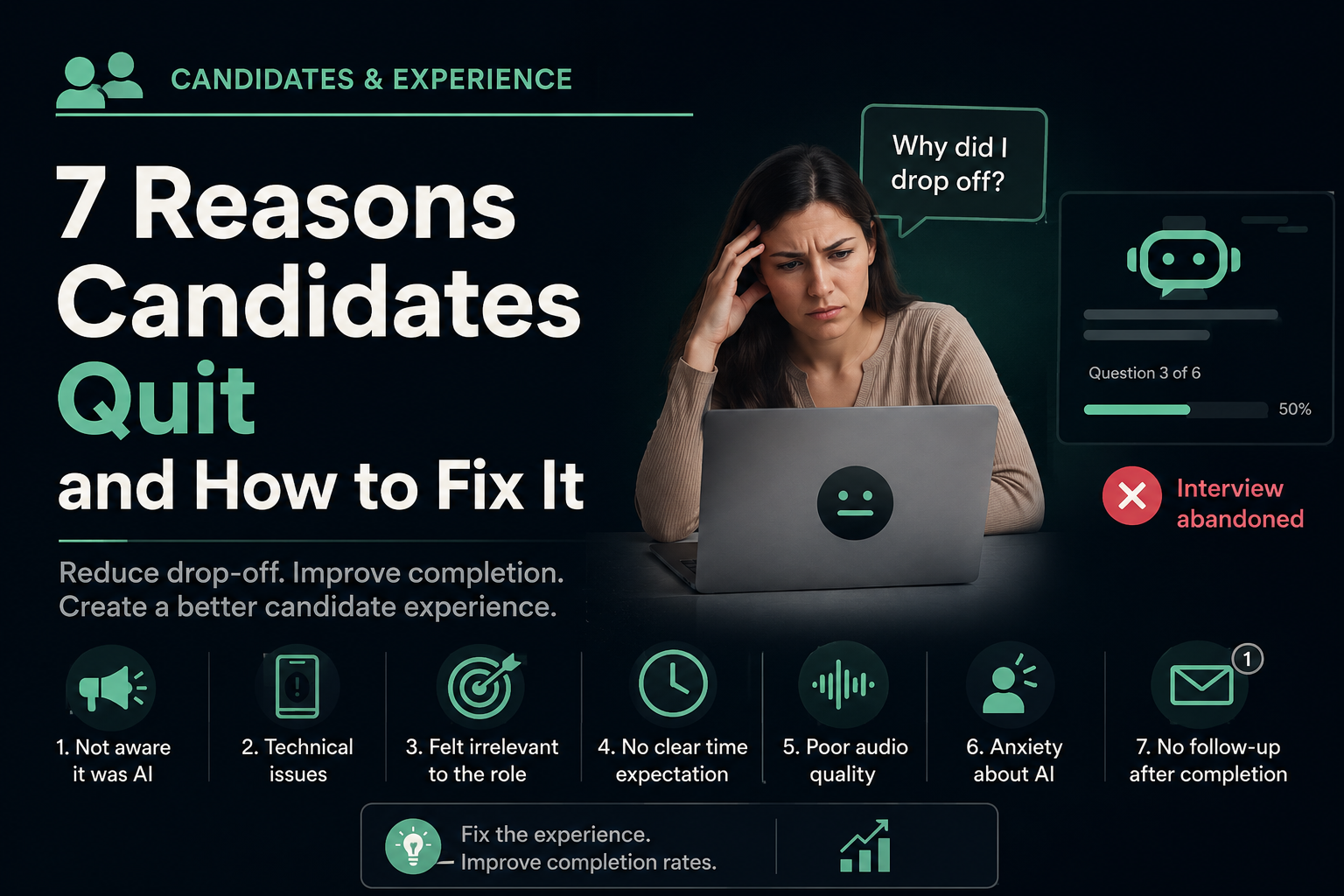
What AI Interview Drop-Off Actually Means
AI interview drop-off refers to the point at which a candidate receives an invitation to complete an AI-powered screening interview but fails to finish it. That's the clean definition. In practice, it shows up in a few distinct ways: candidates who open the invitation email and never start, candidates who begin the interview but abandon it midway, and candidates who complete the process but do so in a way that suggests high friction throughout.
Operationally, drop-off matters because it represents a failure of the hiring funnel at a stage where your pipeline should be widening, not narrowing. By the time a candidate receives an AI interview invitation, they've already expressed interest in your role. They applied, they read the JD, they decided the opportunity was worth pursuing. Losing them at the AI screening stage means you're not just losing a candidate. You're wasting the sourcing investment that got them to that point.
Where exactly do candidates leave? The data typically shows three concentration points: within the first 60 seconds after starting (often due to technical friction), between questions two and three (when the format starts to feel generic or overly long), and immediately after the final question but before submission (when confirmation anxiety or a technical glitch ends the session). Understanding these exit points is the first step toward fixing them.
Why Completion Rate Is One of the Most Important Hiring Metrics
Most recruiting teams track time-to-fill, offer acceptance rates, and pipeline volume. Far fewer track AI interview completion rates with the same rigor, and that's a meaningful gap. Completion rate tells you how much of your sourcing investment is actually converting into screened candidates, which is the foundational input for everything downstream.
Think about what low completion rates actually cost. If you spend resources attracting 200 applicants and only 90 complete the AI screen, you have 110 candidates who generated sourcing cost but produced no screening value. Those 110 didn't necessarily self-select out because they were unqualified. Research consistently shows that many of them were perfectly good candidates who encountered friction in the process and made the rational decision to disengage.
There's also a recruiter workload dimension that often gets overlooked. When completion rates are low, recruiters spend disproportionate time re-inviting candidates, manually following up, and trying to identify whether a non-completion reflects genuine disinterest or a technical issue. That work is largely avoidable with better process design. And it compounds quickly across high-volume roles where you might be managing hundreds of incomplete interviews simultaneously.
Employer brand damage is the longer-tail concern. A candidate who has a frustrating or opaque AI screening experience doesn't just drop out of your funnel quietly. They form an impression of your organization based on that interaction. For consumer-facing companies where candidates are also customers, this is a direct business risk, not just a recruiting problem.
The Real Cost of Candidate Drop-Off
| Drop-Off Problem | Business Impact |
|---|---|
| Low completion rate | Fewer qualified candidates entering the funnel |
| Technical issues | Strong applicants abandoning before being evaluated |
| Slow follow-up | Candidate disengagement and eventual ghosting |
| Generic screening questions | Candidates feel undervalued and exit mid-process |
| Poor candidate experience | Employer brand damage and reduced referral quality |
Why AI Interview Drop-Off Is Getting Worse in 2026
The conditions driving higher drop-off rates aren't mysterious. They're the predictable result of widespread AI adoption outpacing thoughtful implementation. As more companies deploy AI screening tools, candidates are encountering a wider range of experience quality, from genuinely well-designed workflows to poorly configured implementations that feel like obstacles rather than conversations.
Remote hiring growth has changed the candidate profile dramatically. A significant portion of applicants for remote roles are either currently employed or actively interviewing at multiple companies simultaneously. They have limited patience for friction. When your AI interview adds unnecessary complexity to their already busy job search, they'll complete the process for the employer who made it easiest, not necessarily the one paying the most.
Mobile-first application behavior is still catching many employers off guard. The majority of job applications now begin on a mobile device, and a large share of AI interview invitations are opened on phones. If your AI interview platform hasn't been explicitly optimized for mobile, you're designing for a use case that represents a shrinking minority of your actual candidate behavior.
There's also a candidacy fatigue dimension worth acknowledging. Candidates who have been through multiple AI screening processes, some good, some bad, arrive with accumulated skepticism. If your implementation doesn't quickly signal quality and relevance, they'll apply prior negative experiences to your process and disengage before you've had a chance to differentiate.
Most AI interview drop-off is caused by process friction rather than candidates rejecting AI itself. The technology isn't the problem. The implementation usually is.
Candidates Don't Actually Hate AI Interviews
This is an important reframe for recruiting teams who assume high drop-off means candidates are philosophically opposed to AI-assisted hiring. The evidence doesn't support that interpretation. Candidates who complete AI interviews generally report neutral to positive experiences when the process is clear, relevant, and respectful of their time. What they report negatively is the same thing they report negatively about human-led hiring processes: confusion, disrespect for their time, and a sense that the process exists to protect the employer rather than evaluate the candidate fairly.
Trust, not technology, is the real variable. Candidates make a split-second assessment of whether a process feels legitimate when they first encounter it. A well-introduced AI interview from a credible employer, with a clear explanation of how results will be used, typically generates strong completion rates. The same technology deployed with no context, branded with a generic vendor logo, and accompanied by a terse invitation email will perform significantly worse, even though the underlying AI is identical.
This means the optimization levers are largely in your control. You don't need to replace your AI tool to dramatically improve completion rates. You need to fix the way it's introduced, structured, and followed up. The sections below break down each of the seven most common causes of drop-off with specific actions to address them.
Reason 1: Candidates Didn't Know AI Was Involved
Surprise is not a neutral experience in hiring. When a candidate applies expecting a human-led process and receives an invitation to complete an AI-conducted interview with no prior explanation, the default reaction is wariness. Some candidates will complete it anyway. Many won't, particularly those who are currently employed, have other offers in play, or have had negative AI screening experiences previously.
The operational fix is simple but requires intentional communication design. AI involvement should be disclosed in the job posting, reinforced in the application confirmation, and explained clearly in the interview invitation. That explanation doesn't need to be lengthy. It just needs to be honest and informative.
Compare these two invitation approaches:
Version A: "Please complete the following screening interview at your earliest convenience. Link: [url]"
Version B: "The next step is a 12-minute AI-powered screening interview. It's conversational, not a test. You'll answer five questions about your experience relevant to this role. Results go directly to the hiring team for review within 24 hours. Here's your link: [url]"
Version B tells the candidate what to expect, how long it will take, that a human will review their responses, and that the format is conversational rather than evaluative. Each of those details reduces a specific source of drop-off anxiety. Building this kind of transparency into your standard invitation template costs nothing and measurably improves completion rates.
Reason 2: Mobile Technical Problems Are Still a Massive Issue
This one is frustrating because it's entirely preventable, yet it remains one of the most common causes of drop-off in AI screening workflows. Candidates attempting to complete AI video or voice interviews on mobile devices encounter microphone permission prompts that vary by browser and operating system, camera access issues that aren't always clearly explained, interfaces that weren't designed for small screens, and bandwidth-sensitive audio or video components that stutter or fail on mobile connections.
The recruiter's view of this is rarely the candidate's view. When testing an AI interview tool in an office environment on a desktop with a stable connection, everything works. When a candidate attempts the same interview on a commute, in a parked car, or at home on a shared network, the experience is often fundamentally different. Many candidates won't troubleshoot. They'll close the tab and move on.
Practical diagnostics include reviewing your completion data segmented by device type. If mobile completion rates are significantly lower than desktop, you have a technical optimization problem, not a candidate motivation problem. Check whether your AI interview platform has been tested explicitly on iOS Safari and Android Chrome, since these represent the majority of mobile web traffic. Confirm that microphone and camera permission prompts are explained to candidates in plain language before the interview begins, not surfaced as a browser dialog with no context.
For roles where you know candidates are likely to apply primarily on mobile, consider whether a voice-only AI interview option offers meaningfully lower technical friction than a full video format. The optimal format for completion rate isn't always the most feature-rich one.
Reason 3: Generic Questions Destroy Completion Rates
A candidate for a senior account executive role who receives an AI interview asking them to describe their communication style and explain how they handle stress will abandon that interview with a specific feeling: this company has no idea who I am or what this role requires. That feeling is accurate. Generic screening questions are a symptom of a poorly configured AI deployment, and candidates recognize them immediately.
The connection between question relevance and completion rate is direct. When candidates feel the questions are designed to evaluate them specifically for this role, they engage. When questions feel lifted from a generic HR assessment library, disengagement follows quickly. This is especially true for experienced professionals who have strong opinions about how their time should be spent in a job search.
Role-specific question design doesn't require extensive customization for every single role. It requires a few deliberate choices per role family. For a customer success position, questions about specific client scenarios, retention metrics, or tool familiarity signal that the interview was designed for this context. For an engineering role, questions about technical decision-making processes or team collaboration on complex builds communicate the same intent. Even a brief contextual introduction within the AI interview that references the specific role, the team, or the problem the hire will be solving creates a sense of relevance that generic assessments completely lack.
Audit your current question sets with this standard: could a candidate answer these questions without knowing anything about your company, this role, or this industry? If yes, redesign them.
Reason 4: Candidates Have No Idea How Long It Will Take
Duration uncertainty is a significant and underestimated driver of abandonment. Candidates preparing for an AI interview are often juggling work, other interviews, and personal obligations. When they open an AI interview invitation that gives no time estimate, many will defer completion until they have a clear block of uninterrupted time. A significant portion of those deferrals will become permanent non-completions, as the urgency fades and competing priorities take over.
The fix is almost embarrassingly simple: tell candidates exactly how long the interview will take. Not an approximation. A specific number. Twelve minutes. Eight minutes. Fifteen minutes. That specificity is more reassuring than a range, because it suggests the process was designed deliberately rather than assembled arbitrarily.
Progress indicators within the interview itself serve a related function. Knowing you're on question three of five is operationally meaningful information that reduces mid-interview abandonment. When candidates can see the end approaching, completion rates improve. When the end feels indefinite, attrition increases at each subsequent question. This is consistent with behavioral research on task completion and is reliably demonstrated in AI interview platform data.
Consider testing an invitation format that pairs the duration with context: "This 10-minute interview focuses on your experience with [relevant skill]. Most candidates find it straightforward." That structure addresses time, topic, and anxiety simultaneously.
Reason 5: Low-Quality AI Voice Experiences Create Friction
Not all AI interview platforms are built with the same underlying technology, and candidates can tell the difference. Robotic synthesized voices with noticeable lag between candidate responses and the next question, audio that cuts out or repeats unexpectedly, and interfaces that misinterpret speech and then surface visible transcription errors mid-interview all damage candidate confidence in the process.
This matters because candidates interpret poor voice quality as a signal about the employer's investment in the hiring process. An organization that uses a clunky, laggy AI screening tool is communicating something about its standards for candidate experience, whether intentionally or not. For competitive roles where you're trying to attract talent who has options, that signal can push a candidate toward a competitor with a smoother process.
When evaluating or re-evaluating AI interview vendors, voice naturalness and latency should be explicit evaluation criteria, not assumed features. Test the platform on multiple devices and connection speeds, with particular attention to how it handles pauses, disfluencies, and candidates who speak at a faster or slower pace than the training average. Poor interruption handling, where the AI cuts off candidate responses or fails to register when they've finished speaking, is one of the most friction-generating issues in voice AI interviews and one that candidates consistently cite negatively.
Reason 6: Candidate Anxiety About AI Judgment Is Real
There is a meaningful segment of the candidate population who approach AI interviews with genuine anxiety about whether the evaluation is fair, what exactly is being measured, and whether they have any recourse if the AI reaches a conclusion that doesn't reflect their actual capabilities. This anxiety is not irrational. There have been widely reported instances of AI hiring tools producing biased or opaque outcomes, and candidates who have followed that news or experienced poor AI screening personally will carry that skepticism into your process.
The right response isn't to dismiss that anxiety or bury it under marketing language about AI fairness. It's to address it directly and operationally. The onboarding experience before a candidate begins an AI interview is a meaningful opportunity to reduce anxiety by being transparent about what the AI evaluates, who reviews the results, how the output is used in the hiring decision, and what options exist if a candidate has concerns about the process.
A brief pre-interview screen that explains: "This interview is reviewed by a member of our hiring team. It's one input in our evaluation, not an automated decision. Your responses are assessed for role-relevant experience, not speech patterns or personality scoring" addresses the most common anxieties directly. Offering a human alternative for candidates who need accommodation under ADA or similar frameworks and making that alternative genuinely easy to request further reduces the anxiety that drives abandonment before the interview even starts.
Reason 7: Silence After Completion Causes Disengagement
Candidates who complete an AI interview and then hear nothing for three to five days experience a distinctive kind of disengagement. They've put effort into a process, often preparing answers, finding a quiet environment, troubleshooting technical issues, and managing their own nerves, and the response they receive is silence. Many of those candidates will accept competing offers, stop responding to your subsequent outreach, or form a lasting negative impression of your employer brand.
Automated confirmation after AI interview submission is not optional. It should be standard practice in any AI recruiting workflow. The confirmation should arrive within minutes of completion, acknowledge that the submission was received, give a realistic timeline for recruiter review, and provide a contact for candidates who have questions or technical concerns.
Beyond immediate confirmation, recruiter review SLAs for AI interview completion are a meaningful competitive differentiator. A hiring team that reviews and responds within 24 to 48 hours of completion, even with a brief acknowledgment, dramatically outperforms competitors who batch-review interviews weekly. Candidates in active job searches make decisions quickly. The employer who communicates fastest, with genuine information rather than generic delays, converts more top candidates through the funnel.
Consider building an automated status update into your workflow at the 48-hour mark if no recruiter action has occurred. Something as simple as "We're reviewing your interview and will be in touch by [date]" extends candidate patience and reduces ghosting significantly.
What a Healthy AI Interview Funnel Looks Like
| Funnel Stage | Healthy Benchmark |
|---|---|
| Invitation open rate | 75% to 90% |
| Interview start rate | 65% to 80% |
| Completion rate | 70% to 90% |
| Post-completion response time | Automated confirmation within 5 minutes |
| Recruiter review time | Under 24 hours |
If your current metrics fall significantly below these benchmarks, the gap is almost always traceable to one or more of the seven friction points described above. The good news is that all of them are addressable through process changes rather than platform replacement.
Drop-Off Patterns: Where Candidates Actually Exit
Typical drop-off distribution by stage
Illustrative benchmarks based on typical AI interview platform patterns. Actual rates vary by platform, role type, and implementation quality.
Mobile vs. desktop completion rates
How a Well-Designed AI Interview Workflow Actually Flows
The diagram below represents the stages a candidate moves through in a properly designed AI recruiting workflow. Each transition is a potential drop-off point, and each one has specific design choices that improve or damage completion rates.
Explain AI use
Role-specific Qs
< 5 minutes
< 24 hours
The stages between AI Invite and Auto Confirm are where the majority of drop-off occurs. Everything to the left of that sequence is sourcing. Everything to the right is evaluation. Losing candidates in the middle wastes both.
Your 7-Point AI Interview Drop-Off Audit
Use this checklist to identify the specific friction points in your current AI interview workflow. The goal isn't to score yourself against a benchmark. It's to find the one or two items that are generating most of your current drop-off and address those first.
Does every candidate know AI is involved before they encounter it? Is AI mentioned in the job posting, application confirmation, and interview invitation?
Have you tested your AI interview on iOS Safari and Android Chrome? Do permission prompts work correctly? Is your completion rate segmented by device type?
Are your screening questions specific to this role and industry? Would a candidate recognize these as relevant to the position they applied for?
Is a specific time estimate communicated in the invitation? Does the interview interface include a progress indicator? Do candidates know when they're halfway through?
Have you listened to your AI interview as a candidate would experience it? Is the voice natural? Is there noticeable lag? Does it handle pauses and varied speaking speeds gracefully?
Does a confirmation message go out within minutes of submission? Does it acknowledge the candidate's effort, set a timeline, and provide a contact for questions?
What is your actual SLA for reviewing completed AI interviews? Is it documented? Is there a fallback notification if review takes longer than expected?
What the Best Recruiting Teams Do Differently
The teams consistently achieving high AI interview completion rates share a few characteristics that aren't particularly exotic, but they're not universal either. The first is that they treat completion rate as a first-class metric. It appears in their weekly recruiting dashboards alongside time-to-fill and offer acceptance rate. When it drops, there's a defined process for investigating why. This kind of operational discipline, applied to what most teams treat as a secondary metric, produces compounding improvements over time.
The second characteristic is candidate experience ownership. In many recruiting operations, the AI interview sits in a kind of accountability gap: the platform vendor is responsible for the technology, the recruiter is responsible for reviewing results, but no one is explicitly responsible for the candidate's experience of the process itself. High-performing teams close that gap by assigning specific ownership over the AI interview workflow, including messaging, configuration, and follow-up cadence.
Third, they treat drop-off as data rather than as failure. Every incomplete interview is a signal about where friction exists. Teams that systematically analyze where in the interview candidates are exiting, and on which devices, and for which role types, can prioritize improvements precisely. Teams that treat incomplete interviews as lost and move on are forfeiting the diagnostic information that would allow them to recover that attrition.
Finally, the best teams continuously test their own processes. They complete their own AI interviews as candidates would. They check invitation emails on mobile. They run timing tests to verify that progress indicators are accurate. Small investments in this kind of process monitoring prevent the kind of slow degradation in candidate experience that happens imperceptibly until completion rates have dropped significantly.
Key Takeaway
AI interview drop-off is a solvable operational problem. The seven causes described above, undisclosed AI involvement, mobile technical friction, generic irrelevant questions, unclear duration expectations, poor voice quality, candidate anxiety, and post-completion silence, are not fundamental limitations of AI interviewing as a category. They're implementation failures that recruiting teams can address directly.
The candidates you're losing to drop-off are not, for the most part, candidates who decided your role wasn't for them. They're candidates who encountered friction at a vulnerable moment in their decision-making process and made a rational choice to redirect their energy elsewhere. Reducing that friction doesn't require a platform change or a major budget investment. It requires honest diagnosis, specific process improvements, and the operational discipline to maintain those improvements over time.
Improving AI interview completion rates is also not just a conversion optimization exercise. It's a candidate experience initiative that has downstream effects on offer acceptance rates, early tenure retention, and employer brand. Candidates who have a good experience in your AI screening process, one that felt respectful, clear, and relevant, arrive at the human interview stage better disposed toward your organization. That goodwill is worth building.
Start with your audit. Identify the two or three most significant friction points in your current workflow and fix them before adding complexity. Measure your baseline completion rate now, implement changes, and measure again. The signal is clear and actionable if you're willing to look at it.
Build AI interview workflows candidates actually complete
See where candidates drop off, improve completion rates, and create a smoother hiring experience from the first interaction.
Try for free
.jpg)
.png)
