AI interviewer software automates the first stages of candidate interviews by asking structured questions, evaluating responses, generating interview insights, and delivering results to recruiters. Modern platforms can conduct interviews through phone, video, or web-based formats and can personalize questions based on a candidate's resume and the requirements of the role.
The adoption of this technology is growing quickly. A 2026 Greenhouse report found that 63% of job seekers had experienced an AI interview, up 13 percentage points in just six months. This reflects how automated interviews are becoming a more common part of the hiring process.
For recruiting teams, the value goes beyond saving interview time. AI can create a consistent screening process, evaluate candidates against predefined criteria, generate transcripts and summaries, and help recruiters prioritize candidates for the next stage.
LinkedIn's 2025 Future of Recruiting research found that 37% of talent acquisition professionals were experimenting with or actively integrating generative AI into hiring. Those teams reported saving an average of 20% of their workweek.
The practical model is simple:
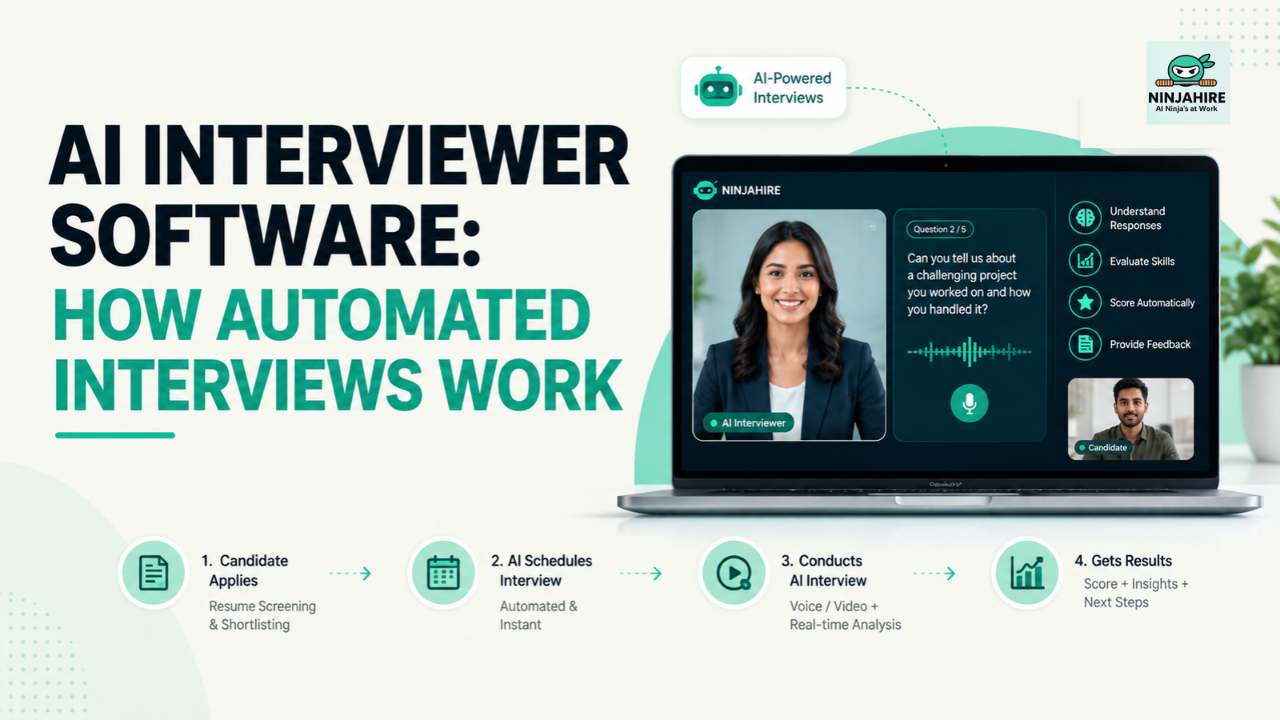
AI conducts the initial interview → AI structures the results → Recruiters review the evidence → Hiring teams make decisions.
What Is AI Interviewer Software?
AI interviewers are applications that utilize AI to conduct the interviews and analyze candidates' responses relative to the job-specific metrics set up by the recruitment team.
Depending on the software platform, the AI interviewer can:
- Provide preset interview questions
- Gather candidate details like resumes
- Tailor interview questions according to candidate's background
- Ask follow-up questions based on earlier questions
- Record candidate answers and transcribe them
- Score answers using a predefined rubric
- Evaluate strengths and weaknesses of the candidate
- Prepare candidate profiles
- Rank candidates for the recruitment team's evaluation
- Enter interview outcomes into recruiting software
Not all AI interviewers can perform all the above operations. While some of them have a set routine of asking questions, others use adaptive questioning that uses candidate's information to ask the appropriate follow-up questions.
The difference lies between the basic one-way video questionnaire and advanced AI interviewing systems. Yet, the degree of the interactivity and personalization depends on the features of the platform itself.
The capabilities of NinjaHire's AI Interviewer platform include phone, video and web interviewing. Among the key features of the tool are personalization of the questions based on the resumes of the candidate, rubric and knockout criteria, investigation of the key answers of the candidate, generation of transcript and ranking of candidates.
How Do Automated Interviews Work?
Automated interviews generally follow a structured workflow from interview configuration through recruiter review.
1. Define the Interview Criteria
The recruiting team first establishes what the AI should evaluate.
This can include:
- Required qualifications
- Technical skills
- Experience
- Behavioral competencies
- Role-specific questions
- Knockout questions
- Scoring categories
- Minimum qualification thresholds
For example, a technical recruiting team may define criteria around programming experience, system design, cloud infrastructure, and problem-solving.
A customer service team may prioritize communication, conflict resolution, customer handling, and product knowledge.
The AI then uses these requirements as the evaluation framework.
2. Invite Candidates
Once the interview is configured, candidates receive an invitation.
Depending on the platform, the candidate may complete the interview through:
- Phone
- Video
- Web-based chat
Ninjahire allows candidates to receive interview invitations through email or SMS and supports phone, video, and web interview formats.
This can reduce the scheduling coordination required for first-round screening.
3. AI Conducts the Interview
The AI interviewer presents questions and captures candidate responses.
The sophistication of this stage depends on the software.
A basic system might follow a fixed question sequence. A more advanced AI interviewer can adapt the conversation.
For example:
Candidate resume: Four years of experience managing cloud infrastructure.
AI question: “Tell us about the most complex cloud migration you have managed.”
Candidate response: The candidate describes a multi-region migration.
AI follow-up: “What was your specific responsibility for reducing downtime during that migration?”
The second question creates a deeper assessment based on the candidate's previous response.
Ninjahire describes its AI Interviewer as resume-aware and capable of generating personalized questions, probing weak or inconsistent responses, and adapting interviews to individual candidates.
4. AI Analyzes Candidate Responses
After capturing the interview, the system processes the candidate's responses.
Depending on the platform, this can include:
- Transcription
- Response analysis
- Skills assessment
- Competency scoring
- Qualification checks
- Strength and weakness identification
- Candidate summaries
Ninjahire's AI Interviewer produces transcripts, scores, strengths and weaknesses, and candidate reports that can be used for recruiter review.
5. Candidates Are Scored and Ranked
AI can apply a predefined scoring rubric to each candidate.
For example:
| Evaluation Area | Weight |
|---|---|
| Required technical skills | 30% |
| Relevant experience | 25% |
| Problem-solving | 20% |
| Communication | 15% |
| Role-specific competencies | 10% |
The actual criteria should be defined by the hiring team and aligned with the requirements of the role.
The objective is not to create a mysterious AI score. It is to give recruiters a structured way to compare candidates against the same job-related criteria.
Ninjahire states that its AI Interviewer scores responses against the configured rubric and ranks candidates by fit.
6. Recruiters Review the Results
The final stage is human review.
Recruiters can use the AI-generated score, transcript, summary, candidate profile, and interview evidence to determine which candidates should progress.
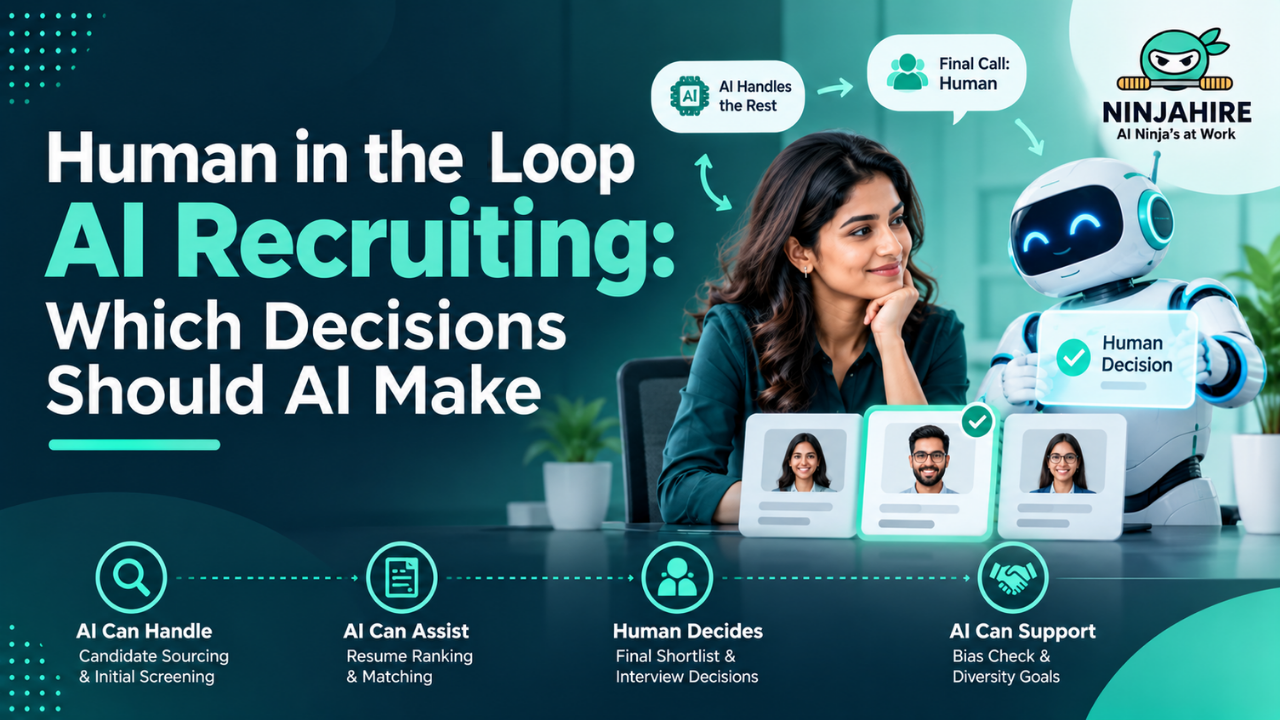
This creates a useful division of responsibility:
- AI: Conducts the repetitive interview.
- AI: Structures the evidence.
- AI: Prioritizes candidates.
- Recruiter: Reviews the evidence.
- Hiring team: Makes the final hiring decision.
AI interviewer software should therefore be treated as a decision-support layer rather than an automatic replacement for human hiring judgment.
What Can AI Interview Software Automate?
AI interview software can automate several time-consuming tasks in the early stages of recruitment.
| Recruiting Task | AI Automation | Human Involvement |
|---|---|---|
| Interview invitations | Automated | Exception handling |
| First-round questions | Automated | Define interview strategy |
| Candidate responses | Automatically captured | Review when needed |
| Resume-based questions | Automated | Define job requirements |
| Follow-up questions | Can be automated | Set boundaries and criteria |
| Transcription | Automated | Verify important details |
| Candidate scoring | Automated against rubric | Review results |
| Candidate ranking | Automated | Decide who progresses |
| Interview summaries | Automated | Validate findings |
| Final hiring decision | Not fully automated | Human-owned |
This is where AI interviewing can create significant operational value.
SHRM's 2025 Talent Trends research reported that 51% of organizations use AI in recruiting, making recruitment the HR function with the highest reported AI usage in that research.
The opportunity is particularly relevant for organizations that conduct hundreds or thousands of first-round interviews.
What Types of AI Interviews Can Be Automated?
AI Phone Interviews
Voice AI can conduct structured phone interviews without requiring a recruiter to manually make every screening call.
Ninjahire's AI Phone Screening can make outbound calls, handle inbound callbacks, conduct structured interviews, evaluate responses in real time, and create transcripts.
This format is useful for high-volume screening where AI recruiters need to quickly determine whether candidates meet basic qualifications.
AI Video Interviews
AI video interviewer software allows candidates to complete recorded interviews asynchronously.
Candidates receive questions, record their responses, and submit the interview for evaluation.
Ninjahire's AI Video Interviewer supports resume-personalized questions, response scoring, transcripts, and shareable reports for hiring managers.
This can remove much of the scheduling friction associated with first-round video interviews.
Web-Based AI Interviews
Web-based interviews allow candidates to complete a text-based interview directly through a browser.
This format can be useful when candidates prefer written communication or when recruiting teams want an accessible screening option without requiring an application download.
Ninjahire's AI Interviewer supports web-based AI interviews alongside phone and video formats.
What Are the Benefits of AI-Powered Interviews?
Faster Candidate Screening
Recruiters can spend less time conducting repetitive first-round interviews and more time reviewing qualified candidates.
Consistent Evaluation
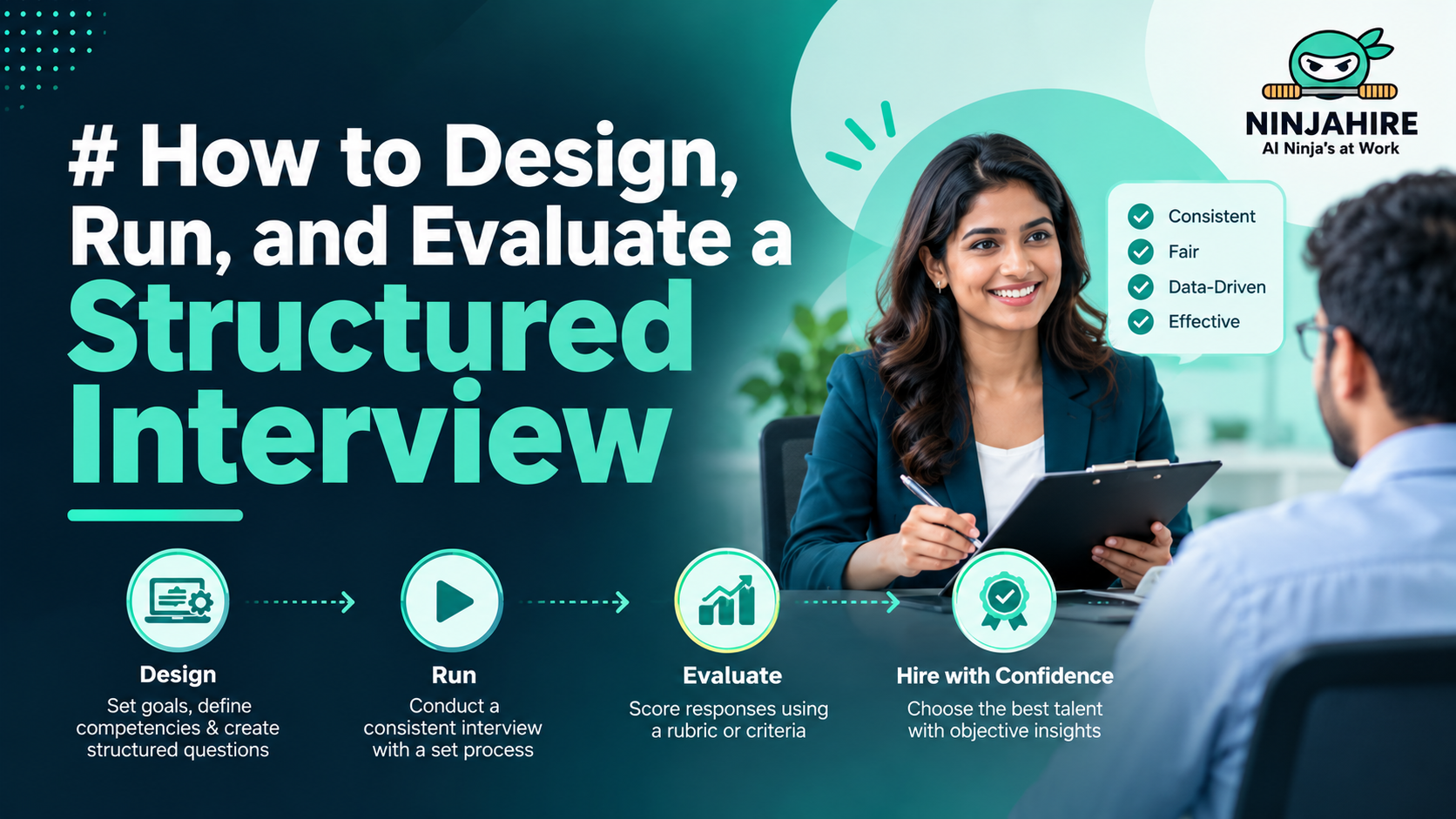
A defined scoring rubric allows candidates to be evaluated against the same job-related criteria.
This can make early-stage screening more structured and easier to standardize across large recruiting teams.
Higher Recruiting Capacity
AI interview software can conduct multiple interviews simultaneously rather than requiring recruiters to handle interviews sequentially.
Ninjahire's AI Interviewer states that it supports concurrent interviews and operates continuously, allowing recruiting teams to increase screening capacity.
Better Candidate Data
Instead of relying only on recruiter notes, teams can receive:
- Interview transcripts
- Scores
- Candidate summaries
- Strengths and weaknesses
- Structured evaluation results
This gives recruiters more information before deciding who should advance.
Reduced Scheduling Friction
Asynchronous interviews allow candidates to complete AI screening without waiting for a recruiter to become available.
That can be particularly useful for global recruiting teams working across multiple time zones.
More Recruiter Time for High-Value Work
LinkedIn reports that talent acquisition professionals experimenting with or integrating generative AI save an average of 20% of their workweek. The report also notes that AI is helping recruiters redirect time toward areas such as candidate screening and skills assessment.
The strongest benefit is therefore not simply automation. It is reallocating recruiter time toward activities that require human judgment.
What Should Recruiters Still Handle?
AI interviewing should not remove human involvement from the entire hiring process.
Recruiters should remain involved in areas where context, empathy, relationship-building, and accountability are important.
Complex Candidate Evaluation
A candidate's experience may not fit neatly into a predefined scoring model.
A recruiter can investigate transferable skills, unusual career paths, project context, and other factors that require interpretation.
Candidate Relationships
Candidates may need answers about:
- Career progression
- Company culture
- Compensation
- Team structure
- Hiring expectations
- Role responsibilities
These conversations often benefit from human interaction.
Hiring Manager Consultation
Recruiters also help hiring managers define realistic requirements and interpret candidate quality.
This strategic role cannot be reduced to automated interview scoring.
Final Hiring Decisions
AI-generated scores should support the hiring process, not become the sole basis for consequential employment decisions.
LinkedIn's Future of Recruiting research emphasizes that AI can augment human judgment by handling routine work while people remain responsible for complex problems and meaningful human interaction.
How Does AI Interviewing Fit Into the Recruiting Workflow?
AI interviewing delivers the most value when it is connected to the broader recruitment process.
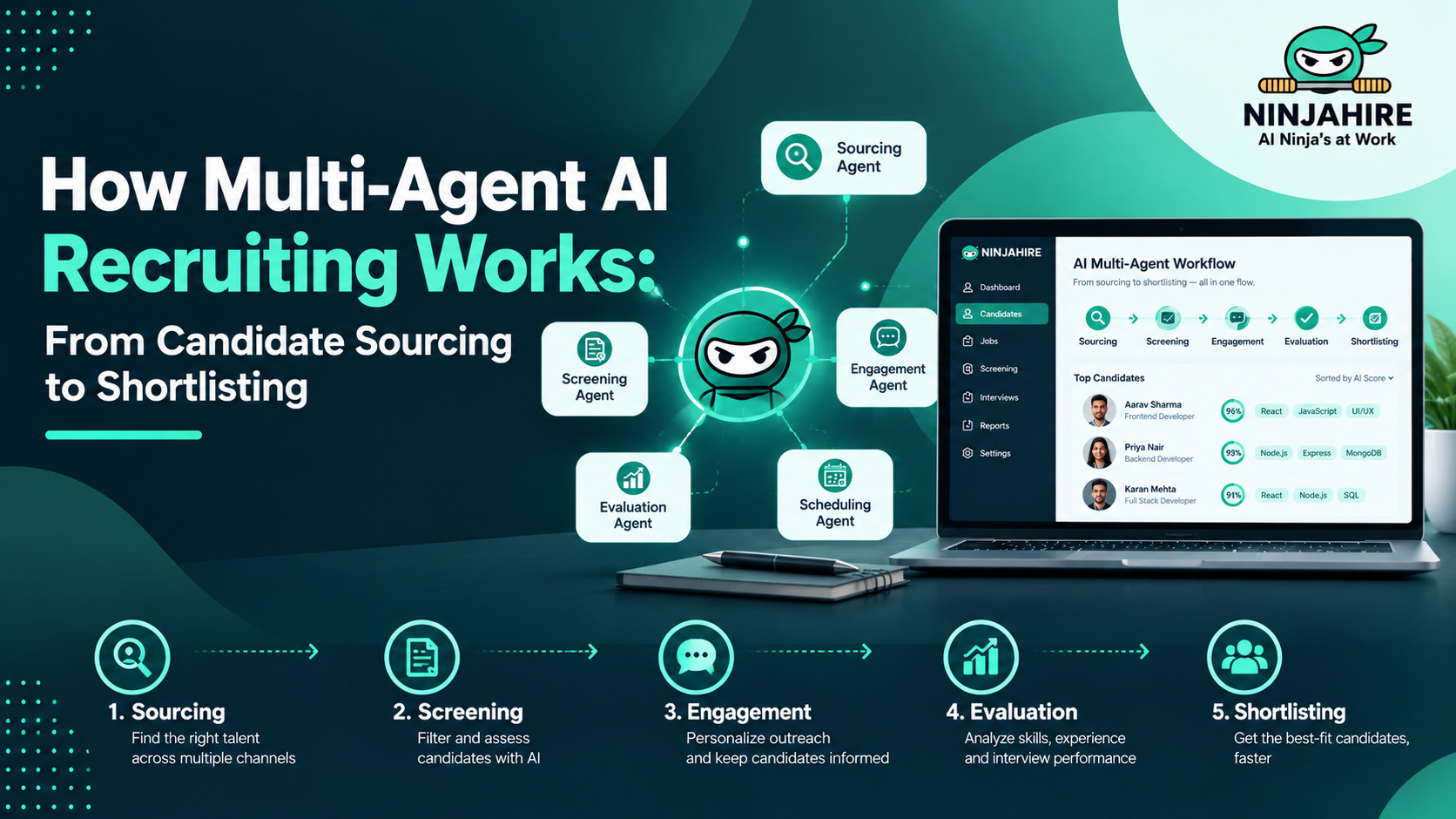
A typical workflow can look like this:
Ninjahire connects AI interviewing with broader recruiting automation, including sourcing, outreach, screening, ATS integrations, and candidate workflow management.
This means an AI interview does not have to operate as an isolated recruitment tool. It can become one stage in a larger automated hiring workflow.
For example, a staffing agency recruiting for a high-volume technical role could automatically source candidates, contact them, conduct first-round interviews, score responses, rank candidates, and deliver a shortlist to recruiters.
The recruiter can then spend time on the candidates most likely to require deeper evaluation.
How Should Companies Evaluate AI Interview Software?
Recruiting teams should evaluate AI interview software based on the entire workflow, not just its ability to ask questions.
| Evaluation Area | What to Check |
|---|---|
| Interview formats | Phone, video, web or chat |
| Question personalization | Resume and role-aware questions |
| Adaptive questioning | Relevant follow-up questions |
| Scoring | Configurable evaluation rubrics |
| Candidate reports | Transcripts, summaries and scores |
| Workflow automation | Automated movement between stages |
| ATS integration | Candidate data and results synchronization |
| Scalability | Concurrent interview capacity |
| Candidate experience | Ease of completing interviews |
| Human oversight | Recruiter review and approval |
| Security and data handling | Clear candidate-data practices |
| Reporting | Visibility into interview outcomes |
The best solution depends on the organization's hiring volume, recruiting workflow, role complexity, interview format requirements, and existing technology stack.
Is AI Interviewer Software Replacing Recruiters?
AI interviewer technology is meant to assist HR personnel rather than eliminate them. The program automates the screening process and leaves the evaluation and decision-making up to humans.
| AI Interviewer | Human Recruiter |
|---|---|
| Initial screening conducted | Establishes connections with candidates |
| Collects replies and produces transcripts | Analyzes context and complicated scenarios |
| Uses predetermined scoring rubrics | Interacts with recruitment personnel |
| Highlights and orders candidates | Makes informed hiring decisions |
Final Decision: AI helps improve the screening process whereas the recruiters offer human insight for effective recruitment.
Conclusion
Interviewer software powered by artificial intelligence revolutionizes the processes of the first-round candidate screening for recruiters to ensure better efficiency and consistency of the whole hiring process in face of rising recruitment challenges.
In case an organization is looking to scale the recruiting process, the services of such tools as NinjaHire can be used to integrate AI interviews into the recruiting process to increase efficiency in screening and selection of candidates.
What really matters is to create a scalable recruiting process that will save recruiters' time and improve screening consistency.
Additionally, AI interviews make it possible to cut down the volume of repetitive tasks and give more attention to the candidate experience.