.png)
The AI recruiter handoff: what stays human and what gets automated

March 15, 2026
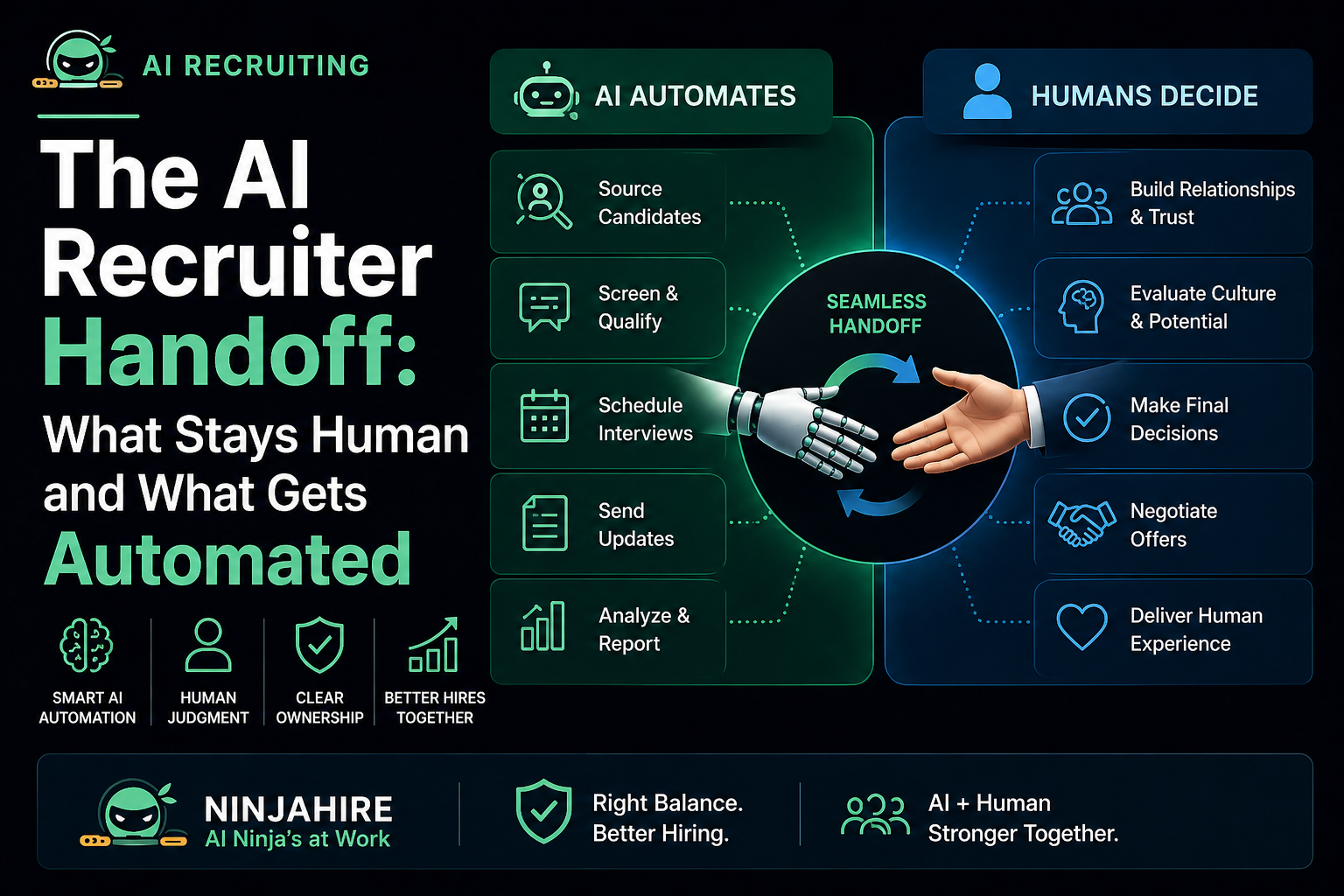
What AI Recruiter Handoff Actually Means
An AI recruiter handoff is the defined point in a hiring workflow where AI-driven automation passes responsibility to a human recruiter. It establishes which tasks the AI owns — sourcing, screening, scoring, scheduling — and at what stage a human takes direct control of candidate evaluation, relationship-building, and final decisions. A well-designed handoff prevents accountability gaps, protects candidate experience, and ensures that AI augments recruiter judgment rather than silently replacing it.
Why AI vs Human Boundaries Matter More Than Tools
Most conversations about AI in recruiting focus on tools — which platform to use, what features it has, how it integrates with the ATS. That is the wrong starting point. The most important decision a TA leader makes when introducing AI into a hiring process is not which tool to buy. It is where the AI stops and where the human begins. Get that boundary wrong and the best technology in the world will produce worse outcomes than a well-run manual process.
Accountability is the first reason boundaries matter. When a candidate is rejected after an AI screening, someone has to be able to explain why. When a hire turns out to be a bad fit six months in, someone has to take ownership of where the process broke down. AI cannot be held accountable. It does not have professional judgment, legal standing, or the ability to reflect and improve based on consequences. Humans do. Which means every decision point in the hiring process needs a named human who owns the outcome — even when AI is doing most of the work upstream.
Candidate trust is the second reason. Hiring is a deeply human process from the candidate's perspective. They are making a significant life decision, and they want to feel that a real person is paying attention to them — not that they are being processed by an algorithm. AI can handle high-volume, repetitive tasks in a way that actually improves speed and fairness. But if a candidate reaches a point in the process where they have a question, a concern, or simply want to understand what comes next, that interaction needs to happen with a human. The handoff moment — when the AI passes the candidate to a recruiter — is when candidate experience either comes together or falls apart.
Operational clarity is the third reason. Teams without defined AI-human boundaries end up with recruiters who are not sure whether they are supposed to review every AI-scored candidate or just the ones above the threshold. Hiring managers who do not know whether the shortlist they are seeing has been human-reviewed or auto-generated. Executives who assume AI is making better decisions than it actually is because nobody has documented what the AI is and is not doing. Clear boundaries prevent all of this by making the workflow explicit rather than assumed.
The Real Risk of Not Defining the Handoff
When nobody has mapped out where AI responsibility ends and human responsibility begins, problems do not announce themselves immediately. They accumulate quietly until something goes visibly wrong — a candidate complaint, a bad hire, a compliance question, or a recruiter who has been quietly routing around the AI system because they do not trust it and nobody noticed.
| Problem | Impact |
|---|---|
| No clear ownership of decisions | When something goes wrong, blame is diffuse and accountability disappears — nobody improves the process because nobody owns it |
| Inconsistent candidate experience | Some candidates get a fast, seamless process while others fall into gaps between systems — drop-off increases and employer brand suffers |
| AI misuse or over-reliance | Hiring decisions are effectively made by algorithm without human review — legal exposure increases and hiring quality decreases |
| Recruiter disengagement | When recruiters are unsure what they are supposed to do with AI outputs, they either ignore the tool or defer to it completely — neither is productive |
| Compliance gaps | Automated decisions without documented human oversight create risk under employment law and data protection regulations in multiple jurisdictions |
Every one of these problems is a process design failure, not a technology failure. The AI is doing exactly what it was configured to do. The gap is that nobody designed the human side of the workflow with the same care they applied to setting up the AI side. The handoff is not a feature you configure in a platform — it is a decision your team has to make explicitly and document clearly before going live.
The RACI Framework for AI Recruiting
RACI stands for Responsible, Accountable, Consulted, and Informed. It is a standard project management tool for clarifying who does what in a process, and it translates remarkably well to AI recruiting workflow design — specifically because it forces an answer to the question that most teams avoid: who actually owns each decision?
Responsible refers to whoever performs the task. In an AI-assisted hiring workflow, AI can be responsible for a number of tasks — parsing applications, scoring responses, scheduling screenings, triggering automated communications. Being responsible for execution does not require judgment or accountability. It just means doing the work.
Accountable refers to whoever owns the outcome. This is always a human. Always. There is no configuration of an AI system that makes it appropriate for the AI to be accountable for a hiring decision. Accountability implies the ability to answer for a choice, to defend it, to learn from it when it goes wrong, and to improve future decisions based on what happened. AI cannot do any of that in any meaningful sense. In a RACI framework for recruiting, the accountable party for every decision — who advances, who is rejected, who gets an offer — is a named human: a recruiter, a hiring manager, or an HR leader depending on the stage.
Consulted refers to parties whose input shapes a decision but who are not directly executing or owning it. In an AI recruiting workflow, AI outputs — scores, rankings, flags — function as consulted inputs to human decision-makers. The recruiter looks at the AI scoring, considers it alongside their own review, and makes a call. The AI informs the decision without making it.
Informed refers to parties who need to know the outcome but are not involved in making it happen. In recruiting, this typically includes HR business partners, compensation teams, or finance when headcount decisions are made. Keeping these parties informed through automated notifications — which AI can handle efficiently — is a perfectly appropriate use of the technology.
Building a RACI matrix for your AI recruiting workflow is not a complex exercise. It should take no more than two hours with the right stakeholders in the room. The output is a simple grid that maps every stage of your hiring process to the four RACI roles, with named humans in the accountable column for every row. If you cannot fill in that column for every stage, you have found your accountability gaps before they become operational problems.
Sourcing Stage: What AI Should Do vs Humans
Sourcing is the stage where AI has arguably the highest legitimate value — and also the stage where over-reliance creates the most subtle risks. The distinction between what AI does well here and what requires human judgment is sharper than most teams realize.
AI is genuinely effective at drafting outreach sequences, generating role-specific messaging variations, identifying patterns in which job boards or channels have historically produced the strongest candidates for a given role type, and parsing large volumes of passive candidate profiles against a defined criteria set. These are speed and scale tasks. A human doing them manually is slower, less consistent, and more likely to introduce unconscious bias through pattern recognition based on superficial profile features.
But the human decides. The recruiter defines what good looks like for this role — not just the job description keywords, but the judgment calls about what experience transfers, what background signals genuine potential, and what the hiring manager actually needs versus what they said they need in the brief. The recruiter reviews the AI-generated outreach draft and adjusts the tone, the specificity, the value proposition for the target audience. The recruiter makes the final call on which passive candidates get a personal message and which get a templated one.
The division at the sourcing stage is: AI drafts, filters, and surfaces — human evaluates, decides, and reaches out. Any sourcing workflow where AI is autonomously reaching out to candidates without human review of the message and the target list is one where the human has ceded too much control too early in the process.
Application and Screening Stage
The application and screening stage is where AI typically delivers the most visible time savings — and where the design of human oversight matters most. The volume of inbound applications on any moderately promoted role makes fully manual review impractical. AI screening is not a luxury at this stage; for most teams, it is a necessity.
AI handles the mechanical work: collecting applications, routing candidates into the screening workflow, delivering asynchronous screening questions or video prompts, scoring responses against a rubric, and surfacing scored candidates to the recruiter in priority order. Done well, this process takes a candidate from application to scored profile in under 24 hours without any recruiter involvement in the execution.
Human oversight at this stage operates at two levels. The first is configuration oversight — the recruiter or TA leader designed the screening questions, defined the scoring rubric, and set the threshold for what constitutes a shortlistable score. These decisions require human judgment about what the role actually demands and should not be delegated to the AI or to a vendor template. The second is review oversight — a human should regularly audit the AI screening outputs to catch cases where the scoring is misaligned with recruiter or hiring manager expectations. This is not the same as manually reviewing every application. It means sampling the results across the score range to verify that the AI is surfacing the right profiles and filtering out the right ones.
The handoff point at this stage is when the AI has scored and ranked the applicant pool and the recruiter begins their review of the shortlist. At that moment, the recruiter is no longer a passive observer of an automated process — they are the decision-maker, using AI output as one input among several.
Shortlisting Stage
Shortlisting is where the AI-to-human boundary becomes most critical and most frequently mishandled. The AI has ranked the candidate pool. The top tier looks strong. The pressure to simply advance the top-ranked candidates without meaningful human review is real — especially on a busy hiring week when the recruiter is managing six open roles simultaneously. Resisting that pressure is where the design of the workflow either holds or breaks down.
AI ranking at the shortlisting stage should be treated as a starting point, not a conclusion. The AI is surfacing the candidates most likely to match the defined criteria based on their screening responses. But criteria are imperfect proxies for actual hiring outcomes. A candidate who scores slightly below the threshold because they answered a question differently from the rubric may be a stronger hire than someone who scored highly because they have seen the question format before. A recruiter who reads the actual responses — not just the scores — will often find nuance that the scoring misses.
The practical design for the shortlisting stage is that AI produces a ranked list and the recruiter reviews the top tier and a sample from the middle tier before finalizing the shortlist. The recruiter then makes an explicit decision — not a default — about which candidates move forward. That decision is documented. If the recruiter chooses to advance someone the AI ranked lower or to hold someone the AI ranked highly, they note the reason. This creates a feedback loop that improves AI scoring over time and maintains clear human accountability for who makes the cut.
Interview Stage
The interview stage is where the human element of hiring is most irreducible. A candidate sitting across from a hiring manager — or in a video call with an interviewer — is having a fundamentally human interaction. AI has a legitimate supporting role here, but it is a supporting role, not a leading one.
AI support tools at the interview stage are genuinely useful in a narrow set of applications. Scheduling automation removes significant friction from the process and is a pure efficiency gain with no quality trade-off. AI-generated interview guides — structured question sets tailored to the role and calibrated to the information already gathered during screening — help interviewers ask more relevant, less redundant questions. Note-taking tools that transcribe and summarize interview conversations help ensure that feedback is captured consistently across interviewers rather than varying based on how good each person's memory is.
What AI should not do at the interview stage is evaluate candidates. Some tools offer AI-powered interview scoring based on facial expression analysis, speech pattern recognition, or keyword frequency. These tools are scientifically contested, carry significant bias risk, and in several jurisdictions face legal restrictions. More fundamentally, the judgment call about whether a candidate is right for a role, for a team, and for a manager is one of the most complex assessments a recruiter or hiring manager makes. It requires contextual understanding, interpersonal reading, and experience-based pattern recognition that no current AI system replicates reliably.
The human owns every evaluation at the interview stage. AI provides scheduling, structure, and documentation. The assessment of whether to advance a candidate belongs to the interviewer and the hiring manager.
Offer and Closing Stage
By the time a candidate reaches the offer stage, they have invested significant time and emotional energy in the process. The stakes for the relationship between candidate and employer are at their highest. This is the least appropriate stage to lean on AI — and also one of the stages where poor handoff design creates the most visible damage to candidate experience.
AI can assist with offer preparation in meaningful ways. Pulling together compensation benchmarking data, generating offer letter drafts, automating the administrative steps of background check initiation or reference request workflows — these are legitimate efficiency uses. AI can also help with tracking candidate engagement signals during the offer period, flagging when a candidate has not responded within an expected window so the recruiter can follow up proactively.
But the offer conversation itself — the call where the recruiter presents the package, answers questions, reads the candidate's reaction, and navigates whatever negotiation or hesitation follows — is a human conversation. It cannot be scripted by an AI and delivered by an automated system. It requires relationship intelligence, real-time adjustment, and genuine care about the outcome for both the candidate and the business. Recruiters who hand off the offer stage to a purely automated flow are making the closing stage feel transactional at exactly the moment when it should feel personal.
The closing stage is where candidates decide whether the experience they had in the process reflects the culture of the company they are joining. AI that helped them move through screening efficiently is a positive signal. An offer email that feels automated and impersonal after a strong human interview experience is a jarring discontinuity. Keep the human front and center at the close.
The Critical Handoff Moment
The handoff moment — the specific point where a candidate transitions from an AI-managed experience to a human-managed one — is the most consequential design decision in the entire AI recruiting workflow. Get it right and the candidate experiences a seamless, increasingly personalized journey. Get it wrong and the candidate feels the seam: a sudden shift in tone, a loss of context, a reset of the relationship that makes them wonder whether anyone was actually paying attention to them before the human showed up.
The handoff moment should be designed, not discovered. That means the recruiter who takes over from the AI-managed screening process should have full context on the candidate before the first human interaction. They should know the screening questions the candidate answered, the score they received, the specific responses that were strong or that raised questions. They should be able to open the handoff conversation in a way that acknowledges the candidate's time and reflects genuine familiarity with their profile — not a generic introduction that signals they are starting from scratch.
Continuity is what separates a good handoff from a bad one. The candidate should experience a single, coherent process rather than two separate processes that happen to share a pipeline. That requires the AI platform and the ATS to be properly integrated — so the recruiter has access to everything the AI captured — and it requires the recruiter to actually use that context before reaching out.
Timing also matters. The handoff should happen at a point where the candidate is still engaged and the process momentum is alive. A candidate who completed screening three days ago and has heard nothing since is already experiencing a deteriorating impression of the employer. The handoff that happens same-day or next-day after screening completion maintains energy and signals that the process is moving. The handoff that happens a week later, with no interim communication, has to overcome re-engagement inertia before it can do anything else.
Common Mistakes Teams Make
Having advised and observed a lot of recruiting teams through AI implementation, the failure patterns are consistent enough to be worth naming explicitly — because most of them are avoidable if you know what to look for.
Over-automation happens when a team is so eager to demonstrate efficiency gains from their AI investment that they push automation further than the process supports. The most common version of this is eliminating human review of AI shortlists under the assumption that if the AI scored it, it must be right. This is how strong candidates get missed, how biases in the training data perpetuate without correction, and how hiring managers end up with shortlists they do not trust — leading them to request more candidates, which defeats the efficiency point entirely.
Unclear role ownership is the quieter failure mode. The AI is doing something, the recruiter is doing something, and nobody has drawn a clear line between the two. Recruiters default to whatever behavior feels most familiar — usually more manual review than the AI workflow requires — and the AI sits underutilized. Or they default to minimal oversight and rely on AI outputs more than they should. Both happen simultaneously in the same team, depending on which recruiter you are watching, which produces wildly inconsistent hiring experiences across roles and candidates.
No documentation of the workflow design is the mistake that makes all the other mistakes permanent. If the AI-human boundary is never written down, it cannot be shared with new team members, cannot be reviewed when results are poor, and cannot be updated when the workflow needs to evolve. Undocumented processes are not stable — they drift based on individual behavior and interpretation until they bear no resemblance to the original design intent.
Finally, teams frequently make the mistake of designing the AI side of the workflow carefully and the human side casually. The AI configuration gets attention, testing, and iteration. The recruiter workflow — what they do when the AI hands off, how they use AI outputs, what they are expected to review — gets a brief verbal explanation during training and nothing else. Strong AI implementation requires equal design rigor on both sides of the handoff.
Designing a Clean AI Human Workflow
A clean AI-human recruiting workflow is not complicated in concept. It is a process map that clearly shows what happens at each stage, which party is responsible for each action, and exactly where the handoff from AI to human occurs. The difficulty is not in drawing the map — it is in the discipline of following it consistently once it is drawn.
Start with process mapping before you configure anything in the AI platform. Map your current hiring workflow stage by stage: where does a candidate enter, what happens at each step, who reviews what, and what triggers the move to the next stage. This existing workflow is what you are improving with AI — not replacing. Identify the stages where AI can take over execution from humans, the stages where humans need to remain fully in control, and the specific handoff points between the two.
For each stage, define three things in writing: what the AI does, what the human does, and what the handoff trigger is. The handoff trigger is the specific event — a screening completion, a score above threshold, a hiring manager review — that moves responsibility from the AI workflow to the human. Making the trigger explicit prevents the ambiguity that leads to candidates sitting in limbo while both systems wait for the other to act.
Build in review cadences from the start. Weekly or biweekly, the recruiting team should spend 30 minutes reviewing AI outputs against human decisions across active roles. Where did the AI score someone highly who the recruiter did not advance, and why? Where did the AI rank someone low who ended up in the shortlist after human review? These divergences are the most valuable learning inputs you have for improving your workflow design over time. Without a structured review cadence, they get lost in the noise of day-to-day hiring activity.
Document the workflow and put it somewhere accessible — not buried in an onboarding deck but visible to the team as an operational reference. When a new recruiter joins, the workflow document should tell them exactly what they are expected to do at each stage, what the AI is handling, and how to read and use AI outputs to make their decisions. This is what makes the workflow scalable beyond the individuals who designed it.
AI should execute tasks, not own decisions. Human accountability must always remain clear — not as a formality, but as the functional backbone of a hiring process that produces good outcomes and can be improved when it does not. The moment you design a workflow where no human is clearly accountable for a decision, you have stopped running a hiring process and started running an experiment with real candidates and real consequences.
Key Takeaway
The teams that get the most value from AI in recruiting are not the ones with the most sophisticated tools — they are the ones with the clearest workflow design. Defining exactly where AI operates and where human judgment takes over is not a constraint on AI capability. It is the precondition for AI capability actually showing up in your hiring results. Clarity of roles determines whether AI makes your process faster and better or simply adds a layer of complexity to a process that was already difficult. Build the workflow before you build the technology, document it before you launch it, and review it regularly after you do. Everything else follows from that discipline.
Build a hiring process that actually works with AI
Try for free
.jpg)
.png)
