.png)
Agency recruiting with AI: how to manage multiple clients without losing quality
.jpeg)
March 15, 2026
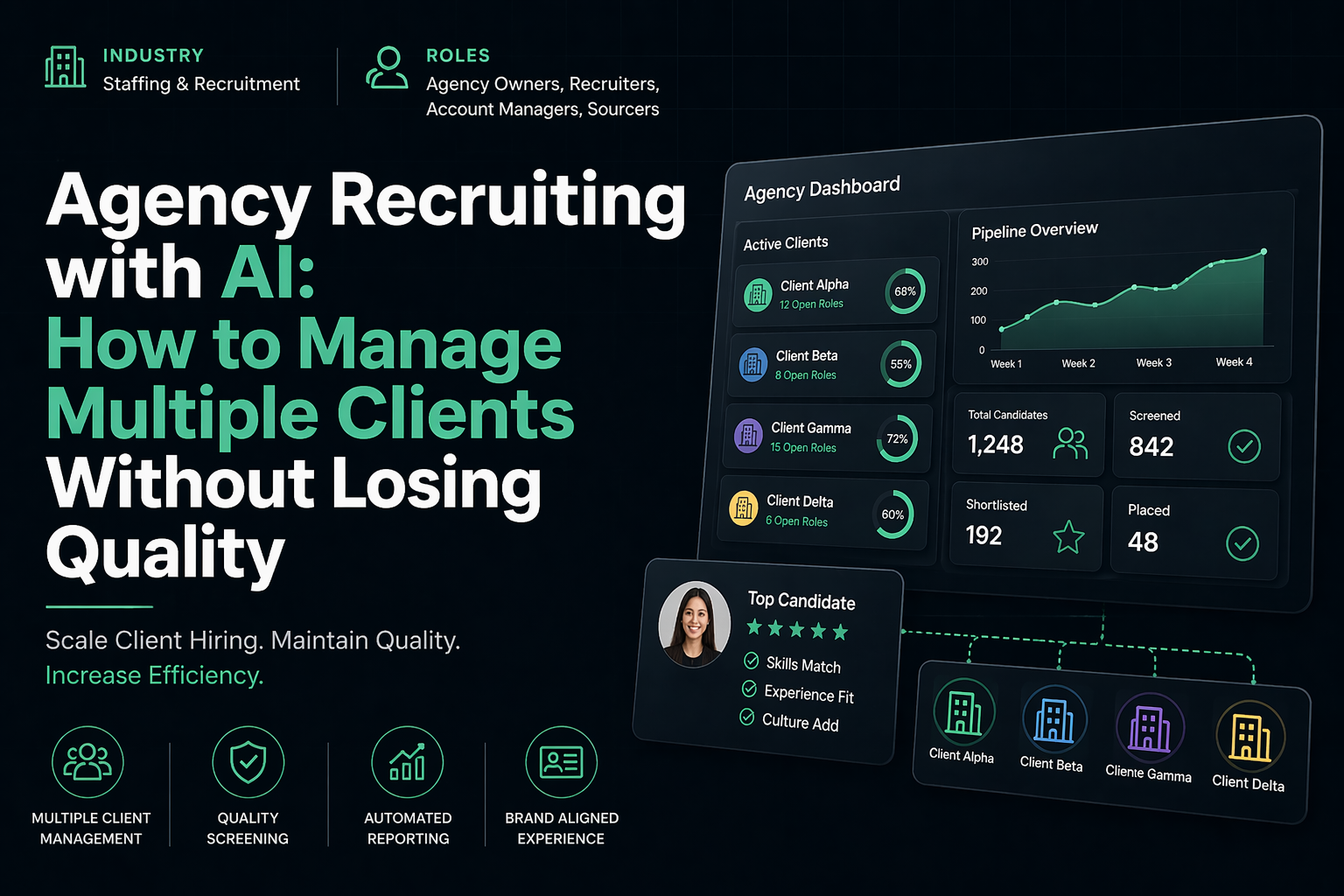
What Is an AI Recruiting Agency
An AI recruiting agency is a staffing or recruitment business that uses artificial intelligence to automate and improve the way it screens, evaluates, and shortlists candidates across multiple client accounts simultaneously. Instead of relying on manual CV reviews and unstructured phone screens, AI recruiting agencies use structured assessment tools to verify real candidate capability at scale.
An AI recruiting agency uses intelligent screening and assessment technology to manage high-volume candidate pipelines across multiple clients — replacing manual shortlisting with structured, repeatable evaluations that produce faster shortlists, better-matched candidates, and measurable outcomes for every client engagement.
This is different from simply using an applicant tracking system. Most ATSs help you organise candidates. AI recruiting changes what you actually know about each candidate before they speak to a human. That distinction matters enormously when managing ten clients simultaneously and trying to maintain quality across all of them.
The agencies building serious competitive advantage right now are not just moving faster. They are producing outputs — candidate briefs, scoring rationale, capability assessments — that their clients could not generate themselves. That is a fundamentally different value proposition than the traditional agency model.
Why Agency Recruiting Is More Complex Than In-House
In-house talent teams recruit for one organisation. They know the culture intimately. They know which hiring managers are demanding and which are flexible. Agency recruiters do not have the luxury of that depth. They are expected to understand multiple organisations, multiple cultures, multiple technical domains, and multiple sets of stakeholder expectations — often at the same time.
This is not just a capacity problem. It is a context-switching problem. Every time you shift from a fintech client needing a compliance lead to a SaaS client hiring their first data scientist, you are rebuilding your mental model of what good looks like. Do that twenty times a week and quality inevitably starts to slip at the edges.
The Multi-Client Operational Reality
When you are running multiple client accounts, you are managing multiple distinct requirements simultaneously. Different seniority levels, different technical stacks, different interview processes, different communication expectations. A shortlist that would impress one client might be immediately rejected by another based on criteria that were never fully articulated during the brief.
The Scaling Challenge
When an agency needs to scale, every new client adds complexity without adding capacity in proportion. You cannot hire one more recruiter per client — the economics do not work. What agencies actually need is a way to extend the reach and consistency of each recruiter across more clients without quality falling off. AI is structurally the answer to that problem — but only if implemented with the specific realities of agency work in mind.
The Three Core Problems Agencies Face
Every agency recruiter identifies variations of the same three operational headaches. They look different on the surface depending on sector and agency size, but the root causes are consistent.
Problem 1: Multiple Screening Criteria Across Clients
Every client has different requirements — not just role requirements but assessment requirements. One client wants candidates pre-screened on specific tooling experience. Another weights communication ability above technical depth. A third has a competency framework they expect reflected in every shortlist. Most screening tools are built around a single evaluation model, forcing agency recruiters into a compromise: apply a generic framework that fits nobody precisely, or spend hours rebuilding screening criteria from scratch for each new role.
Generic screening is the silent killer of agency quality. When every candidate is assessed against the same broad criteria regardless of client or role, shortlists start to look the same. Clients notice, stop trusting the shortlists, and start doing their own additional screening — eroding your value proposition without anyone explicitly acknowledging why.
Problem 2: Candidate Data Complexity
Agencies sit on enormous amounts of candidate data. A firm operating for five years might have tens of thousands of candidate profiles. Very few have been assessed in a structured way that makes data genuinely searchable and useful. Agency recruiters default to new sourcing for every role even when the right candidate might already be in their database. AI can fix this — but only if the underlying data is clean and assessment outputs are structured enough to be compared across candidates and roles.
Problem 3: Client Trust and Transparency
Clients who cannot see how candidates were evaluated have no basis for trusting the shortlist beyond the agency's reputation. When a shortlisted candidate underperforms, the client has no insight into what screening process produced them. The agency relationship becomes a black box — and black boxes erode trust over time. The agencies building durable client relationships show their working. Not just a ranked list of candidates but documented rationale for each shortlist decision.
How AI Changes the Agency Model
The shift from manual screening to AI-assisted evaluation is not just an efficiency improvement. It is a repositioning of what agencies actually sell. The traditional value proposition is access and relationships — knowing candidates you cannot find elsewhere. That was genuinely scarce value for a long time. It is becoming less so as LinkedIn, direct sourcing tools, and employee referral programmes mature.
The new agency value proposition is not access to candidates. It is certainty about candidates. Knowing not just who is available but who is actually capable — and being able to prove it.
AI enables this shift by creating a consistent, documented evaluation layer between sourcing and presentation. The candidate who makes your shortlist has been assessed, not just screened. Their capability summary is based on structured evaluation outputs, not a recruiter's instinct from a 15-minute phone call.
Repositioning Agency Value
Agencies that implement AI well stop competing on volume and start competing on quality. They send fewer candidates per role — but those candidates are right more often. The recruiter becomes a talent adviser rather than a CV forwarder, commanding better fees and more durable client relationships.
Thought Leadership as Differentiation
AI-generated assessment data gives agencies structured market intelligence. When you have assessed hundreds of candidates against consistent criteria over time, you can see patterns — what skills are overrepresented, where expectations and availability are misaligned, what salary ranges are producing the best candidate quality. That data is genuinely valuable and it is an output pure access-and-relationship agencies cannot produce.
Value based on recruiter relationships and network access
Shortlists based on CV review and informal phone screen
Client reporting limited to pipeline counts and stage updates
Screening criteria rebuilt informally for each new role
Candidate reuse rare because data is unstructured
Placement quality defended anecdotally not evidentially
Value based on structured assessment and verified capability
Shortlists backed by documented evaluation rationale
Client reporting includes capability data and prediction metrics
Assessment frameworks configured once and reused systematically
Candidate data structured and searchable across roles
Placement quality tracked and improved through feedback loops
Managing Multiple Client Screening Without Losing Quality
The question is not whether AI can screen candidates — it clearly can. The question is whether it can screen them differently enough across clients to reflect the real differences in what each client needs. The answer is yes, but it requires intentional setup.
Client-Specific Screening Configurations
Good AI recruiting platforms allow you to build assessment configurations specific to each client or role type. This goes beyond changing a few questions. It means defining the evaluation dimensions that matter for this client, the weighting between technical depth and communication quality, the scenarios most predictive for their specific operating environment, and the follow-up probes that surface the signals their hiring managers care about most.
Done well, a client-specific configuration produces a fundamentally different screening experience for the candidate and a fundamentally different output for the hiring manager. Two candidates who would score similarly on a generic assessment might rank very differently when evaluated against a client-specific framework — and that difference is often exactly the signal the client needs.
Building Assessment Template Libraries
The practical way to manage this across multiple clients is to build a library of assessment templates organised by role type, seniority level, and sector. Start with a base template for a given role category and overlay client-specific customisations on top. Over time, this library becomes one of the most valuable assets your agency owns — the accumulated knowledge of what good looks like across dozens of clients and hundreds of placements.
What a Good Template Library Looks Like
- Role-type base templates covering the most common categories your agency fills — with core competency dimensions pre-defined and scenario banks ready to deploy.
- Client overlay files documenting the customisations applied for specific clients — weighting preferences, role-specific technical requirements, and notes from calibration conversations.
- Outcome tagging linking each template version to placement outcomes over time, so you can see which configurations produce the best 90-day performance matches.
- Calibration logs recording feedback from hiring managers after each shortlist — what they accepted, rejected, and why — so the framework improves continuously.
Calibrating With Clients
The setup conversation with a new client is where most agencies miss an opportunity. The standard brief covers role requirements and salary range. A calibration conversation for an AI-assisted process goes deeper — covering what good judgment looks like in this team, what failure modes the client has seen in previous hires, and which signals in a candidate's experience are genuinely predictive versus superficially reassuring.
Candidate Data Management Across Clients
One of the biggest untapped assets in most agencies is their existing candidate database. The candidates are there. The problem is that the data describing them is unstructured, inconsistently captured, and largely unsearchable. AI assessment changes this because structured evaluation outputs create genuinely useful candidate data — data that can be searched, compared, and reused across roles and clients.
Candidate Reuse as a Competitive Advantage
When every candidate who passes through your screening process has a structured capability summary attached to their profile, your database stops being a contact list and starts being an intelligence asset. A candidate assessed for a senior product manager role six months ago and ranked highly on strategic thinking is probably also relevant for a head of product opening that just came in. You can find them immediately and reach out with a warm, specific pitch rather than a cold generic message.
Data Separation Between Clients
Reuse has to be balanced with appropriate data governance. Candidates assessed under one client's configuration have implicitly consented to be evaluated for that client's roles. Using their detailed assessment outputs in a shortlist for a different client — particularly a competitor — is both ethically problematic and a reputational risk. Treat the candidate's basic profile data as reusable with their consent, and the assessment output from a specific engagement as confidential to that client relationship.
Privacy and Compliance
Depending on your jurisdiction, regulatory requirements govern how long you can hold candidate data, what you must disclose about your assessment process, and what rights candidates have to access or delete their information. GDPR in the UK and EU is the most comprehensive framework, but similar obligations exist elsewhere. AI assessment tools that produce structured evaluation data are subject to these rules in the same way as any other data processing activity.
Build your data governance policies before you scale your AI screening process, not after. Retrofitting privacy compliance onto a large candidate database is significantly harder and more expensive than building the right policies into your workflow from the start.
Automating Client Reporting
Most agency client reporting is pipeline-focused — CVs reviewed, phone screens completed, shortlist count, current stage per candidate. This is activity reporting, not performance reporting. It tells the client what you have done, not how well the process is working. AI-assisted processes generate data that makes genuinely useful reporting possible for the first time. Because every candidate has been assessed against consistent criteria, you can report on capability distribution across your pipeline, not just headcount.
| Metric | What It Measures | Why It Matters to Clients |
|---|---|---|
| Time to Shortlist | Days from role briefing to qualified shortlist delivered | Directly impacts how quickly clients can move to interview and offer — slow shortlists lose candidates in competitive markets |
| Assessment Completion Rate | Percentage of invited candidates who complete AI evaluation | Low completion signals poor candidate experience or over-long assessment — both damage your agency brand |
| Shortlist Acceptance Rate | Percentage of shortlisted candidates the client progresses to interview | The clearest signal of shortlist quality — routinely rejected shortlists mean screening criteria are misaligned |
| Interview-to-Offer Ratio | How many interviews the client conducts per offer made | High ratios indicate the screening is not filtering accurately enough |
| 90-Day Performance Match | Hiring manager rating of placed candidate at 90 days vs expectation | The ultimate measure of placement quality — builds the evidence base for your agency's predictive accuracy |
| Candidate NPS | Net Promoter Score from candidates who went through the assessment | Candidate experience is your brand in the market — agencies that treat candidates well attract better candidates |
| Repeat Client Rate | Percentage of clients who return with additional roles within 12 months | The downstream result of everything else working well — the most reliable indicator of client value creation |
Reporting cadence matters too. Weekly pipeline updates keep clients informed but do not move the conversation. Monthly performance reviews that use the metrics above to assess whether the engagement is working build the kind of strategic partnership that makes clients reluctant to work with anyone else.
White-Labelling AI for Clients
Most clients know AI is being used in recruiting. What they do not always know is what it is doing, who is running it, and whether it is working in their interest. White-labelling your AI screening tools — presenting them under your agency's brand rather than a third-party vendor's — addresses all three concerns simultaneously.
Why Branding Matters in AI Screening
When a candidate receives an assessment invitation from your agency rather than an unbranded third-party platform, it signals that your agency takes quality seriously. More practically, white-labelled assessments increase completion rates. Candidates are more likely to engage seriously with an assessment from a named, branded source than one that looks like generic software with a logo attached. Higher completion rates mean better data. Better data means better shortlists. The quality improvement compounds from the first touchpoint.
Configuration and Setup
White-labelling involves more than adding your logo. It means controlling the candidate communication sequence, the language and tone of assessment instructions, the scenarios presented, follow-up messaging, and the format in which outputs are delivered to clients. Done well, the candidate experience feels like an extension of your agency brand — not a detour into a third-party tool.
Positioning as a Premium Offering
White-labelled AI screening is also a pricing lever. Agencies that present a branded, structured assessment process — with documented methodology, consistent evaluation criteria, and performance tracking — have a credible basis for charging premium fees. The service they are offering is materially different from a keyword-matched shortlist, and pricing should reflect that.
The best way to introduce white-labelled AI screening to an existing client is not to announce a product feature — it is to show them a better output. A structured candidate brief with documented evaluation rationale speaks for itself. The technology behind it is a detail. The quality it produces is the story.
Building a Scalable AI Recruiting Agency
Scalability in agency recruiting is not just about adding tools. It is about building systems that allow each recruiter to operate effectively across more clients without the quality of any individual engagement deteriorating. That requires thinking about three interconnected elements: the systems you use, the workflows that connect them, and the team structure that operates them.
Systems Architecture
The core system stack for a scalable AI recruiting agency needs to cover assessment, candidate data management, client communication, and reporting. Assessment outputs should automatically populate candidate profiles. Shortlist decisions should trigger client communication sequences. Placement data should feed back into performance reporting. The goal is a system where the recruiter is spending time on judgment and relationship work — not on moving data between tools.
Workflow Design
Standardised workflows are the mechanism by which a scaling agency maintains quality. When every new client intake follows the same calibration process, every role uses the same template library as a starting point, and every shortlist is delivered in the same structured format, quality becomes a property of the system rather than a property of the individual recruiter.
Structured briefing session capturing role requirements, assessment weighting preferences, and historical failure modes. Outputs a client configuration file for the assessment platform.
Candidate sourcing using the client configuration as a filter for initial targeting. Personalised outreach that sets expectations and improves completion rates.
Candidates complete structured evaluation using the client-specific configuration. Assessment runs asynchronously. Outputs are scored and ranked automatically.
Recruiter reviews AI outputs, applies contextual judgment, and builds a shortlist with documented rationale for each included and excluded candidate.
Structured shortlist delivered in branded format with capability summaries, assessment scores, and recruiter commentary for each candidate.
Post-shortlist feedback captured from client. Assessment configuration updated based on what was accepted and rejected. Performance data collected at 90 days and fed back into the template library.
Team Structure
AI changes how you should think about team roles. The traditional model has junior recruiters doing CV screening and senior recruiters doing relationship management and closing. AI takes over the screening function — which means junior recruiters can operate at a higher level earlier, and senior recruiters can manage more clients with greater confidence in pipeline quality. The new AI-assisted agency typically has a configuration and quality function — someone responsible for maintaining the template library, calibrating assessment frameworks, and tracking performance data — alongside the traditional sourcing and relationship management roles.
Metrics That Matter for Agencies
Most agency metrics dashboards are built around activity — candidates sourced, screened, shortlisted. Activity metrics are necessary but not sufficient. The metrics that actually tell you whether your AI-assisted process is working are outcome metrics.
| Metric | How to Measure | Target Range | What It Tells You |
|---|---|---|---|
| Time to Shortlist | Days from signed brief to shortlist delivered | Under 5 working days | Whether AI screening is actually compressing the timeline |
| Fill Rate | Percentage of accepted roles that result in a placement | Above 70% | Whether you are taking on roles you can actually fill |
| Client Satisfaction Score | Post-placement survey at 30 and 90 days | Above 8.5 / 10 | Whether placed candidates are meeting expectations |
| Candidate Reuse Rate | Percentage of shortlisted candidates sourced from existing database | Above 25% | Whether your structured candidate data is actually being used |
| Shortlist Acceptance Rate | Percentage of shortlisted candidates progressed to interview | Above 65% | The most direct measure of shortlist quality |
| Recruiter Capacity | Active roles per recruiter at any point | 10–15 with AI vs 5–7 without | Whether AI is actually extending capacity |
The most important thing about these metrics is building the feedback loop between them. Time to shortlist and fill rate tell you about process efficiency. Client satisfaction and candidate reuse rate tell you about quality and system health. Together they give you a picture of whether your AI-assisted process is actually working — or just appearing to work until something breaks.
Tools for AI Recruiting Agencies
The tooling landscape for AI recruiting has matured considerably. The challenge is not finding tools — it is understanding which category each tool belongs to, what it actually does well, and where the gaps are that another tool needs to fill.
AI Candidate Assessment Platforms
Conduct structured, scenario-based candidate evaluations at scale. Best platforms allow role-specific configuration and produce documented evaluation outputs rather than just scores.
Best for: Replacing unstructured phone screens and initial CV review.
Watch out for: Platforms that cannot be configured per clientApplicant Tracking Systems
Manage candidate pipelines, stage progression, and communication sequences. The best agency ATSs handle multi-client structures natively — not all of them do.
Best for: Organising candidate flow and maintaining compliance audit trails.
Watch out for: ATSs built for in-house teams with broken multi-client data modelsClient Relationship Management
Track client relationships, role history, and engagement patterns. Ideally integrates with your ATS so candidate placement data flows into client records automatically.
Best for: Managing retainer relationships and tracking client satisfaction over time.
Watch out for: General-purpose CRMs without recruitment-specific fieldsAnalytics and Performance Dashboards
Aggregate data from your assessment and ATS tools into readable performance views for internal teams and client-facing reporting.
Best for: Building the client reporting layer that separates your agency from competitors.
Watch out for: Dashboards that report on activity rather than outcomesThe most important integration in this stack is between your assessment platform and your ATS. Assessment outputs need to live alongside candidate profiles — not in a separate system that requires manual copy-paste to include in a shortlist.
Common Mistakes Agencies Make
The agencies that struggle with AI adoption are not usually struggling because the technology does not work. They are struggling because of specific, avoidable mistakes in how they implement and operate it.
- MISTAKEGeneric screening across all clients. The single most common and most damaging mistake. Using the same assessment configuration for every role regardless of client, sector, or seniority level. This produces superficially efficient screening that actually degrades shortlist quality by treating fundamentally different requirements as equivalent. Clients sense this quickly even if they cannot articulate why.
- MISTAKEPoor data hygiene in candidate profiles. Bringing AI assessment tools into an existing agency without cleaning and structuring the underlying candidate data first. If the base data is a mix of old CVs, inconsistent note formats, and outdated contact details, the structured assessment data will not produce the searchable, reusable asset you need. Clean the database before you try to build intelligence on top of it.
- MISTAKEOver-automating the human relationship layer. AI handles the screening function. It does not handle the relationship function. Agencies that automate candidate communication to the point where no human is involved before the shortlist stage produce candidates who feel processed rather than represented. The automation should be invisible. The human touch should be unmistakeable.
- MISTAKENo feedback loop from placements to assessment configuration. Implementing AI screening without tracking whether the placements it produces are actually performing. If you do not know how your shortlisted candidates are doing at 90 days and 12 months, you cannot improve the assessment frameworks that produced them.
- MISTAKEUnder-investing in the calibration conversation. Treating the client brief as a form to fill rather than a configuration session. The quality of your AI screening output is directly proportional to the quality of the input it is configured against. A lazy brief produces a mediocre shortlist at scale.
The agencies that fail with AI recruiting typically do not fail because the technology is bad. They fail because they implement it on top of broken processes. AI amplifies what is already there. Fix the process first. Then automate it.
Key Takeaway
Running a recruitment agency with AI is not about replacing recruiters with software. It is about giving recruiters the structured evaluation layer they have never had — so they can manage more clients, produce better shortlists, and build the kind of evidential track record that turns clients into long-term partners rather than one-off engagements.
The agencies winning right now have made three commitments: they configure AI tools specifically for each client rather than running generic screening across everything, they treat candidate data as a structured asset that improves over time rather than an unmanageable archive, and they use the outputs to build reporting and thought leadership that their clients cannot get anywhere else.
The ones still manually reviewing CVs and running unstructured phone screens are not just slower — they are producing a structurally inferior product and the market is beginning to notice. Start with the calibration process. Get the template library right. Build the feedback loop. Everything else follows from those three foundations.
Ready to Build a Smarter Recruiting Agency?
NinjaHire gives your agency the AI screening infrastructure to manage multiple clients, produce structured shortlists, and track placement performance — all under your brand.
Try for Free →
.jpg)
.png)
