.png)
How to assess culture fit without bias using AI

March 15, 2026
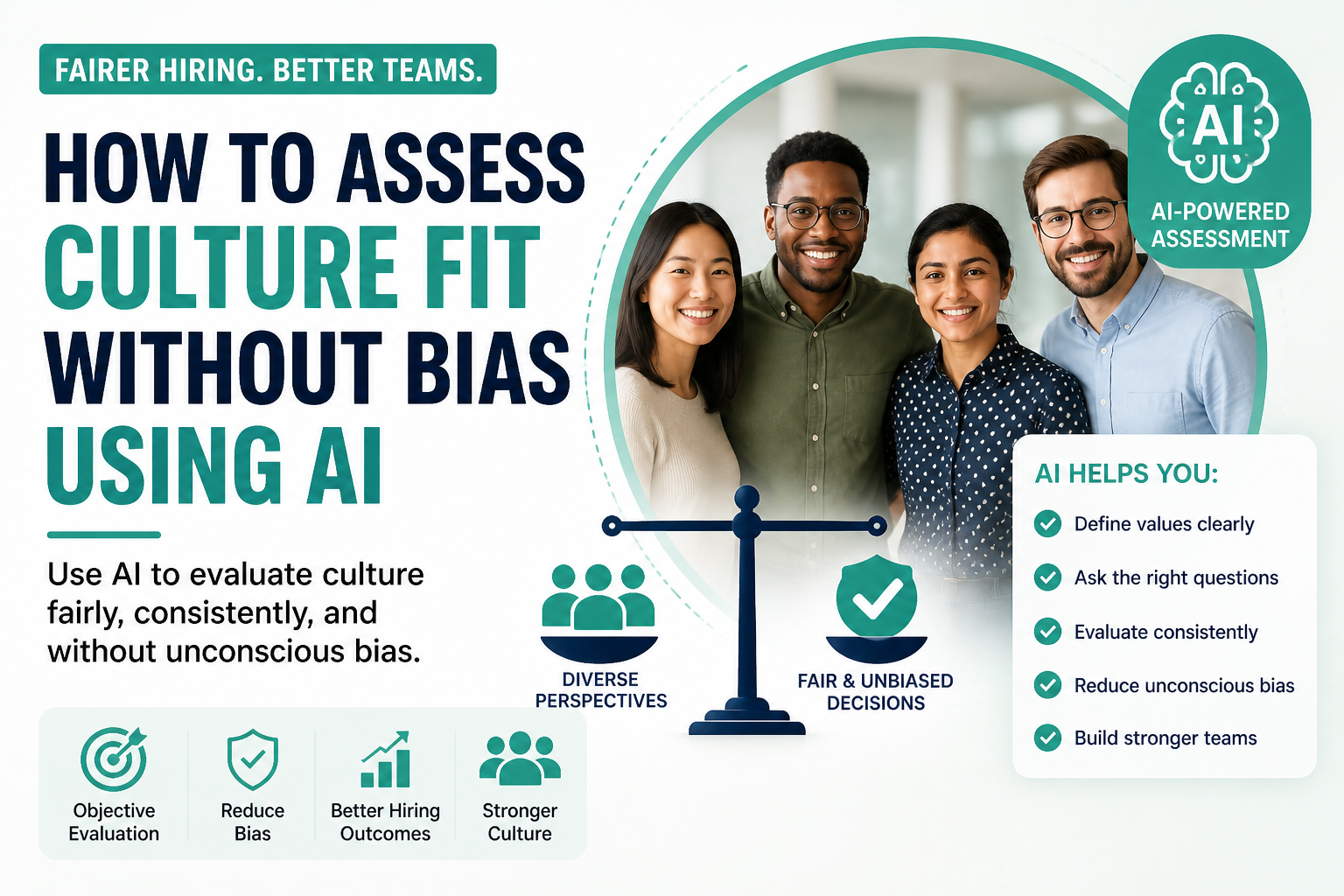
How to Assess Culture Fit Without Bias Using AI
Culture fit is one of the most commonly cited reasons for rejecting a candidate — and one of the least examined. When a hiring manager says someone "just didn't feel like a fit," they're often describing something real. They're just not describing it accurately, consistently, or fairly. The judgment is real. The method isn't. And that gap between intuition and rigor is where some of the most consequential hiring bias lives.
The question worth asking isn't whether culture fit matters — it does. Teams that share values, communication norms, and ways of working together do perform differently than teams that don't. The question is whether the way most organizations assess culture fit actually measures those things, or whether it measures something else entirely — familiarity, shared background, similar communication style, or simply whether the interviewer liked the person. Those are not the same thing. And the consequences of conflating them aren't just bad hires. They're discriminatory patterns that compound across hiring cycles and are increasingly scrutinized by regulators.
AI-assisted hiring offers a way through this problem — not by removing human judgment from the equation, but by structuring evaluation in ways that separate genuine value alignment from affinity bias. This guide covers what that looks like in practice.
Why culture fit assessments are structurally biased
The bias in culture fit evaluation isn't usually intentional. It's architectural. When you ask someone to assess whether a candidate is "a culture fit" without giving them a defined rubric, a set of observable behaviors, or a structured scoring framework, you're asking them to answer an ambiguous question using whatever heuristic is most available. And the most available heuristic is almost always affinity — do I like this person? Do they remind me of people who've succeeded here? Would I want to work with them?
Affinity bias is the tendency to favor people who are similar to ourselves. It's well-documented, well-studied, and almost automatic in unstructured evaluation contexts. It operates across gender, race, educational background, class markers, speech patterns, communication style, and dozens of other dimensions that have nothing to do with whether someone shares the values and working norms that actually predict team performance.
The resulting hiring patterns are measurable. Research on hiring outcomes consistently shows that "culture fit" rejections correlate with demographic homogeneity — teams that hire heavily on unstructured culture fit tend to reproduce their existing demographic composition regardless of the stated intent of the hiring process. The legal exposure this creates is real. Disparate impact theory under Title VII doesn't require intent. If a selection criterion produces adverse impact on a protected class and cannot be shown to be job-related and consistent with business necessity, it's legally vulnerable — regardless of how genuinely the hiring team believed in it.
The compounding problem is that unstructured culture fit evaluation is invisible to audits. Unlike a cognitive test or a structured competency question, a vibe-based culture fit judgment leaves no paper trail. There's no scoring rubric to scrutinize, no inter-rater reliability to measure, no validation study to review. It's bias with no accountability surface.
Why traditional culture fit interviews fail
The standard culture fit interview — typically a 30-minute conversation between a candidate and a team member that isn't the hiring manager — fails for several interlocking reasons that don't get better with interviewer experience. In fact, more experienced interviewers are sometimes worse at unstructured culture evaluation because they've had more time to develop confident but unexamined biases.
The first failure is definitional. Most organizations don't have a written, operationalized definition of what their culture actually is in terms of observable behaviors. They have values statements — "we value collaboration," "we move fast," "we're customer-obsessed" — but those statements don't translate into evaluation criteria. Two interviewers assessing the same candidate against "we value collaboration" will apply entirely different standards because the term means different things to different people.
The second failure is structural. Culture fit interviews are usually unstructured — the interviewer decides what to ask, how to probe, and how to weight responses in real time. Unstructured interviews have consistently lower predictive validity than structured ones across decades of IO psychology research. They're also more susceptible to bias precisely because the lack of structure gives interviewers more latitude for subjective judgment.
The third failure is comparative. When interviewers assess culture fit, they're often benchmarking against existing high performers on the team. The problem is that existing high performers were themselves selected through the same biased process. Benchmarking against a homogeneous reference group reproduces that homogeneity. The culture fit bar isn't neutral — it's shaped by whoever made it through the process before.
Culture fit vs. culture add: why the distinction matters
The shift from "culture fit" to "culture add" isn't just semantic rebranding — it reflects a genuinely different theory of what high-performing teams need. Culture fit asks whether a candidate matches the existing team. Culture add asks whether a candidate contributes something the existing team doesn't yet have while still sharing the core values that make the team functional.
| Dimension | Culture Fit | Culture Add |
|---|---|---|
| Core question | Does this person match who we already are? | Does this person share our values and bring something new? |
| Bias risk | High — rewards sameness and familiarity | Lower — rewards value alignment and contribution |
| Team outcome | Homogeneity, groupthink risk | Diversity of thought, stronger problem-solving |
| Evaluation method | Gut feel, informal conversation | Structured behavioral questions, defined values rubric |
| Legal defensibility | Low — no documented criteria | Higher — criteria tied to observable behaviors |
| Predictive validity | Low to moderate | Moderate to high when structured |
| What gets rewarded | Similarity to existing team | Alignment to defined values + unique perspective |
Operationalizing the culture add frame requires defining your non-negotiable values in behavioral terms — what does "we value ownership" look like as observable actions a candidate has taken or would take in specific scenarios? — and separately identifying where diversity of perspective, experience, or approach would strengthen the team. Those are two different assessments, and keeping them distinct in your process prevents the second from collapsing back into the first.
How AI reduces bias in culture fit assessment
AI doesn't eliminate bias from hiring. That claim is both overstated by vendors and rightly criticized by skeptics. What well-implemented AI does is restructure the evaluation context in ways that make specific, documented forms of bias less likely to operate unchecked.
The primary way AI reduces bias in culture fit assessment is through standardization. When every candidate is asked the same questions in the same order under the same conditions, the variation in evaluation inputs is reduced. Interviewers can't ask warmer follow-up questions to candidates they like. The conversation can't drift toward shared interests that have nothing to do with the role. The evaluation surface is controlled.
The second mechanism is structured scoring. AI-assisted evaluation platforms score responses against predefined rubrics derived from behavioral anchors. The rubric is the same for every candidate. An answer that demonstrates the ownership value is scored against the ownership rubric regardless of who gave the answer. This doesn't eliminate subjective judgment — human raters still apply the rubric — but it constrains judgment to the relevant dimensions and makes the basis for scoring visible and auditable.
The third mechanism is pattern detection. At scale, AI systems can identify whether scoring patterns correlate with characteristics that shouldn't affect scores — candidate name, apparent gender, accent, or communication style proxies. This type of audit is nearly impossible to conduct manually but straightforward to run algorithmically across large evaluation datasets.
The fourth mechanism is documentation. Every AI-assisted evaluation produces a record: what was asked, what was said, how it was scored, and against what criteria. That documentation trail is the foundation for both internal quality improvement and external compliance defense. Gut-feel culture fit judgments produce none of this.
What AI can actually measure in a culture assessment
Values alignment through behavioral evidence
When candidates are asked structured behavioral questions tied to specific values, their answers provide evidence of past behavior that reflects values in action. AI can analyze those answers for behavioral indicators: did the candidate describe taking ownership or deferring responsibility? Did they describe seeking input or acting unilaterally? These patterns, scored against consistent rubrics, produce values alignment signals that are more reliable than general impressions.
Communication style and clarity
AI can assess how clearly and coherently a candidate structures their thinking in response to open-ended questions — use of specific examples versus vague generalities, ability to calibrate detail level to the question. These are observable, measurable dimensions that reflect communication norms relevant to team fit, assessed consistently across all candidates rather than judged more favorably when they resemble the interviewer's own style.
Response consistency across questions
A candidate who describes a highly collaborative approach to conflict in one answer and a highly directive approach in another is showing something worth examining. AI can flag these patterns across a full interview in ways that a human interviewer conducting a 30-minute conversation often can't, particularly when evaluating multiple candidates across a hiring cycle.
Engagement signals and question handling
How candidates engage with ambiguous questions, how they respond to follow-up probes, and whether they ask clarifying questions before answering are all observable behaviors that reflect working style norms — assessable and scored consistently without requiring global personality judgments.
What AI cannot measure — and why human judgment still belongs
- Genuine value coherence: AI can identify behavioral patterns that correlate with stated values, but it cannot reliably distinguish between a candidate who genuinely holds those values and one who has learned to give the right answers.
- Team-specific interpersonal dynamics: How a candidate will function within a specific team — their humor, emotional register, how they handle friction with particular personality types — is not something AI can assess from an interview.
- Long-term cultural evolution: Whether a candidate's values will continue to align as the culture shifts is a judgment that requires organizational context and human foresight that AI doesn't have.
- Edge-case motivation and purpose: Why someone wants to work at your specific organization, what they're running toward rather than away from, and whether that motivation is durable — these require skilled human probing that current AI cannot replicate.
The right architecture uses AI where it adds structure and consistency, and preserves human judgment for the dimensions where structure and consistency are insufficient.
A step-by-step framework to assess culture fit without bias
Step 1: Define your culture in observable behavioral terms
Before any candidate evaluation happens, your organization needs a written, operationalized culture definition — not values statements, but behavioral anchors. For each value, write three to five specific behaviors that would demonstrate that value in a work context, and three to five that would contradict it. This becomes your scoring rubric.
Step 2: Separate values assessment from skills assessment
Values and skills are both important and both predictive of outcomes, but they're different things and should be assessed separately. When mixed in a single interview, skills performance influences values perception via halo effect. Keep them in separate evaluation stages with separate scorers where possible.
Step 3: Build a structured values question bank
Write a validated set of behavioral questions for each value following the STAR structure and anchored to specific, observable past behavior. Hypothetical questions are easier to game and more susceptible to social desirability bias. Past behavior questions produce richer, more discriminating data.
Step 4: Deploy AI screening for initial values signal
Use your AI interview platform to deliver a consistent set of values questions to all candidates at a defined pipeline stage. The AI system ensures every candidate receives identical questions under identical conditions. Responses are scored against your behavioral rubrics, producing a consistent values alignment signal across the candidate pool.
Step 5: Apply human calibration on borderline cases
Design your process so that human reviewers engage with the full AI evaluation output — including confidence scores and flagged inconsistencies — rather than just a final score. Human review should focus on candidates where the AI signal is ambiguous or where high values scores and low skills scores create an interesting tension.
Step 6: Run a structured human culture interview for advancing candidates
For candidates advancing past AI screening, conduct a structured human culture interview using the same behavioral rubrics but with room for deeper probing. The interviewer should score candidates against each rubric before sharing assessments with other interviewers to prevent anchoring.
Step 7: Aggregate scores with documented weighting
Combine AI values scores and human evaluator scores using a predetermined weighting that you can document and defend. If values alignment carries 30% of the overall hiring decision weight, that should be written down before evaluations happen — not decided post-hoc.
Step 8: Audit for disparate impact quarterly
Run selection rate analysis on your culture fit scores segmented by any demographic proxies available in your data. If certain groups are advancing through AI culture screening at significantly lower rates than others, investigate whether the scoring rubric, question set, or transcription accuracy layer is introducing systematic error.
Real hiring scenario: what this looks like in practice
A 200-person SaaS company in the growth stage was hiring aggressively across sales, engineering, and customer success. Their culture fit process consisted of a 30-minute "team fit" conversation with a senior team member. Post-hire surveys and 90-day performance reviews consistently showed that culture fit scores from that conversation had almost no predictive validity — and the company's demographic diversity had declined through three hiring cycles.
They rebuilt the process using the framework above. First, they ran a behavioral anchoring workshop to define their four core values — ownership, directness, learning orientation, and customer empathy — in observable behavioral terms. Each value got five "looks like" behaviors and three "doesn't look like" behaviors. Second, they built a question bank of twelve behavioral questions, three per value. Third, they deployed AI video screening using those twelve questions as a consistent screen for all candidates past resume review.
Results after two hiring cycles: inter-rater reliability on culture scores improved from 0.41 to 0.74. Demographic representation in the hiring pipeline stopped declining and began improving. When they ran an adverse impact audit on the AI screening scores, they found one values dimension — "directness" — was producing slightly lower scores for candidates who communicated in more indirect, high-context styles. They revised the behavioral anchor for that dimension to separate direct communication style from clear communication of position, which addressed the issue.
Bias testing and compliance: the EEOC angle
Organizations using AI in hiring decisions are operating in an increasingly active regulatory environment. The EEOC's guidance emphasizes that employers are responsible for adverse impact produced by third-party tools used in their hiring process — the fact that the tool is provided by a vendor doesn't transfer legal responsibility.
The specific compliance obligations for AI-assisted culture assessment include:
- Selection rate monitoring: Track advancement rates through your culture assessment stage by race, gender, and other available proxies. Flag disparities above 4/5ths rule thresholds for investigation.
- Validation documentation: Document the job-relatedness of each value assessed. "We value directness" is not a validation. A correlation between directness scores and performance ratings is closer to one.
- Vendor audit rights: Ensure your AI platform contract gives you access to accuracy and bias audit data for your specific candidate population.
- Disclosure requirements: In jurisdictions with AI hiring disclosure requirements (Illinois, New York City, EU member states), ensure candidate communications describe how AI is used in evaluation.
- Adverse impact remediation plan: Document what you will do if your quarterly audit finds an adverse impact signal before you need to act on it.
Common mistakes that undermine unbiased culture assessment
- Deploying AI without defining the rubric first: AI structure without a validated scoring rubric just automates inconsistency. The technology is only as unbiased as the criteria it scores against.
- Treating AI scores as final answers: AI culture scores are signals, not verdicts. They're most useful as a consistent first-pass filter, with human judgment engaged for the middle ground.
- Benchmarking against current employees without auditing for bias: Using current high performers as the reference standard bakes in whatever biases produced the current team.
- Conflating communication style with values: Directness, verbosity, storytelling style — these are communication preferences, not values. Rubrics that reward one communication style over another introduce bias against different cultural communication norms.
- Skipping inter-rater reliability validation: If multiple human evaluators are scoring culture fit using your rubric, you need to know whether they're applying it consistently. Low inter-rater reliability means your rubric isn't operational enough.
- Allowing post-hoc culture fit override: When a hiring committee overrides an AI culture score based on informal impressions formed during later interviews, they often reintroduce exactly the affinity bias the structured process was designed to remove.
Frequently asked questions
What is culture fit in hiring, and why is it controversial?
Culture fit in hiring refers to the alignment between a candidate's values, working style, and behaviors and those of the organization they're joining. It's controversial because in practice, culture fit assessments are frequently conducted without defined criteria, which means they default to affinity bias — evaluators favor candidates who remind them of themselves or existing team members. This produces discriminatory hiring patterns even when no discrimination is intended. The solution isn't to abandon culture fit assessment but to operationalize it with structured criteria, behavioral rubrics, and systematic bias testing.
Is culture fit assessment legal?
Culture fit assessment is legal when conducted using job-related, validated criteria that don't produce adverse impact on protected classes. It becomes legally problematic when used as a vague, unstructured criterion that produces disparate impact on protected groups without documented job-relatedness. Under EEOC guidance and the Uniform Guidelines on Employee Selection Procedures, any selection criterion that produces adverse impact must be validated as job-related and consistent with business necessity. Culture fit assessments based on gut feel rarely meet this standard. Structured assessments tied to observable, job-relevant behavioral criteria are substantially more defensible.
Can AI actually reduce hiring bias in culture assessment?
AI can reduce specific forms of bias — particularly evaluator-level affinity bias — by standardizing evaluation conditions, enforcing structured question delivery, and scoring responses against consistent rubrics. It does not eliminate bias: AI systems can encode bias through their training data, scoring criteria, or transcription accuracy disparities. The most accurate answer is that AI, well-implemented, shifts the bias profile of culture assessment from invisible, distributed evaluator-level bias toward more visible, auditable, and remediable systemic patterns. That's a meaningful improvement, but it requires deliberate design and ongoing audit rather than passive deployment.
What is the difference between culture fit and culture add?
Culture fit asks whether a candidate matches who the team already is. Culture add asks whether a candidate shares the team's core values while contributing something — perspective, experience, background, or approach — that the team doesn't yet have. Culture fit assessment tends to reproduce demographic homogeneity because it rewards similarity to the existing team. Culture add assessment, when operationalized well, can improve both team diversity and performance by explicitly valuing what candidates contribute that's new, alongside evaluating genuine values alignment.
How do I build a culture assessment rubric that isn't biased?
Start by defining your values in observable behavioral terms — what does each value look like as specific actions, and what does it look like when someone acts against that value? Validate your rubric by checking whether the behavioral anchors apply consistently across different communication styles and cultural backgrounds. Have a diverse group of evaluators apply the rubric to sample responses and measure inter-rater reliability. Test for adverse impact once you have evaluation data — if certain groups are scoring lower on specific dimensions, investigate whether the dimension is measuring a genuine values difference or a communication style difference.
What AI tools are best for assessing culture fit without bias?
The most important factor isn't which AI tool you use — it's how the tool is implemented. Any AI interview platform should be evaluated on: whether it allows you to define custom scoring rubrics tied to your specific values, whether it produces auditable scoring outputs rather than black-box recommendations, whether it provides accuracy and bias audit data for your specific candidate population, and whether the vendor has conducted third-party adverse impact testing. Platforms that offer configurable values rubrics and transparency into scoring logic are more suitable than those offering pre-built culture scoring models calibrated on generic datasets.
How often should we audit AI culture assessment for bias?
Quarterly audits are the minimum for organizations hiring at moderate volume. The audit should include selection rate analysis by available demographic proxies, inter-rater reliability measurement across human evaluators, and correlation analysis between culture scores and post-hire performance outcomes. For high-volume hiring (100+ roles per year), monthly monitoring of selection rates and a semi-annual deep audit is more appropriate. Bias patterns in automated systems can emerge gradually as candidate pool demographics shift or as the system encounters types of responses it wasn't originally calibrated on.
Build structured, unbiased culture assessments with AI — source, screen, and evaluate candidates fairly in one place.
Try for free
.jpg)
.png)
