Best AI Sourcing Software for Staffing Agencies in 2026

October 30, 2026
A practical comparison of AI sourcing platforms for staffing agencies, covering candidate discovery, ATS rediscovery, contact enrichment, outreach, screening, integrations and total cost.
Reviewed: October 2026. Product capabilities and pricing can change. Confirm the current package and connector scope with each vendor before purchase.
Quick answer: Which AI sourcing software should a staffing agency consider?
The best AI sourcing software for a staffing agency depends on the work it needs to complete. Some platforms focus on candidate search and matching, while others connect ATS rediscovery, contact enrichment, outreach and screening. Compare candidate relevance, existing database coverage, recruiter controls, integrations and total cost using the same live requisition before choosing a platform.
Publisher disclosure: Ninjahire publishes this guide and is one of the platforms compared. Vendor descriptions are identified as vendor-reported capabilities. They are not independent performance results. This is a desk-based comparison of public product information, pricing pages, integration documentation and review material, not a hands-on benchmark.
What Is AI Candidate Sourcing Software?
AI candidate sourcing software helps recruiters turn role requirements into candidate searches, identify relevant profiles and, depending on the platform, continue into contact enrichment, outreach or screening. For staffing agencies, the value is not simply finding more profiles. It is finding candidates who meet a client's requirements and moving suitable people into the next stage without losing recruiter oversight.
A useful buying question is not only who can find profiles. It is which steps the platform can execute for each requisition, what evidence it provides for a match, and where recruiters must review or approve the next action.
What happens between a requisition and a shortlist?
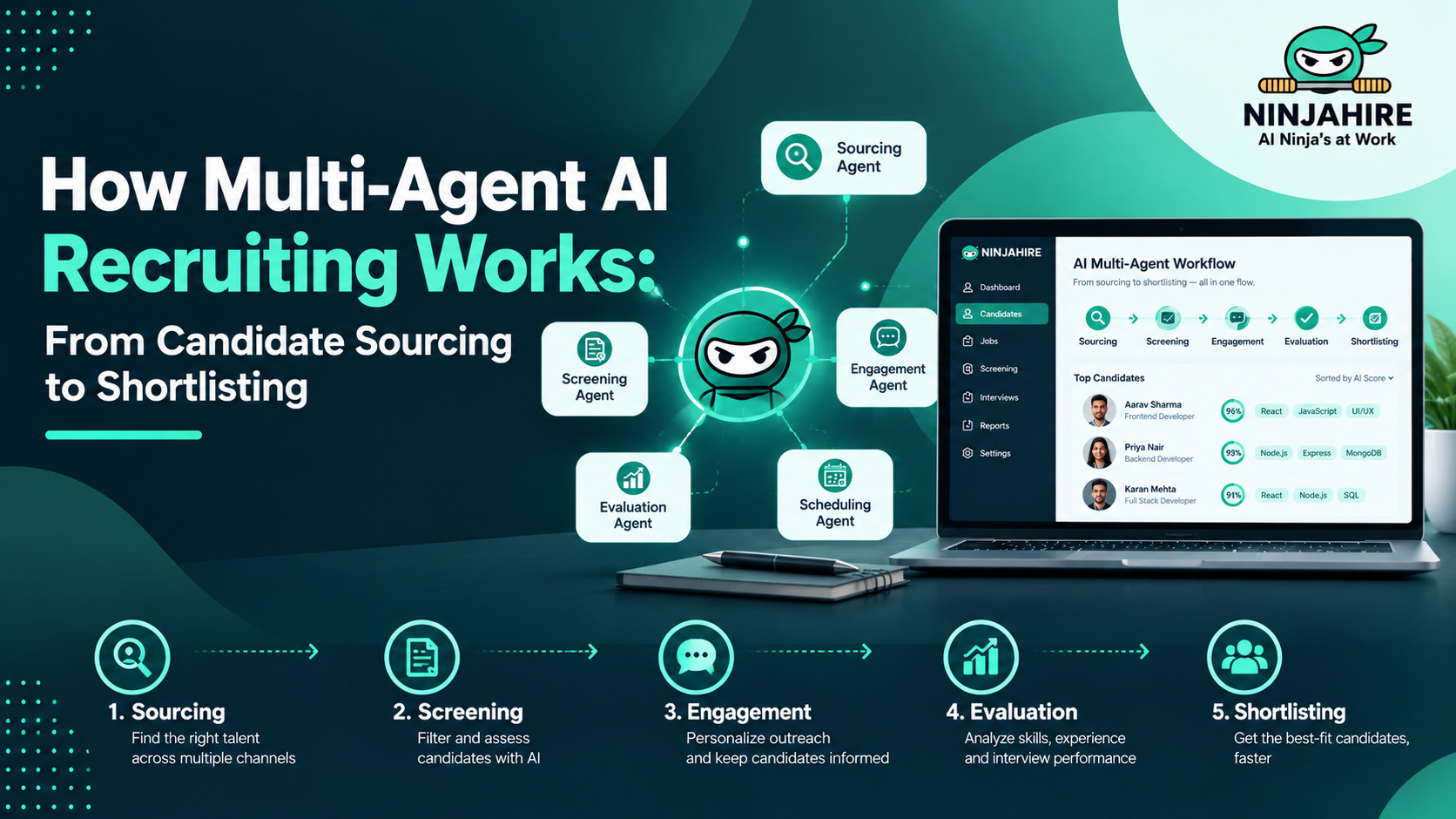
A typical AI candidate sourcing workflow starts with a job brief. The system translates the brief into search criteria, checks existing ATS or CRM records, searches additional talent sources, ranks potential matches and may help with contact discovery. Some products also draft outreach, run communication sequences, conduct initial screening or coordinate interviews.
Ninjahire describes a three-layer sourcing sequence: connected ATS and CRM records, its Ninjagraph professional-profile graph, and supported external job board channels. Access to specific sources, profile fields and contact enrichment depends on the customer's plan and integration configuration. See the Ninjahire AI candidate sourcing workflow for the vendor's current description.
Other products cover different combinations. Noon AI describes role calibration, conversational search refinement and scheduled outreach. Pin describes agent-led sourcing, profile evaluation, personalized outreach sequences and calendar coordination. These workflows should be tested individually rather than treated as interchangeable AI sourcing features.
Why staffing agencies need a different evaluation
Staffing firms manage multiple client requisitions, candidate ownership, changing availability, submission deadlines and different qualification rules. A sourcing platform that works for a single in-house hiring team may not automatically fit an agency managing several client pipelines or contract placements. The requirements become especially specific in AI recruiting workflows for contract staffing agencies, where availability, rate alignment and submission timing need to be checked alongside skills.
- Reuse before expansion: check whether the tool can search existing candidate relationships before buying more external profile access.
- Evidence before ranking: inspect why a candidate matches, which requirements are confirmed and which details need updating.
- Control before volume: test message approval, candidate declines, opt-outs and campaign stopping rules.
- Workflow fit before feature counts: confirm what the ATS integration transfers and which subscription includes it.
Best AI Sourcing Software for Staffing Agencies Compared
The platforms below offer different combinations of candidate discovery, database rediscovery, engagement and screening. The best fit depends on the agency's sourcing model and required workflow. This table is a use-case guide, not a performance ranking.
| Platform | Potential fit to evaluate | What buyers should verify |
|---|---|---|
| Ninjahire | Connected sourcing, ATS/CRM rediscovery, contact enrichment and screening workflow | Plan-specific source access, credits, integration scope and recruiter controls |
| Noon AI | Role calibration, search refinement and automated engagement | Connector availability, campaign controls, pricing terms and production scope |
| Pin | Agent-led sourcing, candidate engagement and calendar coordination | Sequence stop rules, ATS add-ons, match quality and billing basis |
| hireEZ | Open-web sourcing, ATS rediscovery and connected recruiting workflows | ATS permissions, workflow handoffs, included usage and current pricing |
| Juicebox | Natural-language talent search, sourcing agents and outreach | Search relevance, contact quality, connector synchronization and total cost |
The categories above are editorial descriptions based on published product information. They do not establish comparative candidate quality or guaranteed outcomes. Confirm the exact features available in the package being quoted.
How this comparison was prepared
Each platform is assessed against the same buying questions: sourcing coverage, ATS rediscovery, engagement, screening or scheduling, integration scope, pricing transparency and operating controls. Vendor claims are labelled as such. Independent reviews are treated as individual experiences rather than platform-wide failure rates or proof of performance. Where public information does not establish a feature or entitlement, the article says so instead of assuming it is included.
Types of AI Candidate Sourcing Software
AI sourcing software is not one uniform product category. A tool may help a recruiter search more effectively, prepare a shortlist, or execute several connected tasks. Understanding the difference helps agencies compare products on actual workflow coverage rather than marketing labels.
| Category | What it generally does | What to test |
|---|---|---|
| AI-assisted sourcing | Helps recruiters search, filter, match and rank profiles. | Search relevance, explainability, filters and recruiter corrections. |
| AI-curated shortlists | Surfaces a selected group of profiles against role criteria, usually for recruiter review. | Evidence behind matches, exclusions, freshness and shortlist quality. |
| Autonomous sourcing agents | Can execute defined search, evaluation and outreach tasks within configured permissions. | Approval gates, stop conditions, audit history and exception handling. |
These are practical buying categories, not formal industry certifications. A product may combine more than one category. Ask vendors to show the actions that happen automatically and distinguish them from drafts, recommendations or tasks that still require a recruiter.
For a broader explanation of connected recruiting tasks, see the Ninjahire AI Recruiter workflow. The product page describes sourcing, multichannel outreach, initial screening and recruiter-ready shortlists, while retaining human control over hiring decisions.
Five Problems AI Sourcing Tools Must Solve
Evaluate candidate relevance, rediscovery, contactability, qualification and workflow handoffs. Use the same client requisition throughout the evaluation and ask vendors to demonstrate each step with evidence.
1. Finding relevant candidates, not merely matching keywords
Can the tool separate mandatory requirements from preferences, explain its matches and incorporate recruiter corrections? For example, distinguish required professional experience from internships and treat location restrictions separately from desirable skills.
Noon AI describes role calibration and conversational search refinement. Pin describes evaluating profile and career evidence and using recruiter feedback. These are mechanisms to test, not proof of shortlist quality. One Pin reviewer reported rejected profiles resurfacing and internships counting toward experience requirements. That is an individual account, not a platform-wide finding.
Acceptance test
Reject unsuitable profiles, record the reason and rerun the search. Check whether the next shortlist respects those corrections and whether the system explains why a candidate was included.
2. Rediscovering existing candidates before buying more access
Ask the vendor to demonstrate rediscovery separately from external sourcing. Can recruiters search existing relationships using current requirements, distinguish historical profile evidence from newly confirmed information and see where each candidate originated?
Ninjahire describes a sequence that checks connected ATS and CRM candidates before expanding to Ninjagraph and supported external job boards. The agency should test whether that sequence produces relevant candidates for its own requisitions, not assume that a large number of sources guarantees better matches.
Acceptance test
Seed the demonstration with known database candidates. Ask which records were retrieved, which were excluded, why they matched and what must be reconfirmed before outreach.
3. Reaching candidates without losing control of outreach
Evaluate contact discovery and communication behavior together. Request separate reporting for profiles found, usable contact details, outreach attempts, replies and explicit declines. Message volume alone is not a useful measure of sourcing quality.
Pin describes personalized outreach and automated sequences. One reviewer reported sequences continuing after candidates declined. Treat this as a specific failure mode to test with every shortlisted vendor, not an assumed outcome for every deployment.
Acceptance test
Use controlled test contacts to simulate a decline, an unanswered message and a scheduling request. Verify stop rules, recruiter overrides and message approval before allowing unattended outreach.
4. Turning interest into evidence-backed qualification
A ranked profile is not a confirmed qualification. Define what must be checked before client submission, such as assignment availability, required experience, location expectations, work arrangement and compensation alignment.
Ninjahire's vendor-described phone screening includes configurable questions, follow-ups, recordings, transcripts and candidate summaries. Its phone screening page also describes inbound callbacks and interview scheduling. See AI phone screening for structured candidate conversations. Recruiters should compare summaries with source transcripts and review ambiguous answers before accepting a screening outcome.
Acceptance test
Compare each screening summary with its transcript. Require unanswered questions and uncertain responses to remain visible. Keep recruiter approval explicit before presenting a candidate as qualified.
5. Moving work into agency systems at an acceptable cost
Require a demonstration of the actual handoff, not an integration logo. Noon AI describes a Greenhouse connector for job import and candidate push-back. Pin lists ATS integrations as add-ons on some plans. Ninjahire's pricing page places ATS/CRM and VMS integrations in Professional. Confirm the connector, field mapping and permissions included in the exact quote.
Acceptance test
Import a requisition, source and screen a test candidate, then inspect the destination record. Confirm field mapping, ownership, duplicate handling, exception routing and included usage.
Comparing the Best AI Sourcing Platforms
The profiles below summarize published capabilities and pricing information available during the review. Product descriptions are not independent performance tests. Validate the same requisition, candidate sample and workflow with each provider. If your requirement extends beyond sourcing into connected pipeline stages, compare the wider recruitment workflow automation software landscape as a separate buying question.
Ninjahire: sourcing through screening
Ninjahire describes a sourcing workflow that interprets role requirements, searches connected ATS and CRM records, expands discovery through Ninjagraph and supported external job boards, and returns ranked candidate profiles. Contact enrichment queries multiple providers sequentially, according to the vendor. Its broader recruiter workflow describes email, SMS and phone outreach, initial screening and recruiter-ready shortlists with screening summaries.
For a staffing agency, the practical point to test is whether the sequence reuses existing candidate relationships before creating duplicate records or unnecessary external sourcing work. Ask the vendor to show source attribution, candidate freshness, contact validation and how recruiters correct a match.
Screening scope: Ninjahire describes configurable phone-screening questions, follow-ups, outbound calls, inbound callbacks, recordings, transcripts, candidate summaries and interview booking during a screening call. Ask recruiters to compare summaries with recordings before relying on screening judgments.
Commercial fit: The pricing page currently displays annual-billing prices of $170 per month for Starter, with five users and 2,000 monthly credits, and $509 per month for Professional, with 25 users and 6,100 monthly credits. Professional lists ATS/CRM and VMS integrations, phone and video screening, ten parallel phone calls and premium enrichment. Enterprise pricing is custom. Review the Ninjahire pricing and plan inclusions before building a cost model, as pricing and entitlements may change.
Do not treat seat allowances as a complete cost model. Request a worked credit estimate for the agency's actual mix of searches, enrichment, outreach and screening. Ask which unsuccessful enrichment attempts consume credits and what happens when monthly usage is exhausted.
Noon AI: search calibration and engagement
Noon AI describes role calibration, conversational search refinement and automated outreach. Its changelog documents editable search titles, campaign-draft editing and scheduled contact. These are useful evaluation points for agencies whose recruiters need to revise searches as client requirements become clearer.
Noon also advertises inbound application review with fraud flags and a voice agent that conducts candidate conversations and scores calls against a customer rubric. The evidence supports evaluating more than sourcing, but does not establish Noon as a replacement ATS or a fully unattended hiring system.
Commercial fit: Noon publishes quote-based pricing rather than a public dollar price. Its vendor-reported plan describes unlimited seats, agents, sourcing, contacts and email enrichment, plus email and SMS outreach and AI screening. Ask for contractual definitions, fair-use conditions and limits rather than assuming that unlimited means no usage constraints.
Noon's integration directory names Bullhorn, JobDiva, Recruiterflow, Recruit CRM and other connections. Public materials do not establish uniform entitlement or production availability for every connector. Request a demonstration of job import, candidate export and stage handling in the exact system your agency uses.
Trustpilot displayed a 4.0 TrustScore from three reviews in the reviewed material. That is limited feedback to investigate, not sufficient evidence for a comparative performance ranking.
Pin: sourcing, outreach and calendar coordination
Pin describes an agent that sources candidates, evaluates profile and career evidence, drafts personalized outreach, runs sequences, negotiates interview times against calendars and learns from recruiter feedback. Its practical emphasis is moving from prospect identification to a scheduled conversation.
Listed connections include Bullhorn and JobDiva alongside email, SMS and calendar tools. Do not assume every listed connection is included in every plan. The vendor's plan descriptions list ATS integration as an add-on for Solo and Professional, while Business advertises premium ATS integrations. The Free plan limits searches and contact credits and permits email-only sequences.
Commercial fit: Pin currently lists Free at $0, Solo at $100 per user per month billed annually and Professional at $135 or $179 per user per month depending on the displayed billing selection. ATS integration is listed as an add-on for Solo and Professional and included in Enterprise. Confirm the applicable billing basis, credits and connector fees before budgeting.
G2 displayed 4.8 out of 5 from 29 reviews at the time of this review. Review counts and ratings change, and the aggregate rating is not a controlled performance benchmark. Individual reviews also identify checks worth reproducing. One reviewer reported sequences continuing after candidates declined; another reported rejected profiles resurfacing and internships counting toward experience requirements. These are individual observations, not established platform-wide failure rates.
In a pilot, test rejection persistence, experience calculations and outreach suppression explicitly.
hireEZ: open-web sourcing and ATS-connected recruiting
hireEZ describes an agentic recruiting platform layered on an existing ATS. Its published platform materials list open-web sourcing, ATS rediscovery, candidate CRM and nurture, email, SMS and InMail outreach, applicant matching, screening and scheduling. These are vendor-described capabilities, not comparative performance results.
Ask whether the required ATS connector has the necessary read and write access, which actions execute automatically and whether automated stages require recruiter approval.
Commercial fit: hireEZ's published pricing page has listed an individual-recruiter starting price of $494 per month, with enterprise pricing configured for the customer's stack. Confirm the current contract, included usage, connectors and pricing directly with hireEZ before comparing it with other subscriptions.
Acceptance test
Give hireEZ an existing ATS candidate and a new external prospect for the same requisition. Compare matching evidence, deduplication, outreach stop rules, handoff behavior and recruiter-visible audit history.
Juicebox: semantic search and candidate engagement
Juicebox describes AI talent search across 800 million or more profiles and 30 or more data sources, ranked results, sourcing agents, personalized outreach and ATS/CRM integrations. These profile and source counts are vendor-reported and do not demonstrate shortlist accuracy or candidate-contact quality.
Its current integration materials advertise more than 100 ATS and CRM connections. Check the exact integration and synchronization functions needed by your agency. A connector listing does not, by itself, confirm the data fields or actions available in your plan.
Commercial fit: The reviewed public descriptions do not establish a reliable like-for-like total price for an agency deployment. Request pricing for seats, searches, contact enrichment, outreach volume and connector configuration.
Acceptance test
Run the same requisition and suppression scenarios as the other vendors. Evaluate relevant profiles found, contact verification, sequence stop behavior, duplicate handling and export or synchronization to the agency ATS.
Compare performance through a controlled pilot
The available evidence does not establish a comparable performance benchmark across all five platforms. Product descriptions, testimonials and review ratings answer different questions; they should not be combined into a single performance leaderboard.
Give each vendor the same requisition, exclusion rules and acceptance criteria. Measure:
- Relevance: Which candidates would a recruiter actually submit, and why were others rejected?
- Contactability: Which contact records work, rather than merely being present?
- Engagement: Which replies indicate genuine interest rather than automated acknowledgements?
- Execution: Which sourcing, screening and scheduling steps finish without manual repair?
- Economics: What is the total cost per recruiter-accepted candidate, including integrations and recruiter review time?
Require recruiters to inspect rejected profiles and stopped outreach sequences, not just successful shortlists. These are proposed evaluation measures, not reported customer outcomes.
ATS Candidate Rediscovery: A Key Differentiator for Staffing Agencies
ATS candidate rediscovery means searching existing applicant tracking system or CRM records for people who may fit a new requisition, rather than relying only on external sourcing. It treats the agency's candidate database as an active talent pool, not simply an archive of previous applicants.
The potential value is reuse, not database access alone. Previous applicants, silver medalists, former contractors and candidates who were unavailable for an earlier role may be relevant to a new requirement. Their availability, skills, certifications and compensation expectations still need to be reconfirmed.
Ninjahire's sourcing workflow describes checking connected ATS and CRM records before expanding to Ninjagraph and external sources. For an agency-specific example, read the ATS candidate rediscovery case study. It reports a 65% increase in candidate reuse after rediscovery became a standard step in the agency's workflow. The case study does not report downstream effects on time-to-fill, placements or cost, so those outcomes should not be inferred.
Why existing records deserve a separate test
Give the platform a new requisition and ask it to identify previously screened candidates whose recorded experience matches the requirements. Require the recruiter to check current availability, qualifications, contact permissions and client exclusions before outreach.
Separate historical fit from current readiness. Ask the vendor to show which information supports the match, when it was recorded and what still needs confirmation. A familiar candidate should not automatically become an approved submission.
Run a rediscovery acceptance test
- Retrieval: Which existing records are searchable, and can recruiters inspect the evidence behind each match?
- Context: Can the workflow account for screening notes, rejection reasons, assignment history and client exclusions where records contain them?
- Control: Can recruiters review matches and approve outreach before candidates are contacted?
- Record handling: How are duplicates, changed contact details and new screening information handled?
- Commercial scope: Which connector functions are available now, and which require additional fees or implementation?
Score recruiter-accepted matches, duplicate profiles, manual corrections and time spent validating results. Keep rediscovered candidates separate from externally sourced candidates in the scorecard. Request a written list of unsupported fields and actions alongside the demonstration.
AI Sourcing Outreach, Compliance and Contactability
Evaluate outreach on two separate tracks: whether contact details are usable and whether your agency should use them for the proposed communication. Treat enrichment as a sourcing step, not as evidence of permission to contact someone.
Establish requirements before activating outreach
Legal requirements depend on candidate location, communication channel, data source and use case. Before launch, ask qualified counsel to document the requirements that apply to your agency's candidate outreach, automated calling and call recording. Configure the workflow against that assessment rather than accepting a general compliant label.
- Data provenance: Request source records, collection dates and documentation supporting the proposed use of each contact channel.
- Notice and identification: Review sender identity, candidate-facing explanations and any required disclosures before approving templates.
- Opt-outs and suppression: Demonstrate how declines, unsubscribe requests and channel preferences stop future contact across active campaigns.
- Retention and access: Ask who can view candidate details, how deletion requests are handled and whether changes propagate to connected systems.
- Auditability: Request exportable records of messages, permissions, suppression events and recruiter overrides.
For phone workflows, include recording and transcript handling in that review. Ninjahire describes outbound calls, inbound callbacks, recordings, transcripts and candidate summaries. These capabilities identify what to examine; they do not establish that a particular deployment meets every legal requirement.
Verify contactability beyond enrichment
Ask how conflicting contact details are resolved and whether each returned address or number carries a validation status and timestamp. Noon advertises contacts and email enrichment, while Pin describes personalized outreach and automated sequences. These are vendor-reported capabilities, not evidence of deliverability.
Request separate pilot measures for enrichment coverage, validated details, successful delivery, wrong-person contacts, replies and opt-outs. Define the denominator for each measure. For example, calculate delivery against attempted messages, not every profile returned by a search. Keep positive replies separate from declines when assessing recruiter value.
Test stop conditions before scaling
A G2 reviewer reported that Pin's automated sequences sometimes continued emailing candidates who had declined. This is an individual report, not an established platform-wide failure rate. Use it to inform an acceptance test applicable to every shortlisted vendor.
In a controlled test, have a designated participant decline, unsubscribe, change channel preferences and appear in overlapping campaigns. Check whether scheduled messages stop and whether the updated status reaches the recruiter's working record. Also test a bounced address and a wrong-person response. Require the vendor to show the event history, explain any delay and identify who owns remediation before approving broader automated outreach.
How Much Does AI Sourcing Software Cost?
AI sourcing software pricing can be based on seats, usage credits, contact enrichment, outreach volume, integrations or custom enterprise contracts. Compare platforms over the same contract period, requisition volume, recruiter count and workflow scope.
Total cost of ownership
Total cost = subscription + usage and add-ons + implementation + internal operating effort + transition costs.
Keep expected savings separate until a pilot demonstrates which expenses or recruiter tasks you can actually remove. Do not treat every automated activity as a cash saving.
Normalize subscription and usage costs
Public pricing illustrates different purchasing models. Ninjahire currently displays annual-billing prices of $170 per month for Starter and $509 per month for Professional. Noon AI is quote-based. Pin lists a $99 per user per month annual Solo plan and displays two Professional prices alongside its billing toggle. hireEZ has published an individual-recruiter starting price, while enterprise pricing is configured for the customer's stack. Juicebox's reviewed public material does not establish a like-for-like agency deployment cost.
Confirm every figure directly with the vendor before purchase. Request definitions for billable searches, contact reveals, enrichment attempts, outreach and screening. Confirm overages, credit expiry, minimum commitments, renewal terms and conditions attached to unlimited usage. Do not assume one vendor's credit equals another vendor's completed recruiting task.
Price the workflow you will deploy
Map required capabilities to contractual entitlements rather than buying from a feature checklist. Ask whether external data access, messaging, telephony, ATS integration, implementation and support are included or separately charged. Request written answers for the exact plan and connector being quoted.
For Ninjahire, ask which sourcing and enrichment actions consume credits and whether unsuccessful enrichment attempts are billable. The advertised sourcing sequence establishes the workflow described by the vendor, not its unit economics.
Budget implementation and ongoing oversight
Assign internal owners and estimated hours to connection setup, permissions, field mapping, duplicate handling, recruiter training and workflow testing. Include security review and candidate-data governance in the implementation worksheet.
During the pilot, log time spent reviewing profiles, correcting records, adjusting searches, approving messages and handling exceptions. Price that work using your agency's loaded labor rates, not an assumed automation percentage.
Evaluate cost against accepted output
Define a recruiter-accepted candidate before testing: required qualifications, availability, location and evidence sufficient for submission. Use comparable requisitions and record both accepted candidates and recruiter hours.
Calculate pilot cost per recruiter-accepted candidate by dividing attributable pilot costs by accepted candidates. Track interviews and placements separately. Do not substitute profile volume for hiring outcomes.
How to Evaluate AI Sourcing Software for Your Agency
Start with a 100-point scorecard, not a feature checklist. The weights below are suggested buying priorities, not measured vendor performance. Adjust them before demonstrations so each platform faces the same requirements.
Set the test before scoring
Select representative requisitions from your agency's workload. Include explicit requirements, acceptable trade-offs, client exclusions and existing candidate records that should be rediscovered. Have recruiters agree on what makes a candidate submission-ready before reviewing platform output.
Give each vendor the same brief, evaluation window and outreach permissions. Separate sourcing-only tests from tests that include screening or scheduling. Record the plan tested, setup assistance, recruiter interventions and any functionality demonstrated outside the proposed subscription.
Use weighted criteria with observable evidence
| Criterion | Suggested weight | What to test or record |
|---|---|---|
| Candidate relevance | 25% | Recruiter-accepted profiles, requirement mismatches and supporting career evidence. |
| Coverage and rediscovery | 15% | Relevant existing records recovered, genuinely new candidates, duplicates and source visibility. |
| Contactability | 10% | Usable contact details, delivery failures and enrichment charges. |
| Outreach controls | 15% | Message approval, personalization, exclusions, opt-outs and sequence stopping. |
| ATS workflow | 10% | Job import, candidate write-back, field mapping, ownership and duplicate handling. |
| Screening and handoff | 10% | Configurable questions, reviewable evidence, recruiter overrides and scheduling handoffs. |
| Governance and support | 10% | Access controls, retention settings, audit evidence, escalation routes and implementation commitments. |
| Total operating cost | 5% | Subscription, seats, usage, integration fees, onboarding and recruiter review time. |
Use a consistent scale: 0 means fails, 1 means substantial manual workaround, 2 means partially meets, 3 means meets and 4 means exceeds the agreed requirement. Calculate each contribution as rating divided by four, multiplied by its weight. Mark untested capabilities unverified rather than awarding points from a demonstration alone.
Turn product claims into acceptance tests
Test ATS and CRM rediscovery, Ninjagraph search and external sourcing separately. Ask whether the system recovered an appropriate existing record before presenting a new profile and whether recruiters can identify duplicates. For screening, compare the summary with the transcript and flag unsupported conclusions.
Test negative cases as deliberately as successful searches. Include rejected profiles, candidate declines, changed contact preferences, duplicate records, missing information and integration failures. Keep an evidence column beside every rating: observed result, vendor statement, contractual commitment or unresolved question.
Apply buying gates alongside the score
Treat required security documentation, outreach suppression, human approval checkpoints and essential ATS operations as pass or fail gates. Do not let a high relevance score offset a failed mandatory requirement. Request written connector scope and commercial terms for the exact subscription being considered.
Frequently Asked Questions About AI Sourcing Software
What is the best AI sourcing software for staffing agencies?
There is no single best platform for every staffing agency. Compare candidate relevance, ATS rediscovery, contact enrichment, outreach controls, screening, integration scope and total cost. Ninjahire, Noon AI, Pin, hireEZ and Juicebox offer different combinations, so run the same requisition through each shortlisted product before choosing.
What are AI candidate sourcing platforms?
AI candidate sourcing platforms use artificial intelligence to search, identify and rank potential candidates against job requirements. Depending on the product, they may also support ATS rediscovery, contact enrichment, outreach, screening or interview coordination.
Can AI sourcing software work with an existing ATS?
Some AI sourcing platforms connect to existing ATS or CRM systems, but integration depth varies. Verify whether the connector supports job import, candidate search, profile updates, activity write-back, duplicate handling and the permissions your agency needs.
How does AI candidate sourcing work?
AI candidate sourcing typically converts role requirements into search criteria, searches available talent sources, evaluates profile relevance and returns ranked candidates. Some systems continue into contact enrichment, outreach and screening. The exact workflow depends on the platform and its configured permissions.
What is the difference between AI sourcing and AI recruiting?
AI sourcing focuses on finding and matching potential candidates. AI recruiting can cover a broader workflow that may include sourcing, outreach, screening, scheduling and candidate management. Product scope varies, so compare the actual tasks each platform executes.
Can AI sourcing tools automate candidate outreach?
Some platforms can draft or send candidate outreach and manage follow-up sequences. Before enabling automation, test message approvals, candidate declines, opt-outs, channel preferences and the rules that stop future communication.
How do staffing agencies measure AI sourcing software ROI?
Measure recruiter-accepted candidates, relevant matches, contactability, positive replies, interviews, placements, recruiter review time and total operating cost. Compare these results with a defined baseline and calculate cost per recruiter-accepted candidate rather than treating profile volume as return on investment.
Evaluate AI Sourcing with a Real Staffing Requisition
Use a live role, your own candidate database and agreed qualification criteria to see how sourcing, rediscovery and screening fit your team's workflow.
Explore Ninjahire AI Sourcing or review plans and pricing before arranging a product evaluation.
External Sources and Further Reading
The following external materials support vendor capability descriptions and review references. Product details and pricing should be reconfirmed with each provider before purchase.