Best AI Recruiting Software in 2026: 10 Platforms Compared by Workflow, Buyer and Cost

April 8, 2026

The best AI recruiting software depends on which work you need automated. ATS platforms manage records and pipeline stages. Sourcing products help identify talent. Screening tools evaluate applicants. Autonomous recruiting platforms connect several steps, from sourcing through outreach and screening. This article compares ten platforms by use case rather than naming one winner. Judge each on execution depth, ATS connectivity, human oversight, pricing and source coverage, not on the phrase "AI-powered".
How we compared these platforms
This is a researched comparison, not a hands-on review. We compared ten platforms across four overlapping categories: applicant tracking systems (ATS), sourcing platforms, screening and conversational hiring tools, and autonomous recruiting platforms. Many vendors span more than one category, so none is forced into a single label.
Evidence reviewed: vendor product pages, pricing pages and product documentation, as summarized in our research brief dated October 27, 2026. Ninjahire screenshots show interface elements only. We did not independently recheck every live page while writing, so confirm prices before you buy.
Testing status: no vendor in this article, including Ninjahire, has been hands-on tested by our team. Every vendor profile rests on public information.
- Documented: described in official product information or documentation. This confirms what the vendor says it offers, not performance in your environment.
- Hands-on tested: used by the article team in a trial, with the workflow, date, results and limitations recorded. None yet.
- Needs verification: requires a demo, integration test or vendor confirmation.
Scoring: we publish a weighted rubric below for buyers to apply themselves. We do not publish vendor scores or rankings, because the testing needed to support them has not been done. We do not claim to have verified performance, candidate quality, integration depth or security.
Comparison of 10 AI recruiting platforms
An integration listed on a vendor site does not mean full two-way synchronization. Each row below is Documented from public information unless noted.
| Platform | Best fit | Strongest workflow | ATS/VMS or integration approach | Pricing signal | Key point to verify |
|---|---|---|---|---|---|
| Ninjahire | Staffing agencies; teams automating several steps | Sourcing, outreach, AI phone/video screening, shortlists | Advertises ATS/CRM and VMS connections (Beeline, SAP Fieldglass, Coupa, VectorVMS, Magnit) | Starter $170/month, Professional $509/month, billed annually; enterprise by quote | Which actions each ATS/VMS integration supports |
| Noon | Teams automating outbound sourcing | Open-web sourcing, evaluation, outreach, scheduling | ATS integrations described | Company quote; says flat-priced, no per-seat fees or usage caps | Exact plan terms; staffing/MSP fit |
| hireEZ | Teams adding sourcing and engagement over an existing ATS | Sourcing, CRM, outreach, screening, scheduling | Built to sit on top of an existing ATS | Solo $494/month with 7-day trial; team pricing by quote | ATS write-back and manual steps |
| Pin | Recruiters and agencies automating top of funnel | AI agent for sourcing, evaluation, qualification, outreach | States 120+ ATS connections | Free tier; Solo $99/user/month annual; Professional shown at $135/user/month (promotional) | Features by ATS and plan |
| Juicebox (PeopleGPT) | Natural-language talent search | Candidate search, contact discovery, outreach | ATS/CRM integration listed on Business tier | Free tier; Starter $99/seat/month annual; Growth $179/seat/month annual; Agents add-on $199/agent/month | Credit limits; supported systems |
| Gem | Corporate TA teams | Talent CRM, sourcing, sequences, rediscovery | Layers on an existing ATS or offers an all-in-one option | Contact vendor for pricing | Module and seat costs |
| SeekOut | Sourcing teams needing broad search | Search, ATS rediscovery, market intelligence | ATS integration in higher tiers | Recruit Core $149/month annual or $179/month monthly; higher tiers by quote | What each tier includes |
| Paradox | High-volume and frontline hiring | Conversational screening and scheduling | Validate in demo | Contact vendor for pricing | Escalation, languages, integration scope |
| Humanly | High-volume hiring teams | Chat/SMS/voice engagement, screening, scheduling | Works with an existing ATS or its own; Greenhouse integration documented | Contact vendor for pricing | Channels in your plan; ATS data flow |
| Ashby | Corporate TA teams wanting an ATS plus analytics | ATS, scheduling, sourcing, analytics, configurable AI agents | 100+ integrations listed for its Foundations plan | Foundations $400/month for eligible companies up to 100 employees; higher tiers by quote | AI features and limits by plan |
Public prices and advertised capabilities change. Prices here use different billing units (account, seat, agent, company) and are not directly comparable. Verify integration depth and usage limits for your own configuration.
Vendor profiles
Each profile uses the same structure. All details are Documented from public sources unless marked otherwise. Pricing was recorded on October 27, 2026 and should be rechecked on each vendor's official pricing page.
Ninjahire
Best for: staffing agencies and recruiting teams that want sourcing, outreach and first-round screening in one workflow.
Documented capabilities: Ninjahire's published materials describe candidate sourcing, ATS/CRM rediscovery, multichannel outreach, structured screening, AI-led phone and video interviews and recruiter-ready shortlists. It names staffing agencies, corporate TA, RPOs and MSPs as users.
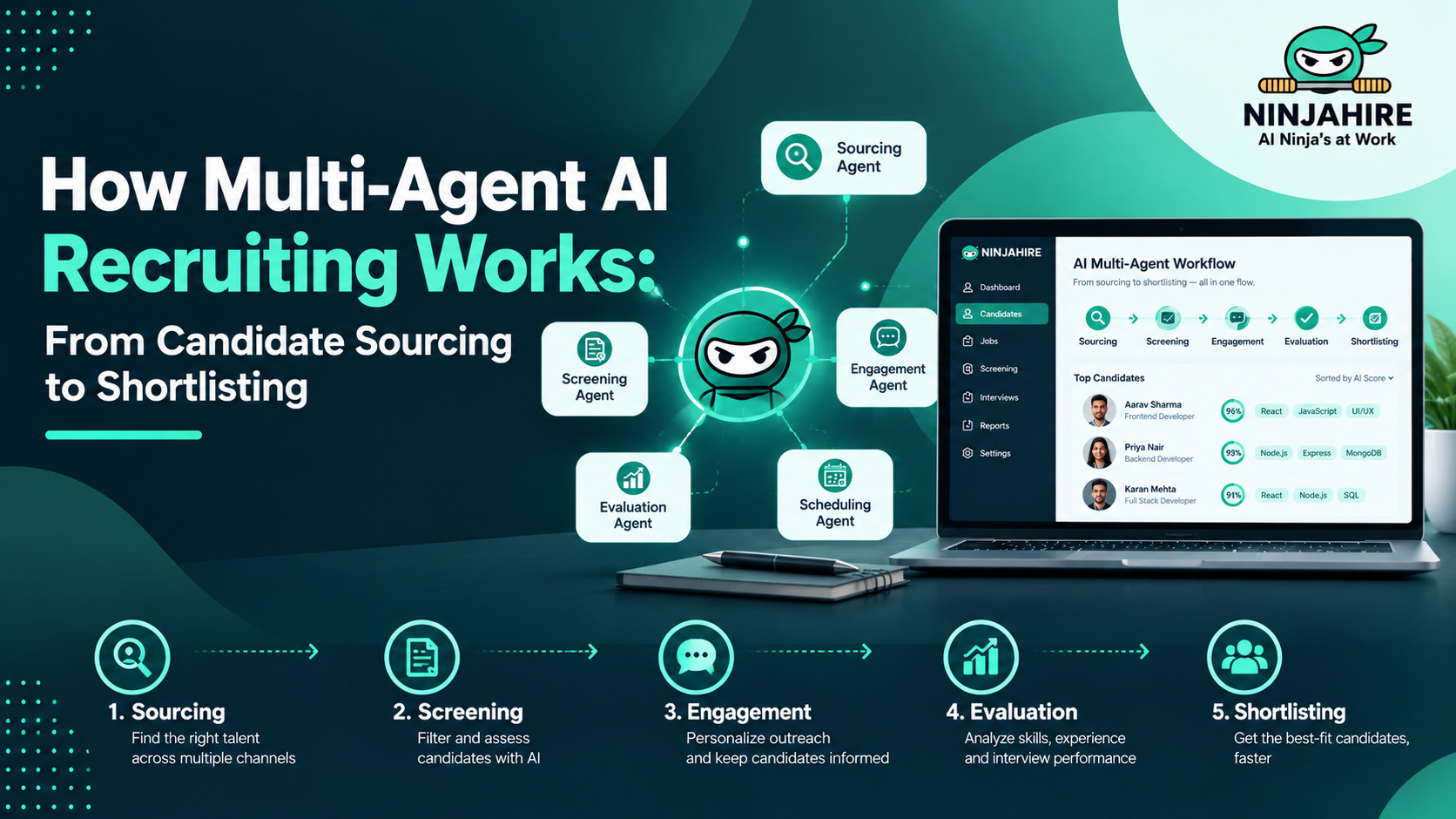
Workflow coverage: sourcing through screening is advertised. The screenshots below show the interface for each stage, but they do not show how far each step runs without recruiter input. That needs testing step by step.
Integration approach: Ninjahire's comparison page advertises VMS connections and ATS/CRM integrations. Which actions each supports for your system is Needs verification. The screenshots show an ATS tag on some candidates but do not show integration behavior.
Pricing: Starter $170/month and Professional $509/month, billed annually. Enterprise and program-management pricing requires a quote. Confirm the billing unit, usage limits and plan inclusions on the Ninjahire pricing page.
Limitations and what to verify: source coverage for your roles, call and screening quality, credit consumption, approval controls, reporting and the exact data exchanged with your ATS or VMS. Public descriptions do not prove performance. A team that mainly needs a traditional ATS, a specialist talent database or high-volume applicant conversations may be better served by another category. Compare Ninjahire with alternative recruiting platforms, and note that this page is Ninjahire's own material.
What a staffing agency should test: one real requisition from client intake through submission, including required VMS fields, client-specific criteria, duplicate candidates and handling of candidates who cannot be reached.
What an internal TA team should test: rediscovery of past candidates from your ATS, stage and activity write-back, hiring manager visibility and the audit trail for screening decisions.
Best question to ask in a demo: "Using our job description, show each step from search to recruiter handoff, and mark every step a recruiter must perform."
Noon
Best for: teams that want to automate outbound sourcing and candidate engagement rather than buy another database for manual searching.
Documented capabilities: autonomous candidate sourcing, evaluation against role criteria, multichannel outreach and scheduling. Noon's own comparison content ranks Noon first, which is the vendor's opinion and not independent evidence.
Workflow coverage: outbound sourcing through outreach and scheduling. It should not be assumed to replace an ATS or a staffing agency's client and VMS workflow.
Integration approach: ATS integrations are described. Which candidate, activity and stage data move in each direction is Needs verification.
Pricing: company quote. Noon describes a flat model with no per-seat fees or usage caps. No universal dollar price was verified; confirm the exact terms.
Limitations and what to verify: source and regional coverage, how sourcing criteria are calibrated, controls on outbound messages, integration depth and fit for contingent staffing or MSP requirements.
Best question to ask in a demo: "Which outbound messages send without approval, and where do we set those rules?"
hireEZ
Best for: teams that want a sourcing and engagement layer on top of an existing ATS.
Documented capabilities: sourcing, CRM, outreach, screening, scheduling and analytics. Its pricing page describes a four-week verification process for enterprise buyers.
Workflow coverage: the stated scope goes beyond search. Which steps run automatically, need recruiter input or depend on plan level is Needs verification.
Integration approach: ATS-connected workflows are central to its positioning. Test write-back, duplicate handling, record ownership and activity logging in your own ATS.
Pricing: Solo plan listed at $494/month with a seven-day trial. Team and enterprise pricing is quoted.
Limitations and what to verify: source fit for your roles and regions, cost against your current stack and the manual work left in your workflow.
Best question to ask in a demo: "Show a candidate moving from your platform into our ATS, with every field that is written back."
Pin
Best for: recruiters and agencies automating repeatable top-of-funnel work.
Documented capabilities: Pin's guide describes a per-job agent that sources, evaluates and qualifies candidates, then routes them to a shortlist or outreach. Recruiters calibrate the agent by approving or declining an initial group of candidates.
Workflow coverage: source, evaluate, qualify and outreach are documented. Scheduling and broader workflow claims need separate testing.
Integration approach: Pin states it connects with more than 120 ATS platforms, including Greenhouse, Lever, Ashby, Bullhorn, iCIMS and Jobvite. Features available for your ATS and plan are Needs verification.
Pricing: free tier. Solo is $99/user/month on annual billing. Professional is displayed at $135/user/month against $179, which appears promotional. Business pricing is by quote. Check live checkout for current terms.
Limitations and what to verify: calibration quality, source coverage, contact-data accuracy, outreach safeguards, ATS sync and oversight needed per role.
Best question to ask in a demo: "After calibration, what does the agent do on its own for a new role?"
Juicebox (PeopleGPT)
Best for: recruiters who prefer natural-language talent search.
Documented capabilities: AI search, contact and export credits, email outreach, talent insights, ATS/CRM integration on the Business tier and a separately priced Agents add-on.
Workflow coverage: the core strength is search and sourcing. Outreach and agent features extend it, but a standard subscription should not be assumed to run the whole funnel.
Integration approach: ATS/CRM integration is listed on the Business plan. Supported systems, data direction and plan restrictions are Needs verification.
Pricing: free tier. Starter is $99/seat/month and Growth is $179/seat/month, both on annual billing. Business is by quote. Agents are listed at $199 per agent per month.
Limitations and what to verify: credit and export limits, contact-data coverage, the cost of extra seats and agents, and whether the execution depth fits your workflow.
Best question to ask in a demo: "What is our total monthly cost at our expected searches, contacts and agents?"
Gem
Best for: corporate TA teams that want recruiting CRM, outbound sourcing and pipeline analytics.
Documented capabilities: sourcing, talent rediscovery, outreach sequences, candidate ranking, scheduling, analytics and an all-in-one option with ATS features.
Workflow coverage: broad CRM and corporate recruiting coverage. It is less obviously aimed at staffing firms with multi-client or VMS-dependent workflows, which is Needs verification.
Integration approach: Gem offers one option that layers onto an existing ATS and another with a built-in ATS.
Pricing: Contact vendor for pricing. Gem prices by company size.
Limitations and what to verify: module and AI seat costs, your ATS integration and whether the all-in-one option meets your process needs.
Best question to ask in a demo: "Which modules and seats are in your quote, and which would we add later?"
SeekOut
Best for: talent teams needing broad search, rediscovery and market intelligence.
Documented capabilities: a Recruit Core tier, sourcing and integration options, ATS rediscovery, market intelligence and a higher tier with inbound evaluation and AI screening.
Workflow coverage: varies by package, from sourcing to a broader funnel offering. The lowest tier should not be assumed to include screening or ATS integration.
Integration approach: ATS integration and rediscovery appear in higher-tier descriptions. Confirm your ATS and the exact data flows.
Pricing: Recruit Core is $149/month paid annually upfront or $179/month billed monthly. Sourcing-plus-integration and full-funnel plans are quoted.
Limitations and what to verify: tier inclusions, contact and export allowances, role and region coverage, and any workflows priced separately.
Best question to ask in a demo: "Which of the features you just showed are not in the tier we are pricing?"
Paradox
Best for: high-volume hiring where applicants need fast answers, initial screening and interview scheduling.
Documented capabilities: its Olivia assistant is described as handling job discovery and application, conversational screening, scheduling, candidate preparation, video interviewing, offers and onboarding.
Workflow coverage: strongest on applicant engagement and moving applicants through a high-volume process. It is a different category from outbound sourcing, and a team whose main problem is finding passive candidates may not need it.
Integration approach: validate the ATS and HR-system configuration in the demo. Do not assume every workflow works with every integration.
Pricing: Contact vendor for pricing.
Limitations and what to verify: candidate experience, screening rules, escalation to recruiters, language coverage, exception handling and implementation effort.
Best question to ask in a demo: "Show what happens when a candidate gives an unclear answer or asks to speak to a person."
Humanly
Best for: high-volume and frontline teams where engagement, screening and scheduling create bottlenecks.
Documented capabilities: AI engagement over chat, SMS and voice, screening, AI interviewing, scheduling, talent CRM and a built-in ATS.
Workflow coverage: emphasis on the path from applicant engagement to scheduled interviews. Advertised voice capability is not the same as a tested screening conversation.
Integration approach: Humanly says it can work with an existing ATS or use its own. An official Greenhouse support article describes screening, job and question sync, and returning assessment results to candidate profiles.
Pricing: Contact vendor for pricing. No generally applicable public price was verified.
Limitations and what to verify: channels and modules in your plan, language and voice quality, ATS data flows, human escalation and implementation, volume and module costs.
Best question to ask in a demo: "Run a live voice screening with interruptions, then show how the result lands in our ATS."
Ashby
Best for: corporate TA teams wanting an ATS, analytics and configurable automation in one system.
Documented capabilities: ATS, scheduling, sourcing, dashboards, integrations and AI features. Its documentation says users can create custom AI agents for repeatable workflows.
Workflow coverage: broad recruiting operations. How far agents execute tasks versus generate suggestions or summaries is Needs verification.
Integration approach: more than 100 integrations are listed for the Foundations plan, with further enterprise capabilities by tier.
Pricing: Foundations is shown at $400/month for eligible companies up to 100 employees. Higher tiers are quoted based on company size, usage and commitment.
Limitations and what to verify: AI capabilities, integrations, reporting and permissions in your plan. If you already run a mature ATS, compare the cost of replacing it against adding a sourcing or automation layer.
Best question to ask in a demo: "Which agent tasks run without a person, and which produce drafts for review?"
Which platforms to evaluate first, by buyer
These are shortlists drawn from product positioning, not trial-verified winners. A strong overall fit can still fail on one requirement, such as no supported connection to your required ATS or VMS.
| Buyer type | Evaluate first | Most important requirements | Resolve before purchasing |
|---|---|---|---|
| Staffing and recruitment agencies | Ninjahire, Pin, hireEZ, Juicebox | Multi-client workflows, sourcing, outreach, screening, ATS connectivity, cost, candidate-data handling | Can it run one real client requisition end to end? What is the cost per recruiter at our volume? |
| Corporate TA teams | Ashby, Gem, SeekOut, Ninjahire | ATS fit, talent CRM, rediscovery, analytics, hiring-manager collaboration, workflow controls | Replace the ATS or add a layer? Which reports and permissions are in our plan? |
| High-volume and frontline hiring | Paradox, Humanly, Ninjahire | Response speed, screening consistency, scheduling, channels, escalation to recruiters | How are unclear answers, languages and no-shows handled? |
| MSPs and contingent workforce programs | Ninjahire, plus your incumbent ATS/VMS ecosystem | Requisition intake, required submission fields, approvals, status visibility, verified integration behavior | Which exact VMS actions work in our environment? Advertised VMS support is not enough. |
| Autonomous-agent or ATS-connected automation buyers | Noon, Pin, Ninjahire, hireEZ | What runs without intervention, what needs approval, exception handling, records in the system of record | Which actions are logged in our ATS, and who approves outbound contact? |
A scoring framework you can reuse
These weights are this article's proposed evaluation approach. They are not a validated industry standard. Score each criterion from 1 to 5, using the same requisition and the same testers for every vendor.
| Criterion | Staffing/MSP | Corporate TA |
|---|---|---|
| Sourcing coverage and candidate relevance | 20% | 15% |
| Workflow execution and screening | 20% | 15% |
| ATS/VMS integration and data flow | 20% | 15% |
| Outreach and candidate engagement | 10% | 10% |
| Governance, approvals and audit trail | 10% | 10% |
| Reporting and workflow visibility | 5% | 15% |
| Pricing and total cost of ownership | 10% | 10% |
| Ease of implementation and usability | 5% | 10% |
| Total | 100% | 100% |
- Not demonstrated, or does not meet the requirement.
- Limited capability, or substantial manual work remains.
- Meets the core requirement with some constraints.
- Strong fit demonstrated in the relevant workflow.
- Strong end-to-end fit demonstrated, including exceptions and data handling.
Use Not verified when evidence is missing. Thin public documentation is not a reason for a low score, and marketing claims are not a reason for a high one. We have not scored any vendor here, so all vendor scores are pending verification.
Five questions to ask every vendor
- Can you complete our actual recruiting workflow? Give the vendor an anonymized real job description and ask it to show sourcing, qualification, outreach, screening and recruiter handoff. Note each manual step.
- What does the AI execute, and what does it only recommend? Ask which actions run in the background, which need approval, how criteria are calibrated and how uncertain candidate information is handled.
- What exactly moves between your platform and our ATS or VMS? Request a field-level map. Test records, notes, activity history, stage updates, duplicates, errors and the direction of each flow.
- What is the full cost at our expected volume? Include seats, contact and usage credits, phone and SMS costs, agent fees, implementation, integration work, support, minimum terms and renewal conditions.
- How can we audit quality, security and candidate treatment? Ask for sample audit logs, permission controls, retention and deletion terms, screening criteria, escalation paths and how errors are corrected.
Demo scorecard
Use the same job description, candidate criteria, workflow and scoring approach for every vendor. Record Pass, Partial, Fail or Not tested, plus evidence, tester, date and follow-up. A polished demo is not proof that a workflow works in production. We have not recorded results for any vendor in this article.
| Test | Expected evidence | Result |
|---|---|---|
| Candidate search | Relevant candidates with explainable matches and traceable sources | Pass / Partial / Fail / Not tested |
| Candidate contact and outreach | Correct personalization, approved messaging, working channels | Pass / Partial / Fail / Not tested |
| Screening | Consistent role questions, usable answers, clear summaries | Pass / Partial / Fail / Not tested |
| Human handoff | Recruiters can review, correct, approve or reject results | Pass / Partial / Fail / Not tested |
| ATS/VMS operation | Required fields and actions work in your test environment | Pass / Partial / Fail / Not tested |
| Error handling | Failures, duplicates, missing data and approvals are flagged | Pass / Partial / Fail / Not tested |
| Reporting | Completion, errors, time spent and conversion are measurable | Pass / Partial / Fail / Not tested |
| Total cost | Written estimate for agreed usage and implementation scope | Pass / Partial / Fail / Not tested |
Frequently asked questions
What is the difference between autonomous and AI-assisted recruiting software?
AI-assisted software helps a recruiter complete tasks such as searching, summarizing or drafting messages, while autonomous software executes several connected steps under configured rules. The useful distinction is what the system actually does, when it needs approval and how it handles exceptions. Ask each vendor to show this on your own requisition.
Can AI recruiting software replace an ATS?
Sometimes, but not by default. An ATS is the system of record for candidates, stages and processes. Some platforms integrate with your existing ATS, while others include ATS features. Decide first whether you need to replace the system of record or automate work around it.
Which sourcing channels should an AI recruiting platform support?
The right channels depend on your roles, locations and candidate pool. Judge each source on relevance, data access, freshness, permissions and contact accuracy. Ask where the data comes from, how current it is, and whether the vendor is permitted to use each source as described. Your own ATS or CRM database is often a useful source to test first.
Can AI recruiting software conduct phone screening?
Some platforms advertise AI-led phone or voice screening, while others focus on chat, assessments or video. An advertised voice feature is not the same as a tested workflow. Run a realistic call that includes unclear answers, interruptions and a request for a human, then check how the result is recorded.
How much does AI recruiting software cost?
Public prices in this article range from free tiers to a few hundred dollars per month, and several vendors quote only by contract. Models include per-seat, per-account, usage or credit-based, per-agent, flat company and custom enterprise pricing. These are not equivalent, so compare the full annual cost at your volume, including integrations, outreach, screening, implementation and support.
If you want to test a connected sourcing, outreach and screening workflow with your own requisition, you can start with Ninjahire. Review the pricing page first, or return to Ninjahire's homepage for the product overview.