.png)
Candidate rediscovery: how to mine your ATS for hires you already have

March 15, 2026
What Candidate Rediscovery Actually Means
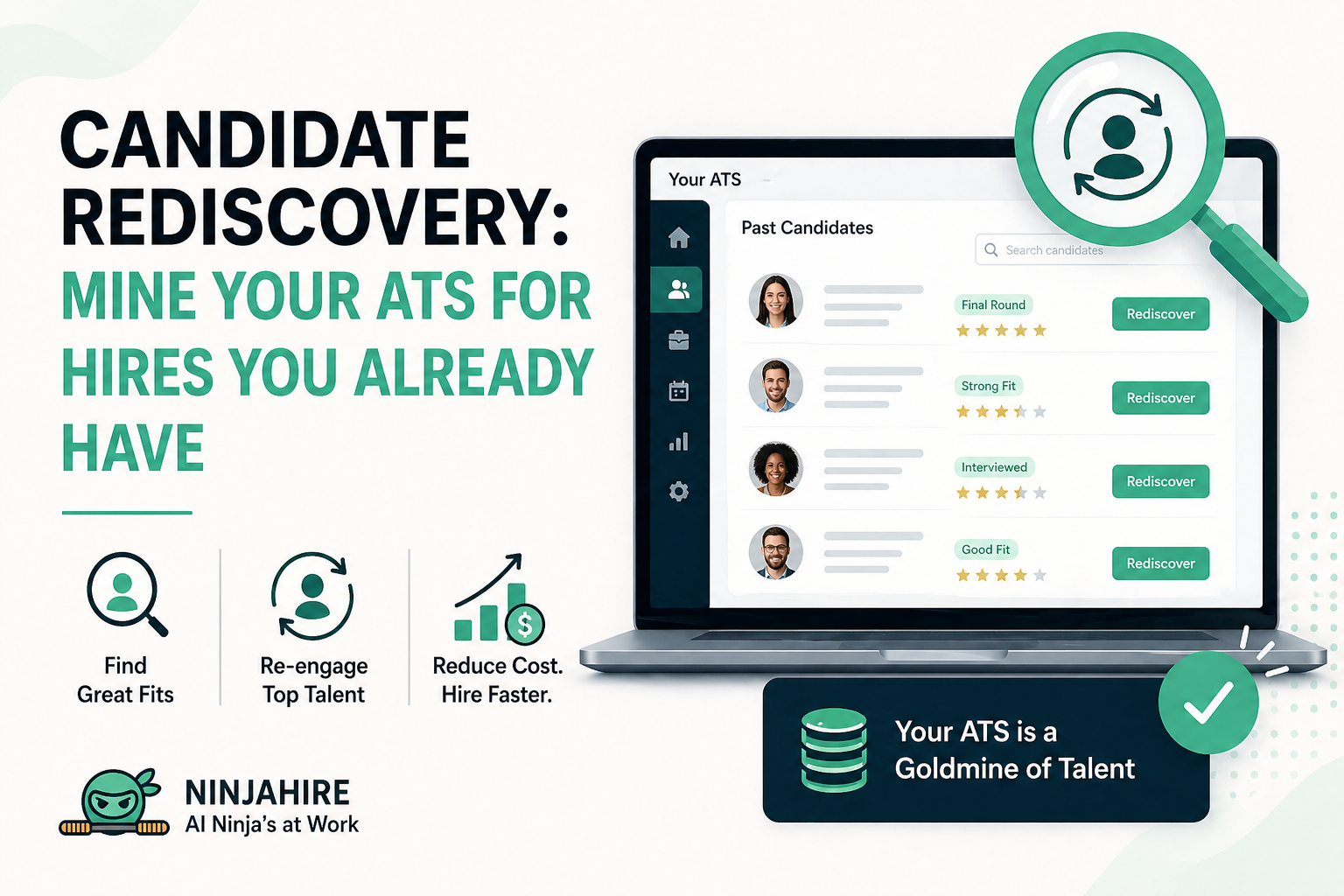
Candidate rediscovery is the practice of systematically searching your existing ATS database to identify past applicants who are now a strong match for a current open role. Rather than treating every new position as a sourcing problem that requires fresh outreach, rediscovery treats your ATS as an active hiring asset — a curated pool of people who already know your company, have already been evaluated, and may be ready to move for the right opportunity. Done well, it reduces cost-per-hire, shortens time-to-fill, and surfaces talent that external sourcing consistently misses.
The Hidden Talent Pool in Your ATS
Most recruiting teams significantly underestimate how much usable talent is already sitting in their ATS. Every hiring cycle adds candidates: people who applied for roles they were slightly overqualified for, people who were strong but lost to an even stronger finalist, people who were right for the role but whose timing was off because they had just accepted another offer. These profiles do not disappear. They accumulate — quietly, in a database that most recruiters only search when they have a specific requisition open and no time to be thorough.
The scale of this accumulation is worth thinking about concretely. An organization that processes five hundred applications per month has six thousand candidate profiles at the end of a year. After three years, that is eighteen thousand people — each of whom has already demonstrated enough interest in your company to complete an application, and many of whom have already been screened, tested, or interviewed. That is not a database. That is a talent pool that most organizations are treating as a filing cabinet.
The missed opportunity compounds over time. Skills that were not relevant twelve months ago become critical when a new business line launches. A candidate who was geographically constrained may have moved. Someone who declined an offer because the salary was too low may be more flexible now. The profiles in your ATS are not static records of past decisions — they are snapshots of people whose circumstances have very likely changed since they were collected. Treating them as live candidates, rather than archived applications, is the fundamental shift that candidate rediscovery requires.
The Cost of Ignoring Your ATS
External sourcing is expensive. Job board fees, LinkedIn licenses, agency commissions, sourcing tool subscriptions — these costs add up quickly, and they are incurred fresh with every new requisition. When a recruiter opens a new role and immediately turns to external channels while ignoring a database of thousands of pre-evaluated candidates, that is not just a missed efficiency. It is a repeating cost that compounds across every hiring cycle.
| Hiring Type | Typical Cost | Time to Hire | Familiarity with Brand |
|---|---|---|---|
| New external sourcing | High — job boards, ads, agency fees | Slow — cold outreach, low response rates | Low — first contact |
| Rediscovered ATS hire | Low — no sourcing spend required | Fast — pre-evaluated, warm contact | High — applied previously |
The time difference is often just as significant as the cost difference. A candidate sourced externally needs to be found, contacted, screened, and evaluated before any hiring decision can be made. A candidate rediscovered from your ATS may have already completed a phone screen, a skills assessment, or multiple rounds of interviews for a previous role. That evaluation history does not disappear — it can be reviewed and applied to a new requisition in a fraction of the time external sourcing would require.
Organizations that measure their cost-per-hire carefully tend to find that rediscovered candidates cost between 60 and 80 percent less than externally sourced hires when all recruiting costs are properly allocated. The sourcing spend alone is nearly zero. The screening time is dramatically reduced. And because the candidate has already engaged with your employer brand at least once, offer acceptance rates tend to be higher. The only thing standing between most organizations and these savings is a deliberate rediscovery practice.
Who Are Silver Medal Candidates
Silver medal candidates are the people who reached the final stages of a hiring process — often the last two or three — but were not selected. They are not candidates who were screened out early for a skills gap or a clear misalignment. They are candidates who were good enough to make it to the end of a competitive process and lost to someone marginally stronger, or to a single differentiating factor that had nothing to do with their underlying capability.
These candidates represent the highest-quality segment in almost any ATS. They have already been evaluated thoroughly. Your team formed a view of their strengths and any gaps. They understand your organization, your culture, and the nature of the roles you hire for. And critically, they are often available — either because they did not find another role as quickly as expected, or because the role they accepted turned out to be less satisfying than hoped, or simply because they remained interested in your company even after receiving a rejection.
The conversion rate for silver medal candidates, when properly identified and re-engaged for appropriate roles, consistently outperforms externally sourced candidates. Recruitment teams that track this metric rigorously find that silver medals hired through rediscovery advance through the hiring process faster, require fewer interview rounds, and have higher offer acceptance rates. This makes intuitive sense — both sides already know each other. The re-engagement is not a cold introduction. It is a continuation of a relationship that was interrupted, not ended.
The practical challenge is identification. Most ATS platforms are not configured to automatically tag final-round candidates from previous processes. Building that tagging discipline — or retroactively applying it to historical data — is one of the foundational investments in any serious rediscovery program. Once silver medals are identified and segmented, they should be the first group searched for any new requisition in a role family where they previously competed.
How to Identify Candidates in Your ATS at Scale
The gap between having a large candidate database and being able to use it effectively comes down to search infrastructure. An ATS with fifty thousand profiles is only as useful as the quality of the data within it and the search tools available to surface the right candidates for a given need. Building that infrastructure is not a one-time setup task — it is an ongoing data discipline that has to be embedded in the recruiting workflow.
Filters and structured data
Effective ATS search starts with structured data. If candidate profiles contain unstructured text with no consistent tagging, every search becomes a keyword guessing game that misses qualified candidates and surfaces irrelevant ones. The foundation is a consistent set of required fields: role family, skill categories, years of experience, location, and last-contacted date. These fields allow Boolean filtering that dramatically narrows a large database to a workable shortlist. If your current profiles lack this structure, a data enrichment exercise — either manually or using an AI parsing tool — is worth the investment before any rediscovery program can function reliably.
Tagging systems
Tags are the most practical tool for organizing ATS candidates beyond what structured fields capture. A good tagging system includes tags for hiring stage reached (screened, interviewed, final round), hiring outcome (hired, silver medal, declined, withdrew), skill specializations that matter for your organization's roles, and any notes about candidate preferences (remote only, open to relocation, salary expectations). Tags should be applied consistently at the end of every hiring process — not retrospectively or optionally. When this discipline exists, searching your ATS for candidates who reached final rounds in a specific role family and have a specific skill set takes minutes rather than hours.
Scoring and ranking
Many modern ATS platforms allow you to configure scoring criteria for candidate profiles — weighting skills, experience levels, location, and previous evaluation results to produce a ranked shortlist for a given search. When this is combined with AI-powered matching, the system can surface candidates who were not actively tagged for a role but whose profile closely matches the requirements. This is particularly valuable for roles that are new to the organization, where historical tags may not exist but where the underlying skill requirements overlap heavily with previous hiring.
Search logic and boolean operators
Recruiters who understand boolean search logic can extract significantly more value from an ATS than those relying on simple keyword search. Using AND, OR, and NOT operators in combination with structured field filters allows precise targeting: find candidates with experience in either Python or R, with at least three years of experience, who reached at least the interview stage, and have not been contacted in the last six months. This combination of logic and structured data is the practical mechanism by which candidate rediscovery works at scale.
Segmenting Your Candidate Database
Not all candidates in your ATS are equally worth pursuing. A structured segmentation approach helps recruiting teams prioritize outreach toward the profiles most likely to convert, while deprioritizing records that are outdated, misaligned, or unlikely to engage. The simplest framework is a three-tier model based on how far each candidate progressed in their original process.
| Tier | Description | Rediscovery Priority | Outreach Approach |
|---|---|---|---|
| Tier 1 — Silver medals | Reached final round, not selected | Highest | Personalized, reference prior process |
| Tier 2 — Screened not advanced | Passed initial screen, not advanced to interview | Medium | Role-specific, highlight growth since last contact |
| Tier 3 — Unreviewed or outdated | Applied but not screened, or data over 2 years old | Low | Verify interest before investing time |
Tier 1 candidates should be the first search run for any new requisition in a relevant role family. The depth of existing evaluation data means the path to a hiring decision is shorter, and the candidate's familiarity with your organization reduces the need for extensive brand-building in the outreach. Tier 2 candidates are worth pursuing when Tier 1 does not produce enough volume, or when the role requirements have shifted enough that candidates who were previously underqualified now fit. Tier 3 requires a lighter touch — a brief re-engagement to verify current interest and update contact information before investing recruiter time in a full evaluation.
A fourth category worth tracking separately is candidates who withdrew from your process voluntarily. These are people who were interested enough to apply and advance but chose to exit — often because they accepted another offer, had a personal change, or felt the role was not quite right. They are not failed candidates. They are candidates whose timing was wrong. Flagging voluntary withdrawals and reconnecting six to twelve months later, when their situation may have changed, converts at a higher rate than most recruiters expect.
Writing Re-Engagement Outreach That Works
The biggest mistake in candidate re-engagement is treating it like cold outreach. It is not. The person you are contacting has already interacted with your company. They completed an application. They may have spoken to a recruiter or interviewer. They formed an impression — hopefully a positive one — that already exists. Your message should build on that existing relationship, not ignore it.
Reference the prior interaction specifically
A re-engagement message that opens with something like we spoke last spring when you interviewed for the data engineering role on our platform team is fundamentally different from a generic we have a new opportunity that might interest you. The first acknowledges the shared history. It signals that you valued the interaction enough to remember it, and that this new contact is a deliberate continuation rather than a mass email. Candidates respond to specificity because it demonstrates that the recruiter actually reviewed their profile rather than harvesting an email address from a search.
Explain why this role is relevant to them
Connect the new role to what you know about the candidate. If their previous application highlighted specific skills that are directly relevant to the new position, name them. If the new role represents a step up from what they applied for before, say so. Candidates are more likely to respond when they understand why this specific opportunity was surfaced for them specifically — not because it is vaguely similar to something they applied for, but because the recruiter saw a genuine fit between what the candidate is good at and what the role requires.
Keep it concise and make the ask clear
Re-engagement messages should be short. Three to five sentences is the right length for an initial outreach. State who you are, reference the prior interaction, describe the new opportunity in one sentence, and ask a clear question — typically whether they are open to a brief conversation. Do not send a full job description in the first message. Do not include lengthy company descriptions the candidate already knows. The goal of the first message is not to sell the role — it is to open a conversation. Save the details for when they respond.
Timing matters more than most recruiters realize
Candidates who declined an offer or accepted a competing role are most likely to be receptive to re-engagement in the window between six and eighteen months after their original process. Earlier than six months, they are typically still in the honeymoon period of a new role. Beyond eighteen months, they may feel the relationship has gone cold enough that your outreach feels unexpected. Building a re-engagement calendar that identifies Tier 1 candidates by the date of their original process and triggers outreach at the right interval is one of the higher-value workflow improvements a recruiting team can make.
AI-Powered Candidate Rediscovery
Manual ATS searches are better than nothing, but they are limited by the quality of your tagging, the consistency of your data structure, and the recruiter's ability to construct effective search queries. AI-powered candidate rediscovery addresses all three limitations by operating on the semantic content of candidate profiles — understanding what a candidate is good at based on the full text of their application, not just the tags that were applied to their record.
Modern AI matching systems can parse a new job description, extract the underlying competency and experience requirements, and rank your ATS database against those requirements — surfacing candidates whose profiles match the intent of the role, not just the specific keywords. This means a software engineer who worked primarily in Python but has a strong data structures background can be surfaced for a role that requires Go, if the AI recognizes that the underlying competency transfers and the candidate has demonstrated the ability to work across language ecosystems. Keyword-based search would miss this candidate entirely.
AI also enables rediscovery at a scale that manual processes cannot match. A recruiter working through a database of ten thousand candidates manually, even with good Boolean search skills, will take hours to produce a shortlist and will inevitably miss profiles that do not match their mental model of what a good candidate looks like for a given role. An AI system can evaluate all ten thousand profiles against a new requisition in seconds, producing a ranked list with confidence scores and explanation of match rationale. That efficiency changes the economics of rediscovery entirely — it is no longer a process reserved for high-urgency roles or dedicated sourcing specialists, but a standard first step in every recruiting workflow.
Ranking and scoring from AI rediscovery tools should be treated as advisory rather than determinative. The goal is to surface a manageable shortlist — typically ten to twenty profiles — that a recruiter can then review with the full context of the role and the team. The AI narrows the field. The recruiter makes the judgment call. That combination is more effective than either AI alone or manual search alone, and it is the architecture that the best recruiting teams are building toward.
Building a Rediscovery Workflow
A rediscovery practice only delivers consistent results when it is built into the recruiting workflow as a standard step rather than an ad hoc activity. The organizations that get the most value from their ATS databases are not the ones with the most sophisticated AI tools — they are the ones where every recruiter follows the same process every time a new requisition opens.
Step one: Search before you source
The first action when a new requisition opens should be an ATS search, not a job board post. This is a cultural and process norm that has to be deliberate — the default behavior in most recruiting teams is to post externally immediately, because that is what feels like action. Reversing that default requires making the ATS search easy enough that it takes less time than posting a job. When your tagging and segmentation are in good shape and you have AI matching available, the first ATS search for a new role should take no more than fifteen minutes and produce a shortlist worth reviewing before any external sourcing begins.
Step two: Quarterly database reviews
Beyond per-requisition searches, a quarterly proactive review of the ATS is valuable for identifying candidates who should be re-engaged based on timing rather than a specific open role. This review looks at silver medal candidates whose process concluded six to twelve months ago, candidates who withdrew voluntarily in the same window, and any profiles that have been enriched or updated since they were last contacted. The output is a list of candidates to warm up proactively — a brief check-in that keeps the relationship active and increases the likelihood of a fast response when a relevant role opens.
Step three: Close the loop after every process
The quality of future rediscovery depends entirely on the quality of data captured at the end of current processes. After every hiring decision, the recruiter responsible for the role should tag all candidates with their final stage, their outcome, any relevant notes about skills or preferences, and a re-engage date if appropriate. This takes five to ten minutes per requisition and is the single most valuable data hygiene practice in any rediscovery program. Teams that skip this step consistently find their ATS search quality degrading over time — more profiles, less usable data.
Step four: Track rediscovery as a sourcing channel
Candidate rediscovery should be tracked in your recruiting metrics as a distinct sourcing channel alongside job boards, referrals, LinkedIn, and agency placements. This means recording the source of every hire — including when that source is a rediscovered ATS candidate — and calculating the cost-per-hire, time-to-fill, and quality-of-hire metrics for each channel separately. When rediscovery is measured this way, its ROI becomes visible to leadership, which creates the organizational support needed to invest in the data infrastructure and tooling that makes it work.
Metrics That Matter in Candidate Rediscovery
Measuring the right things is what separates a rediscovery practice that grows over time from one that stalls after initial enthusiasm. These are the metrics that tell you whether the program is working, where it is underperforming, and what to fix.
| Metric | What It Measures | What to Do with It |
|---|---|---|
| ATS search-to-shortlist rate | Percentage of ATS searches that produce a usable shortlist | Indicates data quality; low rate signals tagging or enrichment problems |
| Re-engagement response rate | Percentage of outreach messages that receive a reply | Indicates message quality and timing; below 20% suggests messaging review needed |
| Rediscovery-to-interview rate | Percentage of re-engaged candidates who advance to interview | Indicates match quality from ATS search; low rate suggests search criteria need refinement |
| Rediscovery hire rate | Percentage of hires sourced from ATS rediscovery | Primary efficiency metric; target is typically 15-25% of total hires for mature programs |
| Cost-per-hire by source | Total recruiting cost divided by hires, broken out by channel | Demonstrates ROI of rediscovery vs external sourcing; the most compelling metric for leadership |
| Time-to-fill by source | Average days from requisition open to offer accepted, by sourcing channel | Quantifies speed advantage of rediscovery; typically 30-40% faster than external sourcing |
The most important of these metrics for a program in its early stages is the re-engagement response rate. If candidates are not responding to outreach, the rest of the funnel does not matter. A low response rate usually points to one of three things: the outreach is too generic, the timing is off, or the candidate experience during their original process was poor enough that they are not interested in re-engaging. Each of these has a different fix, and the metrics help you identify which problem you are actually solving.
Common Mistakes in Candidate Rediscovery
Most candidate rediscovery programs that fail do not fail because the idea is wrong. They fail because one of a small number of recurring execution mistakes undermines the practice before it gains traction.
Treating the ATS like a filing cabinet
The most fundamental mistake is organizational — treating the ATS as a record-keeping system rather than a sourcing channel. This manifests in how the system is configured (minimal search infrastructure, no tagging standards), how recruiters are trained (the ATS is where applications are tracked, not where candidates are sourced), and how success is measured (no rediscovery metrics in the recruiting dashboard). Until the ATS is operationally positioned as a talent pool rather than a filing system, individual rediscovery efforts will be inconsistent and under-resourced.
Poor data hygiene
A candidate database with inconsistent tagging, missing fields, and outdated contact information is difficult to search effectively and produces unreliable results. Organizations that have never invested in data standards find that their ATS searches surface candidates who are clearly misaligned or, worse, miss candidates who are a strong fit because their profiles lack the tags that the search criteria depend on. Fixing this retroactively is time-consuming. The better practice is establishing data standards going forward and gradually enriching historical records as resources allow — starting with silver medal candidates, who represent the highest-value profiles in any database.
Generic re-engagement messaging
Sending a mass email to everyone in an ATS segment with a message that reads like a job board alert is worse than not reaching out at all. It signals that the candidate is being treated as a name on a list rather than a person with a specific history with your organization. It damages the relationship that the original hiring process built, and it produces very low response rates — which then get interpreted as evidence that ATS rediscovery does not work, when in fact the problem is the outreach, not the channel. Personalization at scale, using mail merge fields that pull candidate-specific data, is not a nice-to-have. It is the minimum viable standard for re-engagement outreach.
Ignoring the candidate experience from the original process
Candidates who had a poor experience during their original hiring process are unlikely to re-engage positively, regardless of how relevant the new role is. If a candidate was ghosted after an interview, received a generic rejection with no feedback, or had their time wasted in a poorly run process, they remember. Re-engagement outreach that does not acknowledge this — or worse, that cheerfully ignores it — will not land well. Organizations with known candidate experience problems should address those before investing heavily in rediscovery, because the database reflects the experiences that created it.
Choosing Tools That Support Candidate Rediscovery
The tooling you use shapes what your rediscovery practice can realistically achieve. ATS platforms differ substantially in their search capabilities, AI matching features, tagging flexibility, and the ease with which recruiters can move from a database search to a personalized outreach sequence. These differences matter more than most buying decisions account for.
When teams compare platforms — whether evaluating ninjahire vs linkedin recruiter or looking at ninjahire vs hireez — the rediscovery-specific questions tend to get less attention than sourcing features and pipeline management. But for an organization that has a meaningful candidate database and wants to use it, the search and matching capabilities are often the highest-leverage feature in the entire platform. Can the system surface candidates by role stage reached? Can it match profiles to new JDs semantically rather than just by keyword? Can it trigger re-engagement workflows automatically based on tags and timing?
Newer AI-native platforms have made particular progress in this area. Comparing options like ninjahire vs converzai or ninjahire vs tenzo ai on rediscovery-specific features — specifically, how they handle existing candidate matching, what automation they provide for re-engagement, and how transparent their ranking logic is — reveals meaningful differences in how much lift the platform provides versus how much manual process is required from the recruiting team. Similarly, ninjahire vs heymilo comparisons often come down to the depth of ATS integration and whether the AI can actually read and match against existing candidate profiles rather than treating the database as inert storage.
Your best candidates are often already in your system — you just are not looking in the right way. A structured rediscovery practice does not require a bigger database or a larger sourcing budget. It requires treating the database you already have as an active talent pool rather than a record of past decisions.
Key Takeaway
An ATS is not a storage system. It is a hiring asset — one that compounds in value with every candidate who enters it, provided that the data is structured, the search is disciplined, and the outreach is personal. Organizations that build a genuine rediscovery practice reduce their cost-per-hire, shorten their time-to-fill, and fill roles with candidates who already understand their culture and brand. The investment required is not large. The discipline required is consistent. And the return, measured in sourcing spend avoided and hiring cycles shortened, accumulates with every quarter the practice runs.
Start with your silver medals. Build your tagging standards. Make ATS search the first step in every requisition workflow. Measure rediscovery as a sourcing channel. The candidates are already there — the practice is what brings them forward.
Turn your ATS into a hiring engine
NinjaHire helps recruiting teams rediscover and re-engage their best past candidates — with AI matching, smart tagging, and outreach automation built for the way modern teams hire.
Try for free
.jpg)
.png)
