.png)
EU AI Act and recruiting: what hiring teams in Europe need to do before the deadline

March 15, 2026
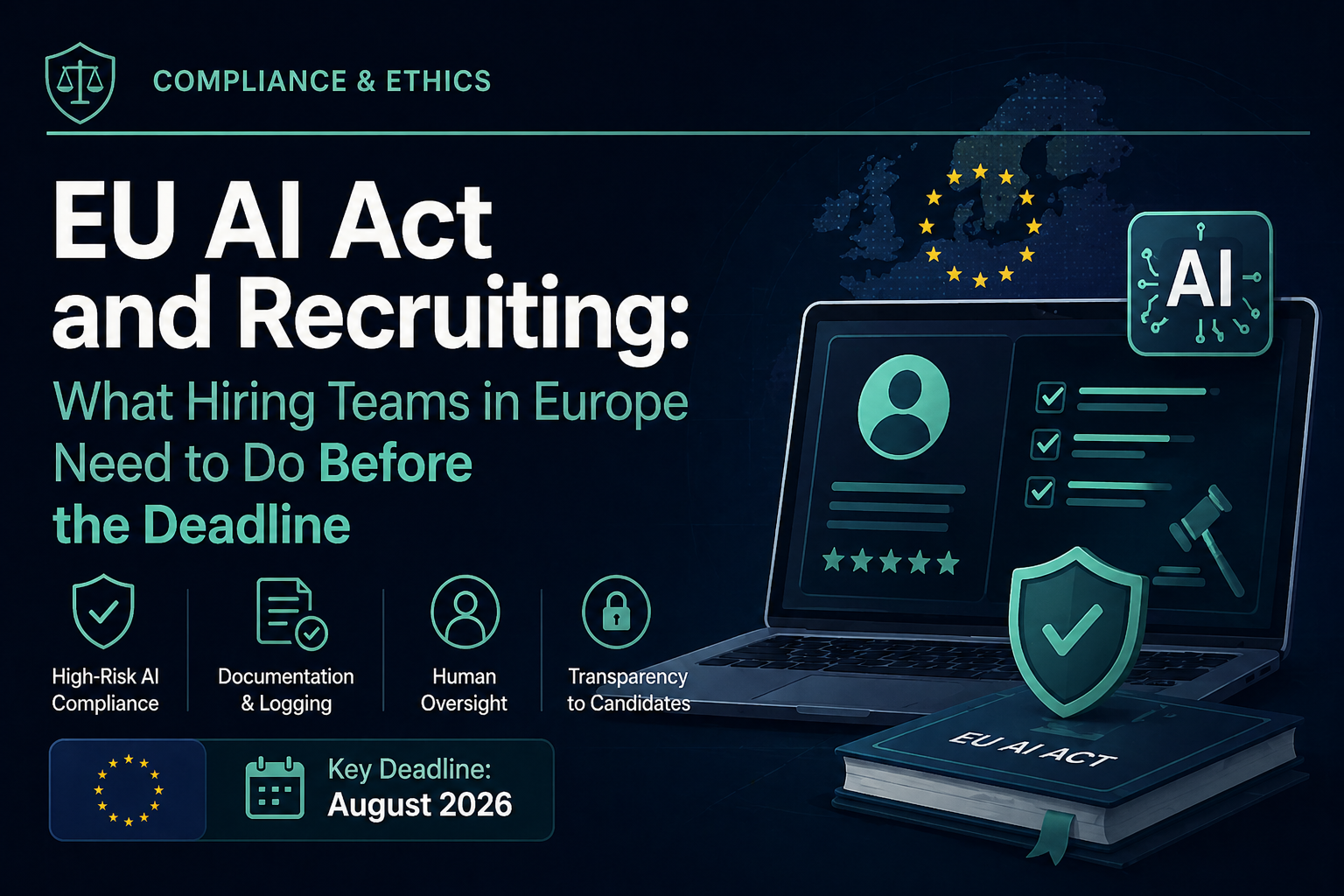
Section 1: Why the EU AI Act Matters for Hiring Teams Now
For most hiring teams in Europe, the EU AI Act has been sitting somewhere between background noise and vague anxiety. The headlines have been there — major new regulation, high-risk AI, compliance obligations — but the practical implications for a TA team using an AI screening tool or an automated interview scheduler have been less clear. That clarity gap is closing fast. The deadlines are no longer abstract, and the obligations that apply to employers using AI in hiring are more specific — and more demanding — than many organizations have prepared for.
The reason this matters particularly for hiring teams is that the EU AI Act explicitly classifies AI systems used in employment decisions as high-risk. That is not a hypothetical interpretation — it is written into Annex III of the regulation. Any AI tool your organization uses to screen CVs, conduct automated interviews, rank candidates, or assess suitability for a role falls into a regulatory category that carries documentation, transparency, and human oversight requirements. Using a tool that does not comply — or failing to meet the employer-side obligations yourself — creates exposure that goes beyond a fine. It creates defensibility problems in any candidate challenge and reputational risk in a labor market where candidate experience increasingly matters.
The good news is that the compliance path is navigable. It requires effort and attention, but it is not technically complex for organizations that start from a clear-eyed assessment of what they are using and what those tools require of them. This guide walks through exactly that — what the regulation requires, what the deadlines are, and what your hiring team specifically needs to have in place.
Section 2: What the EU AI Act Is — A Plain Explanation
The EU AI Act is a regulation passed by the European Parliament that establishes a legal framework for the development and use of artificial intelligence systems across the European Union. It classifies AI systems by risk level — from minimal to unacceptable — and imposes obligations proportionate to that risk. For high-risk systems, which include AI used in employment and hiring decisions, it requires documentation, human oversight, transparency to affected individuals, and conformity assessment before deployment.
It entered into force in August 2024. Unlike a directive, it applies directly in all EU member states without requiring separate national implementation. For organizations based outside the EU that use AI systems which affect people in the EU — including employers hiring European candidates — it applies to them as well. The territorial reach is broad and intentional.
The regulation creates four tiers of AI risk. Unacceptable risk systems — such as social scoring by governments — are banned outright. High-risk systems face the most substantial compliance requirements. Limited-risk systems have lighter transparency obligations. Minimal-risk systems, such as spam filters, have no mandatory requirements under the act. AI used in hiring falls firmly into the high-risk tier, which is why it commands specific attention from TA teams and HR compliance functions.
The Act also distinguishes between providers — the companies that build AI systems — and deployers — the organizations that use them in practice. An employer using an AI screening tool is a deployer under the Act. Both providers and deployers have obligations, and they are not identical. Understanding which obligations fall on your vendor and which fall on your organization is one of the first practical steps any hiring team needs to take.
Section 3: Why AI in Hiring Is Classified as High-Risk
The logic behind classifying employment AI as high-risk is straightforward: these systems make or influence decisions that materially affect people's livelihoods, opportunities, and economic security. A CV screening tool that filters out 80 percent of applicants before a human reviews them is not a neutral sorting mechanism — it is a decision-making system that shapes who gets a job and who does not. The EU legislature took the position that systems with that level of impact on fundamental rights need to be held to a higher accountability standard.
Annex III specifically lists AI systems used for recruitment and selection of natural persons — including CV screening, interview assessment, and candidate evaluation — as high-risk. This means any AI tool you are using to sort, rank, filter, or assess candidates in a hiring context falls within the regulation's highest-obligation tier, regardless of how the vendor describes the tool's function or how automated the decision-making actually is.
The classification also captures tools that might not be primarily marketed as hiring AI but are used in that context. An AI-powered video analysis tool used to evaluate candidate responses in an interview, a chatbot that qualifies candidates through a screening conversation, a scheduling system that uses behavioral signals to predict no-show likelihood — all of these fall within the high-risk classification if they are used to inform employment decisions affecting people in the EU.
The regulation is deliberately broad in its definition of what counts as AI in employment. If your tool is doing anything more than displaying data to a human who makes all the judgments independently, you are likely in high-risk territory and need to treat it accordingly.
— EU AI Act compliance practitioner, BrusselsFor hiring teams, the practical takeaway is this: do not assume your tools fall outside the high-risk definition. The threshold is lower than many vendors will initially suggest, and the cost of incorrectly assuming you are not in scope is significantly higher than the cost of preparing as if you are.
Section 4: What High-Risk AI Actually Requires — 6 Key Obligations
High-risk AI systems under the EU AI Act come with six categories of obligation that apply to both providers and, to varying degrees, deployers. Here is what each one means in the hiring context.
Organizations deploying high-risk AI must maintain an ongoing risk management process covering the AI system throughout its lifecycle. In hiring, this means documenting and periodically reviewing the risks associated with using AI screening or assessment tools — including the risk of biased outcomes, errors, or decisions that adversely affect candidate groups disproportionately.
Training, validation, and test data used by high-risk AI systems must be subject to appropriate governance practices. For deployers, this means understanding what data your vendor's system was trained on and whether that training data is representative, accurate, and free from systematic biases relevant to your candidate population.
Providers must maintain detailed technical documentation about the system. Deployers need to request and retain this documentation. In practice, your AI screening vendor needs to be able to provide you with documentation sufficient to demonstrate how the system works, how it was validated, and what its known limitations are.
High-risk AI systems must log activity automatically to enable post-hoc auditing. This means the system must retain records of when it was used, what inputs it processed, and what outputs it generated — in a way that allows the deployer to reconstruct any specific hiring decision that might be challenged.
Deployers must ensure that candidates and employees know when AI is being used in processes that affect them. For hiring teams, this means clearly communicating in job postings, application materials, or candidate communications that AI tools are being used in the recruitment process, and what role they play.
High-risk AI systems must be designed and used in ways that allow humans to understand, monitor, and override the system's outputs. In hiring, this means that AI screening outputs cannot be the final word on a candidate's advancement — a human must be in the decision loop in a meaningful way, not just as a rubber stamp on AI recommendations.
Section 5: Conformity Assessment — What Employers Must Check
Conformity assessment is the process by which a high-risk AI system is evaluated against the requirements of the EU AI Act before it can be deployed in the EU market. For most AI systems — including the hiring tools most employers use — this is a self-assessment process conducted by the provider. For certain higher-risk applications, third-party assessment is required.
As a deployer, your obligation is not to conduct the conformity assessment yourself — that is your vendor's responsibility. Your obligation is to verify that it has been done and to obtain the evidence. Concretely, this means requesting the following from any AI hiring tool vendor before or as part of your procurement process: the EU Declaration of Conformity, which is a formal statement by the provider that the system meets the Act's requirements; the CE marking, which should be affixed to the system once compliance has been established; and technical documentation that supports the conformity claim.
If a vendor cannot produce these — or if they are vague about the timeline for producing them — that is material information for your procurement decision. The Act creates a chain of accountability between provider and deployer. If the provider has not completed conformity assessment, you as the deployer cannot validly use the system for high-risk applications in the EU market. This is not a theoretical future risk; it is a current compliance exposure for organizations that have already deployed AI hiring tools without confirming the vendor's compliance status.
Conformity assessment documentation is not the same as a vendor's general GDPR compliance statement or their standard data processing agreement. It is a specific EU AI Act artifact. If your vendor offers you their privacy policy when you ask about EU AI Act conformity, they have either not completed the process or do not understand the question — either way, that needs a follow-up conversation.
Section 6: Documentation and Logging Requirements
Documentation under the EU AI Act is not a one-time exercise — it is an ongoing operational requirement. For hiring teams, this has practical implications for how AI tools are configured, how decisions are recorded, and how long records are retained.
The Act requires that deployers of high-risk AI systems keep logs of the system's operation for a period appropriate to the use case — for employment decisions, this is typically interpreted as aligning with the retention periods under applicable employment law, which in most EU jurisdictions is between two and five years. Those logs must be detailed enough to allow reconstruction of any specific decision the system contributed to. If a candidate in 2025 challenges their rejection in 2027, you need to be able to show what the AI system did, what it output, and what human decision followed.
Beyond system logs, deployers are required to maintain records of their use of the AI system: which version of the system was in use, over what period, for what purpose, and with what configuration settings. This is particularly relevant for organizations that use AI screening tools across multiple hiring workflows — different roles, different departments, different criteria. Each configuration should be documented, along with the rationale for how screening criteria were set.
Instructions for use provided by the AI system's provider must also be retained and followed. If your vendor's documentation specifies that the system should not be used as the sole basis for rejection decisions — which is a common specification in responsible AI hiring tools — and your team uses it that way regardless, you have a documentation gap and a human oversight gap simultaneously. Both are compliance failures under the Act.
Section 7: Transparency Obligations to Candidates
Candidates affected by high-risk AI systems in hiring have a right to be informed. This is one of the clearest and most immediately actionable obligations the EU AI Act places on employers, and it is one of the areas where many organizations are currently non-compliant without realizing it.
The transparency requirement means that candidates must be told, in plain language, that AI is being used in the recruitment process and what role it plays. If your hiring process uses an AI screening tool that ranks or filters candidates before human review, candidates need to know that before they submit their application — not buried in a privacy notice three clicks deep, but in a clear, accessible way that allows them to make an informed decision about whether to participate.
The transparency obligation extends to meaningful explanation. Candidates have the right, under the Act and under GDPR's existing automated decision-making provisions, to receive an explanation of how AI-assisted decisions about them were made. For hiring teams, this means being able to provide — on request — a coherent account of why a candidate's application was advanced or declined, and what role the AI system played in that outcome. This requires that the AI system itself produces explainable outputs, and that the human reviewer can articulate the decision in terms that go beyond citing the AI's score.
We updated our job posting template to include a two-sentence disclosure about our use of AI in initial screening. We also added it to the automated email candidates receive when they apply. It took an afternoon to implement and immediately put us ahead of most of our peers on this specific requirement.
— HR Director, mid-size European technology companyPractically, the minimum disclosure for most hiring teams looks like this: a statement in the job posting and application confirmation communication that AI tools are used to assist in initial candidate screening, that the results inform but do not solely determine advancement decisions, and that candidates can request information about the AI's role in their application outcome. This does not require a legal department to draft — it requires clarity about what your process actually does and honesty in describing it to candidates.
Section 8: EU AI Act Timeline — Deadlines That Affect Hiring Teams
The EU AI Act phases in its obligations across a multi-year timeline. The deadlines that are most relevant to hiring teams using AI screening and assessment tools are concentrated in 2025 and 2026. Here is the full picture.
| Date | Milestone | What It Means for Hiring Teams |
|---|---|---|
| Aug 2024 | EU AI Act entered into force | The regulation is law. The compliance clock started. |
| Feb 2025 | Prohibited AI practices ban applies | AI systems classified as unacceptable risk are now banned. Confirm none of your tools fall into this category. |
| Aug 2025 | General-purpose AI model obligations apply; governance provisions active | AI literacy training obligations for staff using AI systems begins. Document AI use in hiring processes. |
| Aug 2026 | Full high-risk AI obligations apply | All requirements for high-risk AI systems — including employment AI — are fully enforceable. Conformity assessment, documentation, transparency, and human oversight must all be in place. |
| Aug 2027 | Obligations apply to certain legacy high-risk AI systems | General-purpose AI systems already on the market before the Act also fall under full requirements. Affects organizations using older AI tools. |
August 2026 is the headline deadline for hiring teams. That is when full enforcement of high-risk AI obligations applies, and when using an uncompliant AI hiring system without the requisite documentation, transparency, and oversight structures in place creates active regulatory risk. Given that procurement cycles, vendor due diligence, and internal documentation processes all take time, organizations that have not started this work yet are already behind schedule if they want a comfortable runway to August 2026.
The August 2025 AI literacy obligation is worth flagging specifically because it is often overlooked. Organizations deploying high-risk AI systems must ensure that staff working with these systems have sufficient AI literacy — meaning they understand how the system works, what its limitations are, and how to apply appropriate human judgment to its outputs. For hiring teams, this means training for anyone who reviews AI screening outputs, makes advancement decisions based on AI-assisted shortlists, or manages vendor relationships with AI tool providers.
Section 9: Vendor vs Employer Responsibilities
One of the most practically useful distinctions in the EU AI Act for hiring teams is the split between provider obligations and deployer obligations. Getting this wrong — either by assuming your vendor is handling everything, or by trying to take on obligations that belong to the vendor — wastes effort and creates compliance gaps.
Providers — the companies that build and supply the AI system — are responsible for conformity assessment, technical documentation, CE marking, and ensuring the system meets the fundamental requirements of the Act including data governance, accuracy standards, and robustness. They are also responsible for providing instructions for use that are clear enough to allow deployers to use the system compliantly.
Deployers — employers using the tool — are responsible for using the system in accordance with the provider's instructions, maintaining logs of the system's use, implementing the human oversight mechanisms the system requires, ensuring candidate transparency disclosures are in place, and conducting a fundamental rights impact assessment if required by the specific context of use.
The critical point is that deployer compliance depends partly on provider compliance. If your vendor has not completed conformity assessment, you cannot fully satisfy your own obligations by compensating with better internal documentation. The chain of accountability requires both links. This is why vendor due diligence — specifically EU AI Act compliance status — needs to be part of your procurement process now, not a future consideration.
Practically, the conversation with your AI tool vendors should cover: whether they have completed or have a documented timeline for completing conformity assessment; whether they can provide the EU Declaration of Conformity; what logging capability their system provides and in what format; what instructions for use documentation they supply; and what support they provide for deployer-side compliance — including candidate transparency language, data retention configurations, and human oversight design guidance.
Section 10: How AI Recruiting Platforms Differ in Compliance Readiness
Not all AI recruiting platforms are at the same point in their EU AI Act compliance journey, and the differences matter for organizations making procurement decisions now. Compliance readiness is increasingly a genuine differentiator — not a marketing claim, but a verifiable operational reality that affects what obligations you take on when you select a tool.
When evaluating platforms, the first question is whether the vendor has a documented EU AI Act compliance roadmap and can share it. Vague assurances are not sufficient — you need to know whether conformity assessment has been initiated, what the expected timeline is, and who within the vendor organization owns the compliance process. A vendor that cannot answer these questions is a vendor that has not yet treated EU AI Act compliance as a priority.
Teams comparing NinjaHire vs LinkedIn Recruiter in the context of EU compliance often find the comparison instructive: LinkedIn operates at a scale where regulatory compliance teams exist but move slowly due to organizational complexity, while purpose-built AI recruiting platforms can move more nimbly on compliance requirements. The question is not which is larger — it is which can actually provide the documentation and configuration options your compliance process requires.
Logging and explainability capability is a specific technical differentiator worth examining closely. Some platforms produce detailed, exportable activity logs with candidate-level decision trails. Others produce aggregate usage data that would be inadequate for reconstructing a specific hiring decision under audit. When comparing NinjaHire vs ConverzAI or similar platforms, ask specifically what a per-candidate decision log looks like and whether it can be exported in a format your legal team can work with.
Transparency configuration is another differentiator. Compliance-ready platforms give deployers the ability to configure candidate-facing communications that include the required AI disclosure language. This sounds minor but matters operationally: if your platform cannot surface disclosure language in automated candidate communications, you have to manage it manually across every hiring workflow — which is error-prone at scale. Platforms like those compared in NinjaHire vs Tenzo AI evaluations show meaningful differences in how configurable the candidate communication layer is.
Human oversight design is the final dimension that separates compliant-by-default platforms from those that require significant deployer effort to use compliantly. A well-designed compliance-aware platform makes it structurally difficult to advance or reject candidates based solely on AI output — it builds in human review checkpoints, flags AI confidence levels, and prevents one-click mass actions based purely on AI ranking. Teams doing thorough comparisons — including NinjaHire vs hireEZ and NinjaHire vs HeyMilo — should test specifically whether the platform's default workflow configuration supports the human oversight requirement or works against it.
Section 11: EU AI Act Compliance Checklist for Hiring Teams
Use this as a working checklist for your organization's compliance preparation. It covers the deployer-side obligations most relevant to hiring teams using AI screening and assessment tools.
- Audit all AI tools currently used in hiring — CV screening, async interviews, candidate ranking, scheduling, chatbots — and confirm which fall under the high-risk classification
- Request EU AI Act compliance status from each vendor: Declaration of Conformity, CE marking, and technical documentation
- Review vendor instructions for use and confirm your current hiring workflows align with specified usage parameters
- Implement candidate-facing disclosure language in job postings, application confirmation emails, and any AI-mediated candidate interactions
- Configure or document the human oversight mechanism for each AI tool: who reviews AI outputs, what authority they have to override, and how override decisions are recorded
- Establish logging and record-retention processes for AI tool usage in hiring, with retention periods aligned to applicable employment law in your jurisdiction
- Conduct AI literacy training for all staff who use, review outputs from, or manage vendor relationships with AI hiring tools
- Develop a process for responding to candidate requests for explanation of AI-assisted hiring decisions
- Assess whether a Fundamental Rights Impact Assessment is required for your specific use of AI in hiring — particularly if AI tools are used at scale or in sensitive screening contexts
- Set a calendar reminder for August 2026 full enforcement and build backwards from that date to establish internal completion targets for each item on this list
Section 12: Key Takeaway
The EU AI Act is not a future compliance exercise — it is a current one, with deadlines already passed and August 2026 approaching faster than most hiring teams have prepared for. AI used in employment decisions is high-risk under the Act, and the obligations that attach to it are specific: documentation, logging, candidate transparency, human oversight, and vendor conformity assessment. The organizations that will navigate this well are the ones treating compliance preparation as an operational project with an owner, a timeline, and vendor conversations already underway. The ones that will struggle are the ones waiting for clarity that the regulation has already provided.
AI Screening Built with Compliance in Mind
NinjaHire gives European hiring teams async AI screening with the logging, transparency configuration, and human oversight design that EU AI Act compliance requires. See how it works with a free trial.
Try for FreeSection 13: Frequently Asked Questions
The EU AI Act is a regulation that establishes a legal framework for the use of artificial intelligence across the European Union. It classifies AI systems by risk level — from minimal to unacceptable — and imposes compliance obligations proportionate to that risk. It entered into force in August 2024 and applies directly in all EU member states. It also applies to organizations outside the EU that use AI systems affecting people within the EU, making its reach genuinely global for employers hiring European candidates.
Yes, explicitly. Annex III of the EU AI Act lists AI systems used for recruitment and selection — including CV screening, interview assessment, and candidate evaluation — as high-risk. This means any AI tool your organization uses to filter, rank, or assess candidates in a hiring context is subject to the Act's highest-obligation tier, including requirements for documentation, human oversight, candidate transparency, and conformity assessment.
High-risk AI in recruitment refers to AI systems that materially influence employment decisions — specifically those used to screen CVs, rank candidates, conduct automated interview assessments, or otherwise filter applicants before or during human review. The classification applies regardless of how the tool is marketed: if it is being used to inform hiring decisions affecting people in the EU, it is in scope. The threshold is deliberately broad because of the impact these systems have on people's economic opportunities.
The most significant deadline for hiring teams is August 2026, when full obligations for high-risk AI systems — including employment and recruitment AI — become fully enforceable. The August 2025 deadline for AI literacy obligations is also relevant: by that date, organizations must ensure staff using AI hiring tools have sufficient understanding of how those tools work and what their limitations are. Preparation should be underway now to allow adequate time for vendor due diligence, documentation, and internal training before both deadlines.
Employer compliance involves several parallel workstreams: auditing current AI tools to confirm which are in scope as high-risk; requesting conformity assessment documentation from vendors; implementing candidate transparency disclosures in hiring communications; establishing human oversight processes for AI-assisted decisions; configuring or implementing activity logging for AI tool usage; conducting AI literacy training for relevant staff; and developing a process for responding to candidate requests for explanation. The full checklist is covered in Section 11 of this article.
Both, with distinct obligations. AI vendors — classified as providers under the Act — are responsible for conformity assessment, technical documentation, CE marking, and ensuring the system meets the regulation's fundamental requirements. Employers — classified as deployers — are responsible for using the system according to the provider's instructions, maintaining usage logs, implementing human oversight, disclosing AI use to candidates, and completing a fundamental rights impact assessment if required. Neither party's compliance substitutes for the other's — both obligations must be met for a deployment to be fully compliant.
Using a high-risk AI system that does not comply with EU AI Act requirements after the August 2026 enforcement date exposes organizations to fines of up to 30 million euros or 6 percent of global annual turnover, whichever is higher. Beyond financial penalties, non-compliance creates defensibility risk in candidate disputes — particularly around rejection decisions made with AI assistance — and reputational risk in labor markets where candidate experience and organizational transparency are increasingly scrutinized. The risk is compounded for organizations that cannot demonstrate documentation of their AI use, because the absence of records makes any challenge harder to defend.

.jpg)
.png)
