.png)
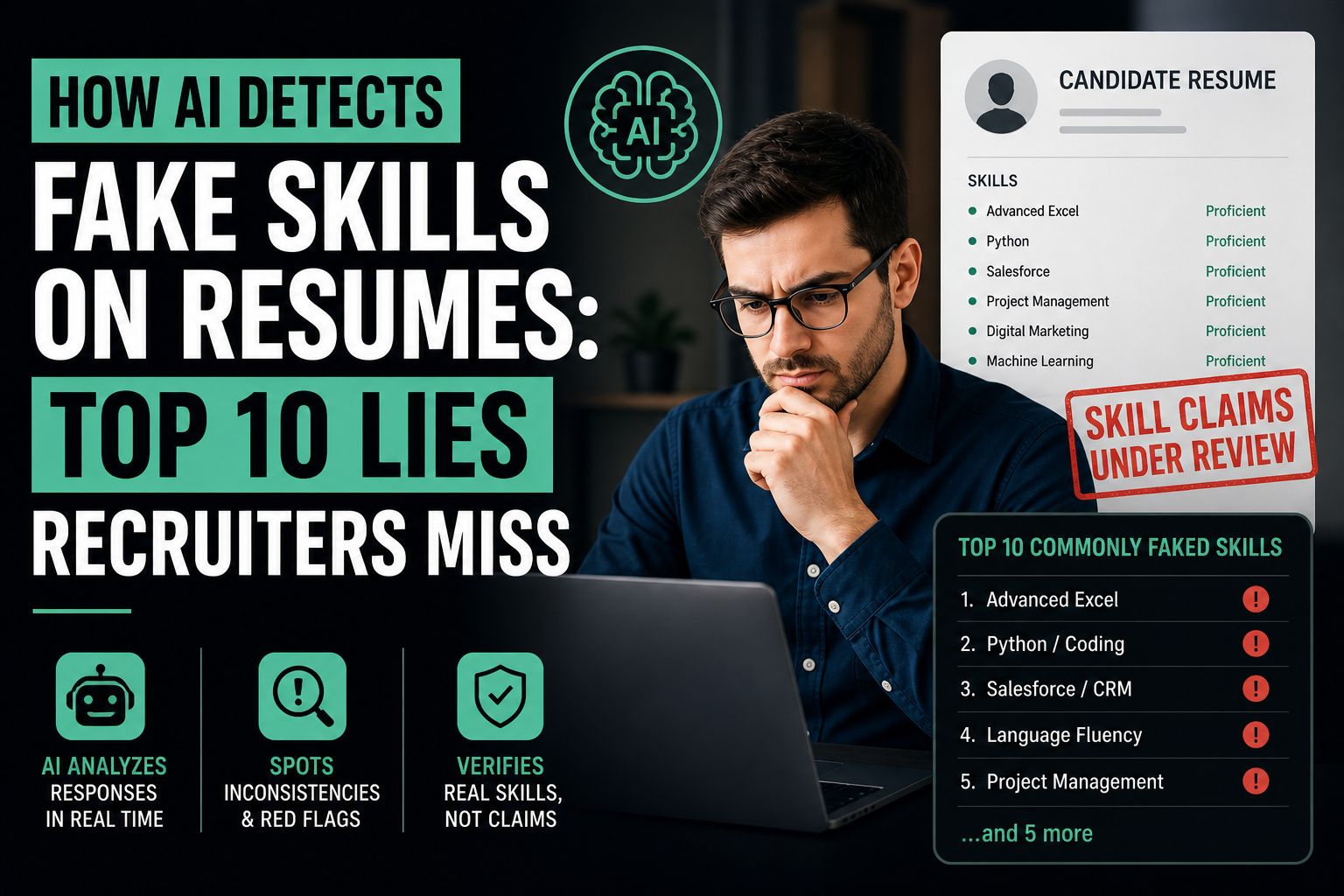
The 10 most commonly faked skills on resumes and how AI catches them
.jpeg)
March 15, 2026
The Resume Has Always Been a Document of Aspiration. Now It's a Document of Fabrication.
Resume fraud isn't new. Candidates have always stretched the truth — inflated titles, vague responsibilities, skills listed because they once sat through a webinar. What's changed is the scale and the sophistication. AI writing tools can now produce a polished, keyword-dense resume in under three minutes. ATS optimisation guides tell candidates exactly which words to include to pass automated screening. And a generation of hiring tools designed to filter at speed have created a paradox: the easier it is to screen, the easier it is to game the screening.
The result is a significant portion of the resumes in your pipeline contain skills the candidate either doesn't have, can't demonstrate under pressure, or learned at a surface level that won't survive contact with real work. A 2023 study by StandOut CV found that nearly 36% of workers admitted to lying on a resume at some point. The actual number is almost certainly higher — most people don't admit it even anonymously.
This guide covers the 10 skills most commonly faked on resumes, what a real vs fabricated answer looks like, and how modern AI hiring tools detect the difference between genuine capability and a well-worded bluff.
Why Resume Fraud Is Getting Worse
Three forces are converging to drive resume fraud upward:
- AI resume generation: Tools like ChatGPT, Kickresume, and Teal can generate a skills-rich, professionally written resume in minutes. Candidates don't need to have done something — they just need to describe it convincingly.
- ATS keyword gaming: Entire communities exist to teach candidates how to reverse-engineer job descriptions and mirror language back into their resumes. Skills get listed not because they're real, but because they match what the algorithm is screening for.
- Unverified claims going unchallenged: Most interviews still rely on self-report. Candidates say they know something. Interviewers take it at face value and move on. The skill is never actually tested until the person starts the role — at which point the cost of the mistake is already baked in.
The fix isn't catching liars. It's building a hiring process where the truth surfaces naturally — and where AI can accelerate that surfacing at scale.
The Business Cost of Hiring on Faked Skills
| Scenario | Estimated Cost | Source of Loss |
|---|---|---|
| Bad hire at mid-level role ($60k–$90k salary) | $25,000–$50,000 | Recruiting, onboarding, productivity loss, replacement |
| Bad hire at senior/specialist role ($100k+) | $80,000–$200,000+ | Delayed projects, team disruption, knowledge gaps |
| Engineering hire who can't code to stated level | 3–6 months of productivity loss per team member | Carrying underperformer, technical debt, morale |
| Sales hire who can't prospect or close | Lost pipeline, missed targets, customer churn | Revenue directly tied to their quota |
| Data hire with surface-level analytics skills | Wrong decisions made on bad analysis | Business decisions downstream, not just the hire cost |
Insight: Resume claims are cheap signals. Real experience shows up in specificity — the details, numbers, failures, and decisions that someone who actually did the work can produce without thinking.
The 10 Most Commonly Faked Skills on Resumes
1. Data Analysis / Advanced Excel
Why candidates fake it: "Data analysis" is listed on almost every job description and sounds more impressive than "I know how to sort a spreadsheet." Most candidates have used Excel at some level — they just list the most advanced-sounding version of that truth.
What a weak answer looks like: "I'm proficient in Excel and use it for data analysis and reporting." No tools named, no scale described, no methodology mentioned.
What a strong answer looks like: "I built a weekly revenue variance model in Excel using INDEX-MATCH and dynamic named ranges, pulling from three separate data sources. It reduced the FP&A team's monthly close from 3 days to 6 hours."
How AI detects it: AI interview tools probe for specificity — which functions, at what scale, for what business purpose. Candidates who fake Excel proficiency typically describe outcomes but cannot describe the method. AI flags this gap between claimed capability and demonstrated knowledge when follow-up questions get more technical.
2. Project Management
Why candidates fake it: "Project management" is ambiguous enough to mean almost anything, from coordinating a team lunch to managing a $2M product rollout. Candidates know this and use the vagueness as cover.
What a weak answer looks like: "I have strong project management skills and am experienced in managing stakeholders and timelines." Generic, untestable, meaningless.
What a strong answer looks like: "I ran a cross-functional ERP migration across 4 departments, managing 14 stakeholders, a €400k budget, and an 8-month timeline using a hybrid Agile-Waterfall approach. We went live on day 238, 2 weeks ahead of schedule."
How AI detects it: Real project managers can describe scope, constraints, stakeholder dynamics, and what went wrong. AI-assisted interviews ask specifically about scope changes, escalations, and decisions made under pressure. Fabricated experience collapses quickly when asked for specifics on how a risk was handled or a deadline was renegotiated.
3. SQL / Database Skills
Why candidates fake it: SQL is one of the most in-demand technical skills and also one of the easiest to list without demonstrating. Anyone who has run a SELECT query once will list "SQL" on their resume.
What a weak answer looks like: "Proficient in SQL, used for querying databases and pulling reports." Could mean anything from one introductory course to daily production work.
What a strong answer looks like: "I write complex multi-table joins and window functions daily in Snowflake. I built and own our customer churn prediction query — it runs every Monday and feeds the CS team's weekly dashboard. Happy to walk through the logic."
How AI detects it: AI tools can administer simple technical questions inline — "describe a query you wrote that required a subquery or CTE and explain why" — and evaluate whether the response reflects genuine working knowledge or surface-level familiarity.
4. Leadership / Team Management
Why candidates fake it: Every candidate wants to appear leadership-ready. "Leadership" gets added to resumes after managing one intern, leading one standup, or being the most senior person in a two-person team for three months.
What a weak answer looks like: "Demonstrated strong leadership skills managing a team of 5 across multiple projects." Who, doing what, for how long, with what outcome — all absent.
What a strong answer looks like: "I managed a team of 6 SDRs for 18 months. During that time I implemented a structured coaching cadence — weekly 1:1s with call recording review — and we improved average meetings booked per rep from 6 to 11 per month. One rep was promoted internally."
How AI detects it: AI probes for the hard parts of management: underperformance conversations, hiring decisions, team conflict, giving difficult feedback. Candidates who have genuinely managed people describe these scenarios with friction and nuance. Those who haven't give answers that sound like a LinkedIn post about leadership principles.
5. CRM Proficiency (Salesforce, HubSpot)
Why candidates fake it: CRM tools are listed on virtually every sales and marketing job description. Having "Salesforce" on a resume is table stakes — and candidates know it. Many have used it at the surface level (logging calls, looking up contacts) and list it as a proficiency.
What a weak answer looks like: "Experienced with Salesforce CRM for managing pipelines and customer data." That's the description of someone who opened Salesforce once.
What a strong answer looks like: "I built our team's custom Salesforce dashboard for pipeline velocity tracking — created custom fields, set up workflow automation rules for lead routing, and trained 12 reps on the new process. It reduced our average deal stage stagnation from 18 to 9 days."
How AI detects it: AI asks for the last workflow or automation the candidate configured, or what they changed in their CRM setup that improved a team metric. Real users can answer immediately. Those who listed it as a skill because they know the name typically can't describe anything beyond basic functionality.
6. Communication Skills
Why candidates fake it: "Excellent communication skills" appears on so many resumes it's become invisible. The irony is that candidates who can't communicate well are the ones most likely to list it — because they believe they have it and it costs nothing to add.
What a weak answer looks like: "Strong written and verbal communication skills with experience presenting to stakeholders." Identical to what 80% of applicants write.
What a strong answer looks like: "I wrote the monthly executive briefing for our CTO and CFO for 2 years. I learned to lead with the metric that changed, explain why in two sentences, and recommend one action. It replaced a 20-slide deck and our exec time per briefing dropped from 45 minutes to 8."
How AI detects it: Communication skill is demonstrated, not described. AI-assisted async interviews reveal communication quality directly — through how a candidate structures their answer, their clarity under ambiguity, and whether they can explain something complex concisely. A candidate who claims strong communication but rambles, hedges, or over-qualifies every point is self-revealing.
7. Python / Programming Languages
Why candidates fake it: Python has crossed from technical skill to general resume currency. Candidates in analytics, finance, and even marketing list Python after completing a single Coursera module. The skill sounds technical; the reality is often beginner-level at best.
What a weak answer looks like: "Proficient in Python for data analysis and automation." Could describe anything from pandas basics to production ML pipelines.
What a strong answer looks like: "I built a web scraping script in Python using BeautifulSoup that pulled competitor pricing data from 14 sites and piped it into a Google Sheet via the API. It ran on a cron job and saved our pricing team 6 hours a week of manual work."
How AI detects it: AI tools can administer short technical probes — "walk me through a script you wrote and what problem it solved" — and evaluate the response for depth, debugging awareness, and library familiarity. Candidates who learned Python for the resume can describe what Python does; they can't describe what they built with it.
8. Strategic Thinking
Why candidates fake it: "Strategic thinking" is one of the most overused and least defined phrases in hiring. It appears on resumes and job descriptions with equal vagueness, which makes it easy to claim and almost impossible to disprove without good interview design.
What a weak answer looks like: "Strong strategic thinker with experience aligning teams to long-term business goals." Nothing here is falsifiable — or meaningful.
What a strong answer looks like: "When I joined, our team was chasing 22 different KPIs with no clear priority. I ran a 3-session working group to identify the 4 metrics that actually drove revenue, built a single-page strategy document, and got sign-off from the VP. Quarter-on-quarter target hit rate went from 54% to 78%."
How AI detects it: AI identifies whether a candidate can articulate a decision they made, the trade-offs involved, what they gave up to focus, and what the outcome was. Strategic thinking candidates describe choosing not to do things as readily as they describe what they did. Fabricated strategic thinkers describe direction without constraint and outcome without sacrifice.
9. Digital Marketing / SEO
Why candidates fake it: Digital marketing encompasses enough sub-disciplines that a candidate can list it confidently while only having touched one part of it superficially. SEO in particular is listed by anyone who has read three blog posts about keywords.
What a weak answer looks like: "Experienced in digital marketing including SEO, social media, and content strategy." No channel, no metric, no outcome.
What a strong answer looks like: "I ran SEO for a 400-page ecommerce site. Over 14 months, I grew organic sessions from 22k to 91k per month through a combination of technical fixes (crawl budget, Core Web Vitals), topical cluster content, and a backlink outreach programme. Conversion rate from organic traffic held at 2.4% throughout."
How AI detects it: AI asks for the last campaign or initiative run, the metrics tracked, what worked and what didn't. Real digital marketers speak fluently about attribution, platform changes, and performance variance. Those who listed the skill based on personal blog management or a short course answer in generalities and avoid specific numbers entirely.
10. Adaptability / Working Under Pressure
Why candidates fake it: Every candidate knows they're supposed to be adaptable. It costs nothing to say it. Virtually no one lists "struggles with change" on their resume, which means "adaptable" signals nothing — unless it's backed by specific evidence.
What a weak answer looks like: "I'm highly adaptable and thrive under pressure in fast-paced environments." This is on approximately 60% of resumes. It conveys nothing.
What a strong answer looks like: "Three weeks into my role, my manager left suddenly and I was asked to cover two departments while a replacement was found. I built a prioritisation matrix, worked with both teams to triage deliverables, and maintained output on both sides for 11 weeks. The replacement hired me as their deputy when they joined."
How AI detects it: AI asks for the hardest change a candidate has had to navigate at work and what it cost them personally. Real adaptability stories include the difficulty — the anxiety, the things that slipped, the trade-offs made. Fabricated adaptability stories describe challenge-free pivots and effortless adjustment. The absence of struggle is the tell.
How AI Detects Fake Skills: The Depth and Specificity Signal
AI interview evaluation doesn't catch liars by looking for inconsistency in what they say — it catches them by probing for depth they don't have. The detection mechanism is simple: real experience generates specific, unprompted detail. Fabricated experience generates polished generality.
AI tools use several signal types to distinguish the two:
- Specificity probing: Follow-up questions that require candidates to name the exact tool, the specific number, the precise decision. Fabricated experience can answer the first question; it rarely survives the second or third.
- Failure and obstacle detection: Real experience includes things that went wrong. AI prompts for what didn't work, what the candidate would do differently, what the hardest part was. Candidates who fabricated experience cannot describe failure because they have none to describe.
- Transferability testing: AI asks the candidate to apply the skill to a hypothetical scenario close to the role. Someone who genuinely knows SQL can describe how they'd approach a specific data problem. Someone who listed SQL cannot.
- Unprompted detail analysis: AI evaluates whether candidates volunteer supporting detail without being asked. Real expertise naturally generates context — tools used, team size, timeline, constraint. Fabricated skill produces clean, contextless answers.
AI vs Human Verification: What Each Does Better
| Verification Task | Human Interviewer | AI Tool |
|---|---|---|
| Assessing rapport and interpersonal fit | Strong | Limited |
| Probing technical depth consistently across all candidates | Inconsistent (depends on interviewer knowledge) | Strong |
| Detecting vague or evasive answers | Good (with training) | Strong (consistent) |
| Administering skill-based tasks or scenarios inline | Rarely done at volume | Scalable |
| Catching fabricated credentials or fake employment history | Poor without background check | Poor (needs background check integration) |
| Evaluating response quality against structured criteria | Variable (bias-prone) | Consistent (anchored to scorecard) |
| Asking 30 follow-up probes across 200 candidates | Impossible at scale | Standard operation |
| Adjusting evaluation based on role seniority | Good (with training) | Good (with configured scorecard) |
Insight: The best hiring processes don't choose between human and AI verification — they sequence them. AI handles depth probing at scale during screening. Humans handle relationship, judgment, and final decision at the panel stage.
Skill Comparison: What Faked vs Real Looks Like Side by Side
| Skill | Faked Answer Pattern | Genuine Answer Pattern |
|---|---|---|
| Data Analysis | "I use data to drive decisions and present insights to stakeholders." | "I built a churn model in Python using logistic regression. It flagged 340 at-risk accounts. CS worked 90 of them and retained 61." |
| Leadership | "I led cross-functional teams and developed high-performing individuals." | "I had to put one of my reports on a PIP. It was the hardest 6 weeks of my management career. Here's what I did and what I learned." |
| SEO | "I developed SEO strategies to improve organic search visibility." | "Domain rating went from 24 to 41 over 18 months. Here's the link profile strategy I used and why I stopped doing guest posts in month 9." |
| Project Management | "I manage timelines, budgets, and cross-functional stakeholders." | "The project went 3 weeks over on phase 2 because procurement delayed a vendor sign-off. Here's how I recovered the overall deadline." |
| Adaptability | "I'm a flexible self-starter who adapts quickly to changing priorities." | "Our product strategy pivoted completely in month 4. Three people on my team handed in notice. Here's how I held things together." |
Building a Skill Verification Layer in Your Hiring Process
Identifying faked skills isn't about assuming candidates lie — it's about building a process where the truth surfaces naturally regardless. Here's a practical layered approach:
- Map skills to evidence requirements upfront. For every skill listed as a requirement in the job description, define what demonstrated evidence looks like at 30, 60, and 90 days in the role. This becomes your scoring anchor for interviews.
- Use structured behavioural questions mapped to listed skills. Don't just ask "do you know SQL?" Ask for the most complex query the candidate has written in the last 90 days and why. The specificity requirement separates real from fabricated.
- Add a short practical task to the process. For technical roles, a 30–45 minute task reveals skill level faster than any number of interview questions. Keep it relevant, scoped, and respectful of candidate time.
- Use AI-assisted screening to probe consistently at volume. AI tools can ask the same depth-probing follow-ups to every candidate without fatigue or variation. This creates comparable data across your pipeline — something human-only screening rarely achieves.
- Reference check against specific skills. Most reference checks ask generic questions. Instead, ask references: "On a scale of 1–10, how would you rate their SQL proficiency, and can you describe a specific piece of work that informs your rating?" Specificity from references is as valuable as specificity from candidates.
Metrics to Track Hiring Quality Over Time
| Metric | What It Measures | Target Benchmark |
|---|---|---|
| 90-day performance vs. interview score correlation | Whether interview evaluation predicts real performance | Positive correlation r > 0.5 |
| Skill gap rate at 30 days | % of new hires with a material gap in a listed skill | Below 15% |
| Voluntary exit within 6 months citing role mismatch | Indicator of misrepresented candidate fit | Below 8% |
| Interviewer score variance per competency | Consistency of panel scoring (interrater reliability) | Max 1-point variance |
| Time to identify skill gap post-hire | How quickly the hiring process failure surfaces | Aim to surface via process, not post-hire |
FAQ: Resume Fraud, Skill Verification, and AI Hiring
What skills are most commonly faked on resumes?
The most commonly faked skills are data analysis, project management, SQL and programming languages, leadership, CRM proficiency, communication, digital marketing, and broad soft skills like adaptability and strategic thinking. These are targeted because they appear frequently in job descriptions, sound impressive, and are rarely tested directly during traditional screening.
Can AI detect resume fraud?
AI tools can't verify that a candidate never held a job or fabricated a credential — that requires background screening. What AI excels at is detecting the gap between claimed and demonstrated skill. By probing for depth, specificity, failure examples, and technical application, AI-assisted interviews reveal whether a candidate's knowledge is genuine or surface-level. Fabricated skill collapses under structured follow-up questioning.
How do recruiters verify skills listed on a resume?
Effective skill verification combines structured behavioural interviewing (STAR-based questions mapped to specific skills), practical tasks or assessments for technical roles, AI-assisted depth probing at the screening stage, and targeted reference checks that ask about specific capabilities rather than general performance. Relying on resume claims alone — or asking "are you proficient in X?" — verifies nothing.
How do you test real ability during an interview?
Ask for the most recent specific example of the skill in use, then probe for the method, the obstacle, the decision made, and the measurable outcome. For technical skills, include a short practical task. The combination of behavioural specificity plus applied demonstration catches fabricated experience more reliably than any number of direct skill questions.
Is it worth spending time on skill verification for every hire?
Yes — but the depth of verification should match the cost of a bad hire in that role. A senior technical or commercial hire warrants a structured skills assessment, practical task, and AI-assisted behavioural screening. A junior administrative role may only require a single targeted behavioural question per listed skill. The principle is the same; the investment scales with the stakes.
How does AI-assisted interviewing reduce skill fraud at scale?
AI handles the part of skill verification that humans find hardest to do consistently at volume: asking the same structured follow-up questions to every candidate without variation, fatigue, or bias. At 200 applications per role, no human panel is asking 15 depth-probing questions per candidate. AI can — and the consistency creates comparable data that surfaces faked skills across the entire pipeline, not just the candidates who get to a live interview.
Stop hiring on resume claims. NinjaHire uses AI to probe skill depth, surface faked experience, and give your team structured, comparable data on every candidate.
Try for free
.jpg)
.png)
