The ATS-Adjacent Approach: Enhancing Without Replacing
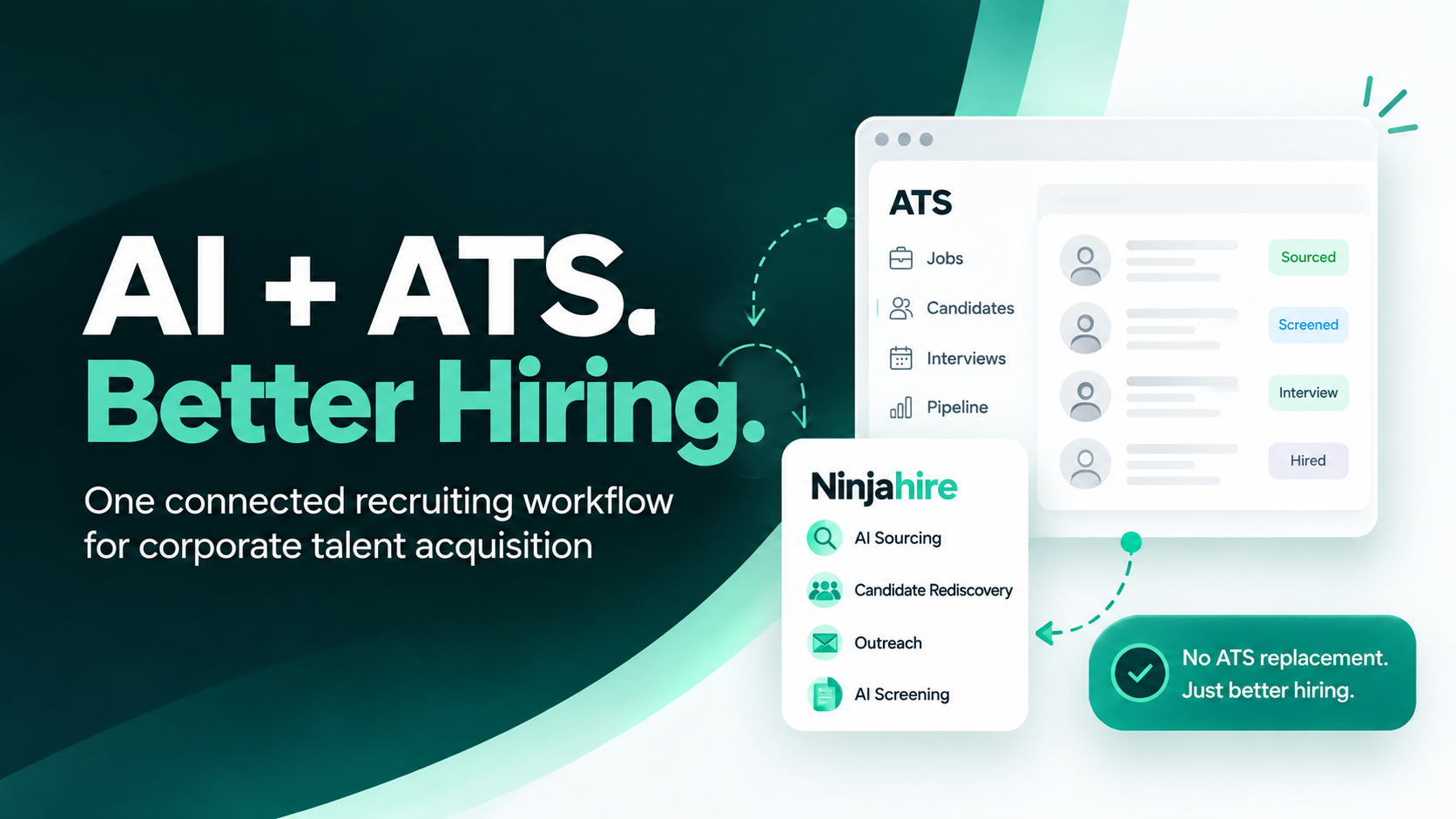
The ATS-adjacent approach keeps your existing ATS as the system of record while connected AI tools execute selected recruiting workflows around it. Sourcing, matching, screening and outreach sit alongside the ATS, with results returned to the central record. This is the architecture Ninjahire describes in its vendor-reported explanation of an AI recruiting stack.
Publisher disclosure: Ninjahire publishes this article and is one of the product examples below.
Can you add AI recruiting tools without replacing your ATS?
Yes. Corporate talent acquisition teams can add specialist AI tools around an existing applicant tracking system to support candidate rediscovery, sourcing, outreach and screening. Before choosing a tool, verify what the integration can read and write, which actions require approval, how candidate data is handled, and whether the workflow improves hiring outcomes. An integration listing alone does not guarantee that every required action is supported.
The broader principle is not specific to Ninjahire. In a November 2025 interview with Recruiting Future, Josh Bersin recommended a robust ATS supplemented by industry-, job- or role-specific tools, rather than expecting one platform to excel at every recruiting function. The Josh Bersin Company's architecture also places recruiter oversight across applications, AI execution and data integration.
What AI does around the ATS
Think in workflows, not additional software licenses. For a hypothetical new requisition, an ATS-adjacent design could follow these steps:
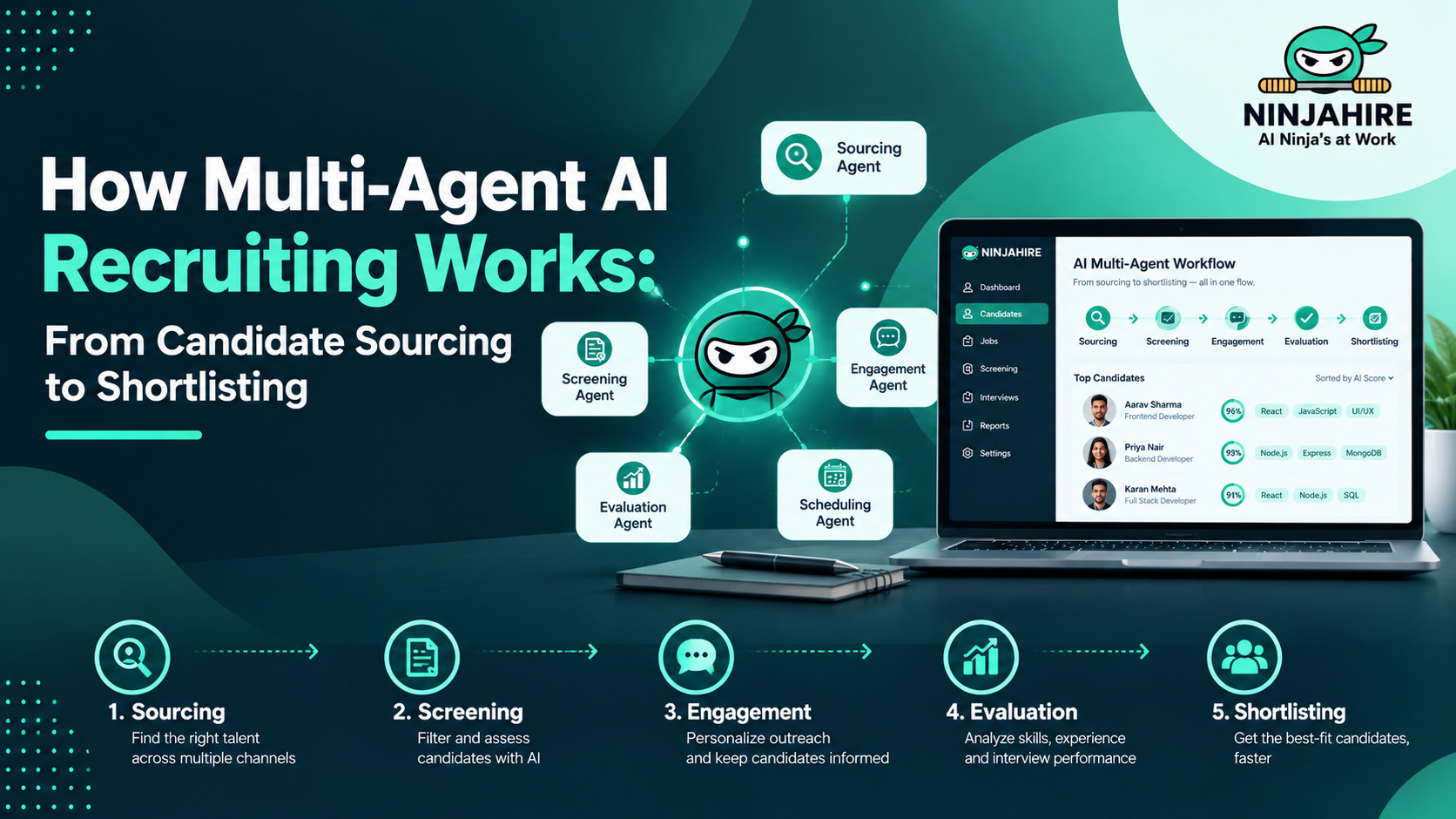
- Rediscover previous candidates. Search existing records before starting external sourcing. Ninjahire's vendor-reported AI sourcing workflow begins by searching a connected ATS or CRM for previous candidates who match the new role. The practical question is whether relevant people already exist in your database, not simply how many new profiles a tool can find.
- Expand the search where needed. Ninjahire describes moving beyond existing ATS records into its Ninjagraph database and external job boards, followed by sequential contact-data enrichment in its AI sourcing workflow. This is a vendor-reported workflow, not evidence that every profile is qualified or every contact detail is usable.
- Run approved outreach. Ninjahire's pricing page lists email, SMS and phone outreach as commercial capabilities; these are vendor-reported. For a pilot, define which candidates may be contacted, through which channels, and who approves the communication before enabling execution. That permission boundary is a deployment recommendation, not an assumed connector capability.
- Produce screening evidence for review. Ninjahire describes configurable questions and scoring criteria, outbound AI calls, inbound callbacks, and transcripts, summaries and scored results for recruiters in its AI phone screening workflow. These are vendor-reported capabilities. In this example, a useful review checkpoint would be checking the interview evidence before deciding whether a candidate progresses.
An adjacent tool is not automatically necessary for every step. Greenhouse's native talent rediscovery includes AI-generated search keywords, past-interview filters, CRM segmentation and reusable searches. Evaluate what your current ATS already provides before buying overlapping functionality.
ATS-adjacent integration map (reference architecture)
| Layer | System responsibility | What to verify |
|---|---|---|
| Existing ATS | Authoritative requisitions, applications, statuses, and hiring records | Record ownership, field permissions, audit trail |
| Ninjahire workflow layer | Configured discovery, sourcing, outreach, and screening activities | Which steps are available for your plan and deployment |
| ATS connector | Reads permitted requisition/candidate fields and writes authorized updates | Connector-specific field mappings, sync timing, retries, duplicates |
| Recruiter and hiring manager | Approves criteria and consequential candidate decisions | Review controls, exceptions, escalation and accessible alternatives |
This is an evaluation architecture, not a claim that every named connector supports every operation. Compare the proposed design to the connector documentation and a real end-to-end pilot.
Define the integration contract
"Integrates with your ATS" should start a technical conversation, not end it. Ask which records the connector reads, which outputs it writes, how quickly changes synchronize, and which actions must still happen inside the ATS.
Workday's HiredScore documentation illustrates why those details matter: it describes synchronization of actions and requisition status, but says new applicants usually appear after approximately 5-15 minutes and may take up to 24 hours. Candidates cannot be moved between requisitions inside HiredScore. These are product-specific boundaries, not universal limits of ATS-adjacent architecture.
For your pilot, specify the expected destination for each output: a candidate record, screening summary or recruiter review queue. Treat those destinations as acceptance criteria to verify, not capabilities implied by an integration listing.
Separate access from decision authority
A connected application should not automatically receive authority to reject candidates. The deployment inference is to authorize reading data, writing records, changing stages, sending outreach and triggering rejection separately.
Greenhouse's Harvest v3 integration documentation requires an appropriately authorized user to connect partner integrations and presents requested permissions through OAuth. That establishes an access checkpoint. Before processing likely to create high risks, the ICO recommends completing a data protection impact assessment and contractually documenting controller and processor roles.
High-Value Workflows: Rediscovery, Sourcing, Outreach, and Screening
Four workflows offer practical starting points for AI integration. Evaluate each as a defined recruiting process, with inputs, permitted actions and a recruiter checkpoint, not simply as an AI feature. This approach aligns with Josh Bersin's recommendation to supplement a robust ATS with specialist tools rather than expect one platform to excel at everything.
Example: a corporate TA team reopening a high-volume role
Imagine a corporate TA team needs to fill several similar roles and has already interviewed candidates for an earlier hiring round. Instead of starting from scratch, the team could first search its existing ATS for people who may fit, ask recruiters to review the shortlist, and expand to external sourcing only if the database does not meet the requirement.
The team would agree on job-related criteria with hiring managers, approve any outreach before it is sent, and keep screening evidence available for recruiter review. During the pilot, it would compare qualified candidates progressed, recruiter review time, candidate completion and total operating cost with a baseline.
This is an illustrative workflow, not a customer case study or a claim of measured results. The actual steps depend on the ATS, connector and product plan.
1. Rediscovery: search existing candidates first
Rediscovery starts with people already in your recruiting database. Greenhouse's vendor-reported capabilities include AI-generated search keywords, past-interview filters, CRM segmentation and reusable searches. Ninjahire's vendor-reported sourcing workflow similarly begins by searching a connected ATS or CRM for previous candidates matching a new role.
The intended improvement is more systematic reuse of existing records before starting an external search. For example, a proposed workflow could retrieve previously interviewed candidates for a reopened role, then ask a recruiter to verify current fit and decide whom to recontact. Treat historical assessments as context, not automatic approval.
Before buying another tool, test whether native rediscovery meets the requirement. For evaluation, a proposed scorecard should count qualified reactivated candidates and hires, not merely records retrieved.
2. Sourcing: expand the search beyond existing records
External sourcing addresses the next question: where should the team look when its existing database does not produce a suitable shortlist? Ninjahire's vendor-reported sequence expands from ATS records into its Ninjagraph database and external job boards, followed by sequential contact-data enrichment.
This illustrates how search and enrichment can form a connected workflow rather than separate research tasks. It does not establish that every returned profile is suitable or every contact detail is current. Ask recruiters to approve job-related search criteria and review a sample of proposed candidates before expanding activity.
Data provenance belongs in that checkpoint. The ICO found recruitment tools collecting excessive personal information and combining scraped professional-network and social-media data without adequate awareness among recruiters or candidates. A proposed sourcing measure is qualified candidates accepted into the process, not database size.
3. Outreach: connect contact channels to progression
Outreach is the contact stage between identifying someone and inviting participation. Ninjahire lists email, SMS and phone outreach as commercial capabilities; these are vendor-reported features, not evidence of improved response rates.
For a pilot, define which candidates may be contacted, which channels are appropriate, what messages require approval and when contact must stop. A proposed workflow might prepare an invitation after recruiter approval, then route interested candidates to the next step. Verify that the selected product supports each action before deployment.
Keep permission to send outreach separate from permission to read candidate records; that separation is a recommended deployment design, not an automatic property of an ATS connection. Evaluate qualified positive responses and subsequent progression rather than message volume alone.
4. Screening: gather structured evidence for review
Screening offers a concrete execution workflow. Ninjahire's vendor-reported phone-screening capabilities include configurable questions and scoring criteria, outbound AI calls, inbound callbacks, and transcripts, summaries and scored results for recruiter review. Its outbound agent reportedly identifies itself as an AI recruiter before the interview.
The potential improvement is structured evidence collection before recruiter assessment, not proof that an AI score should determine rejection. Configure role-specific questions and require reviewers to examine supporting responses, especially when a candidate falls near a decision threshold.
A reasonable deployment design should provide advance explanation, a visible human-contact or alternative-process route, accessible participation and review of disputed records. For the pilot, track validated progression, false negatives and candidate completion, rather than completed screens alone.
Governance and Permissions: Ensuring Compliance
Before deployment, separate permission to connect a tool from permission to act on candidates. A practical governance model should authorize data access, record changes, outreach and hiring decisions independently, not treat an ATS connection as blanket approval. This is a deployment recommendation drawn from the available evidence, not a universal legal requirement.
Define permissions by action
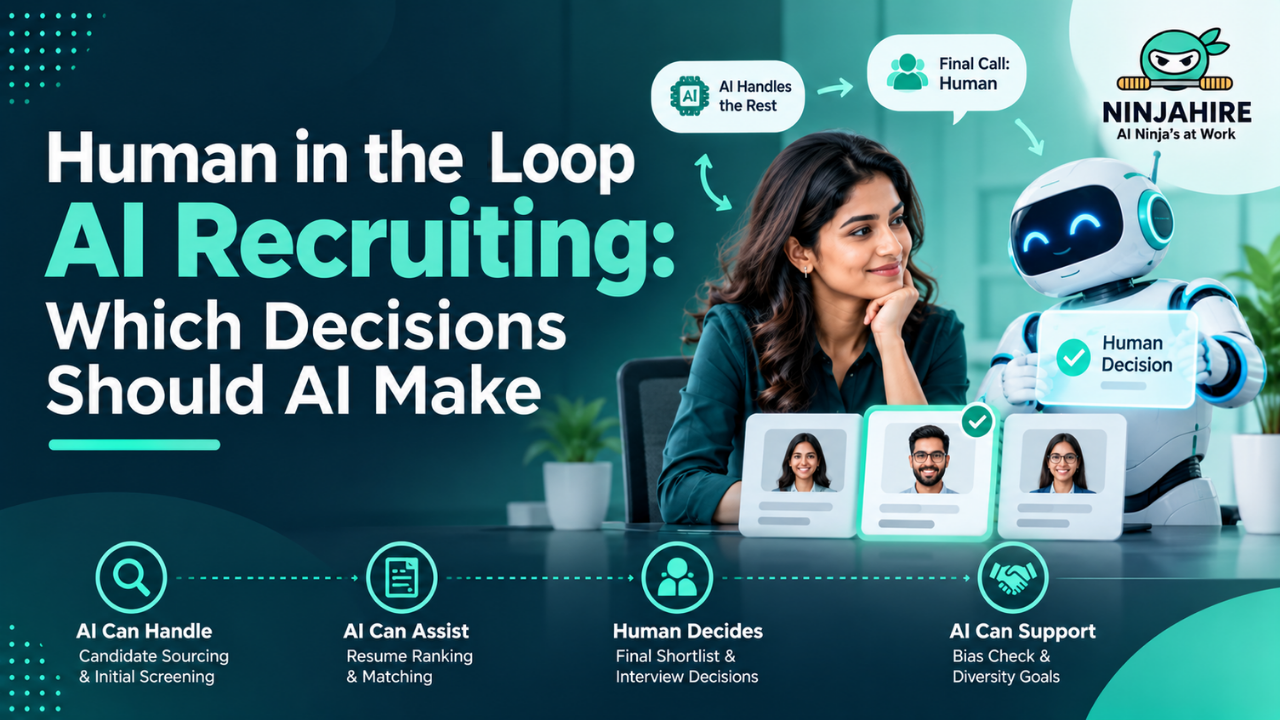
Create a permission matrix covering five actions: reading candidate data, writing records, changing stages, sending outreach and triggering rejection. For each, name an approver, specify the permitted scope and decide whether execution requires human approval.
For example, a proposed sourcing pilot could permit reading past applications and writing recruiter-review notes while withholding permission to reject candidates. That is an illustrative configuration, not a documented customer implementation. Verify that the selected connector supports the intended restrictions before granting access.
Establish privacy ownership before processing
The ICO's recruitment AI audit recommends defining controller and processor roles, documenting those roles contractually, and completing a data protection impact assessment before processing likely to create high risks. Make those decisions part of deployment approval, rather than leaving them until after candidate data starts flowing.
Ask suppliers to document where candidate information originates, which fields enter the workflow and why each is necessary. The ICO found excessive personal-information collection and combinations of scraped professional-network and social-media data entering recruiting databases without adequate recruiter or candidate awareness. An available profile should not automatically become an approved recruiting input.
Make human review consequential
After gathering evidence from more than 30 employers between March 2025 and January 2026, the ICO concluded that many employers using automated recruitment were likely making solely automated significant decisions without meaningful human involvement. A nominal review step should therefore not be your acceptance criterion.
As an operational safeguard, require reviewers to inspect supporting evidence, challenge scores and change proposed outcomes before consequential decisions execute. Specify who handles disagreements and how their reasoning is recorded. These are recommended controls for making oversight meaningful.
Ninjahire provides one concrete workflow illustration: its vendor-reported AI phone screening process returns transcripts, summaries and scored results for recruiter review. Use those outputs as review material; their availability alone does not establish meaningful human involvement.
Map obligations to the actual use
Ask legal counsel to assess the tool, hiring use and applicable jurisdictions before launch. For tools and employment uses covered by New York City Local Law 144, requirements include a bias audit within one year of use, publicly available audit information and required notices. City guidance specifies notice 10 business days before use. Build applicable deadlines into the launch plan.
Give candidates a usable route to assistance
A reasonable deployment design should explain AI's role in advance, provide a visible human-contact or alternative-process route, support accessible participation, allow disputed records to be reviewed and define when screening outcomes will be communicated. These are recommended safeguards, not a claim that every jurisdiction mandates identical steps. Assign an owner to each safeguard and test the candidate-facing process before enabling production outreach or screening.
Safeguarding Candidate Experience
38% of US respondents in Greenhouse's survey of job seekers of 2,950 job seekers across five countries reported withdrawing from a hiring process because it included an AI interview. That is a vendor-reported survey finding, not a predicted withdrawal rate for your organization. It nevertheless gives TA leaders a reason to test candidate acceptance alongside screening performance.
The practical risks extend beyond interview preference: unclear automation, excessive data collection, decisions without meaningful human involvement, and no obvious way to resolve problems. The safeguards below combine regulatory findings with recommended deployment practices; they are not evidence that any particular implementation eliminates those risks.
Explain the process before candidates enter it
Before an automated screen, explain what the AI will do, what information it will collect, how recruiters will use its output, and when candidates should expect an update. Make the human-contact route visible in the invitation rather than leaving candidates to discover it after a problem. These are recommended design safeguards.
Ninjahire, this article's publisher, provides one workflow illustration. Its vendor-reported phone-screening process includes an outbound agent that identifies itself as an AI recruiter, configurable questions and scoring criteria, and transcripts, summaries, and scored results for recruiter review. Disclosure at the start of a call is one checkpoint; advance explanation and an escalation route should be separate deployment requirements.
Where NYC Local Law 144 covers the tool and employment use, required notices are not optional process preferences. The city requires a qualifying bias audit within one year of use, public availability of audit information, and notices; its guidance specifies notice 10 business days before use.
Offer a usable alternative and correction route
Design participation around exceptions, not just the default journey. Recommended safeguards include accessible participation, a visible human-contact or alternative-process route, review of disputed records, and a defined deadline for screening outcomes.
For example, a proposed screening invitation could explain how to request another format or contact a recruiter if the interview record is inaccurate. Assign an owner to those requests and define how unresolved disputes affect progression. Treat this as a workflow to implement and test, not as a capability automatically supplied by an AI vendor.
Make human review consequential
The ICO's evidence gathering from more than 30 employers found that many employers using automated recruitment were likely making solely automated significant decisions without meaningful human involvement. A nominal review step is therefore not sufficient reassurance.
As a deployment recommendation, authorize candidate-data access, record writing, stage changes, outreach, and rejection separately. Do not let permission to connect a tool become blanket permission to reject candidates. For disputed screening records, specify who can examine the record, reconsider the outcome, and communicate the response.
Protect data before expanding sourcing
The ICO found recruitment tools collecting excessive personal information and combining scraped professional-network and social-media information without adequate awareness among recruiters or candidates. This makes data provenance a candidate-experience concern, not merely an integration question.
Before deployment, ask what information enters the workflow and why each category is needed. Follow the ICO's recommendations to define controller and processor roles, document them contractually, and complete a data protection impact assessment before processing likely to create high risks.
Measure experience during the pilot
Use a predefined pilot cohort and a concurrent control or carefully matched baseline. The recommended evaluation should include candidate experience, fairness, downstream quality, and total operating cost, not throughput alone.
For screening, track candidate completion, validated progression, and false negatives. Add a review of disputed records and whether promised outcome deadlines were met. Use those observations to decide which workflow steps need revision before broader rollout. These are proposed operating measures, not established product results.
Defining Success Metrics: Focusing on Outcomes
Define AI success as better hiring outcomes at an acceptable cost, not more automated activity. Treat profiles found, messages sent and interviews completed as diagnostic counts, not the pilot's primary success criteria. A proposed evaluation framework should connect each workflow to downstream quality, candidate experience, fairness and total operating cost. This is an evaluation recommendation, not a claim of demonstrated improvement.
Start with the hiring outcome
Agree with hiring managers on what a successful hire looks like before configuring sourcing or screening criteria. LinkedIn's guidance on quality of hire describes quality of hire as an organization-specific combination of job performance, retention and hiring-manager satisfaction, measured consistently.
For your pilot, specify which measures you will use, who owns them and when they become available. Keep early indicators, such as acceptance into the interview process, separate from post-hire outcomes. Do not label a larger shortlist "better quality of hire" before validating what happens to those candidates. This distinction follows the proposed evaluation framework's emphasis on downstream quality.
Match metrics to the workflow
Use this proposed four-workflow scorecard as a starting point, rather than treating it as an established industry benchmark.
| Workflow | Primary outcome to measure | Activity count to keep secondary |
|---|---|---|
| Rediscovery | Qualified previous candidates reactivated, and eventual hires | Existing records searched |
| Sourcing | Qualified candidates accepted into the hiring process | Profiles found |
| Outreach | Qualified positive responses and subsequent progression | Messages sent |
| Screening | Validated progression, false negatives and candidate completion | Screens completed |
These outcome measures reflect the evidence-informed scorecard; the activity column provides suggested operational counters for comparison.
Define "qualified" before launch using agreed role criteria. Track both counts and conversion rates, with explicit denominators. For example, evaluate qualified positive responses against candidates contacted, not simply total replies. Treat this as a recommended measurement design, not a customer result.
Ninjahire provides a concrete screening example: its vendor-reported workflow delivers transcripts, summaries and scored results for recruiter review. Evaluate those outputs by whether candidates progress under an agreed human assessment, while auditing a sample of non-progressing candidates for potential false negatives, not by how many summaries the system produces. This is a proposed application of the screening scorecard.
Establish a baseline and decision rules
Compare a predefined pilot cohort with a concurrent control or carefully matched baseline. Include downstream quality, candidate experience, fairness and total operating cost rather than attributing every change during the pilot to AI.
For implementation, define these rules before reviewing results:
- Comparable cohorts: Match role requirements and recruiting conditions as closely as practical; document differences.
- Full operating cost: Include software, implementation, recruiter review and correction work in the proposed cost calculation.
- Quality checks: Review progression decisions and sample rejected candidates rather than inspecting successful candidates alone.
- Candidate safeguards: Track completion, withdrawals and disputed records alongside speed.
- Decision thresholds: Agree what improvement justifies expansion and what deterioration requires investigation.
These are practical recommendations derived from the pilot-evaluation and workflow-scorecard frameworks, not validated thresholds. Set review dates that accommodate both early workflow indicators and later hiring outcomes.
Pilot scorecard template
Agree on the baseline and measurement period before launch. Fill in the results during the pilot rather than assuming the tool will improve them.
| Measure | Baseline | Pilot result | Owner |
|---|---|---|---|
| Recruiter review time per qualified candidate | To be measured | To be measured | TA operations |
| Qualified candidates progressing to the next stage | To be measured | To be measured | Recruiting lead |
| Candidate completion and withdrawal rate | To be measured | To be measured | Candidate experience owner |
| Screening records requiring correction | To be measured | To be measured | Recruiting operations |
| False negatives found in a reviewed sample | To be measured | To be measured | TA and hiring manager |
| Total operating cost, including review and correction work | To be measured | To be measured | Finance and TA operations |
Set expansion criteria before the pilot starts. If candidate experience, data quality or downstream quality deteriorates, investigate and adjust the workflow before increasing usage.
Ninjahire: A Practical Example of ATS-Connected AI Recruiting
The practical pattern is an execution layer around the ATS, not a replacement. Ninjahire, this article's publisher, describes sourcing, matching, screening and outreach with results returned to the existing system of record. This architecture is vendor-reported.
Integration scope. Ninjahire advertises more than 50 ATS integrations, including Workday, Greenhouse, iCIMS and Lever, on its integrations page. That is vendor-reported compatibility, not connector-specific implementation evidence. Before deployment, ask which records the connector reads, which outputs it writes, and which actions require separate authorization, a recommended governance distinction rather than a confirmed product configuration.
Workflow execution. Ninjahire describes these vendor-reported stages:
- Search a connected ATS or CRM for previous candidates matching a new role.
- Expand into Ninjagraph and external job boards, then enrich contact data sequentially.
- Conduct outreach through email, SMS and phone.
- Run phone screens using configurable questions and scoring criteria; deliver transcripts, summaries and scored results for recruiter review.
Evidence of success. These capabilities illustrate the operating model, but do not establish corporate-TA outcomes. The published case study concerns an unnamed US IT staffing agency, not an attributable corporate-TA reference. A proposed pilot should compare downstream quality, candidate experience, fairness and total operating cost against a control or matched baseline.
Frequently Asked Questions
Can AI recruiting software work with an existing ATS?
Yes, some AI recruiting tools connect to an existing ATS, but the level of integration varies. Check which records the connector reads, which fields it can update, how quickly changes sync and which actions still require a recruiter.
What is the difference between a native ATS feature and an external AI recruiting tool?
A native feature is part of the ATS you already use. An external tool adds a specialist capability and may connect through a partner integration or API. Compare actual workflow coverage, permissions, implementation effort and ongoing maintenance before deciding.
What should corporate TA teams check before connecting AI to an ATS?
Confirm field mappings, read and write permissions, duplicate handling, sync timing, data retention, outreach approvals and the route for human review. Test the full workflow with sample records before using it with live candidate data.
How should a team measure the ROI of AI recruiting integration?
Compare a defined pilot with a baseline or suitable control. Track qualified candidate progression, recruiter review time, candidate completion, false negatives, data corrections and total operating cost. Profiles found and messages sent are useful activity measures, but they do not prove hiring quality or ROI by themselves.
How can recruiters retain control over candidate decisions?
Separate permission to read data, update records, change stages, send outreach and reject candidates. Make sure a qualified person can review the evidence, challenge an output and document a decision before consequential actions occur.
Evaluate an ATS-Adjacent Pilot
Start with one ATS, one recruiting workflow, and clearly defined read/write permissions. Verify candidate import, data provenance, approved outreach, screening summaries, and synchronization before expanding. Explore Ninjahire integrations, AI Sourcing, and our existing ATS and CRM rediscovery workflow. Confirm connector-specific capabilities directly rather than inferring them from a partner logo.