.png)
Outreach response rates in recruiting: benchmarks and how AI improves them

March 15, 2026
Updated May 2026 · 14 min read
Outreach Response Rates in Recruiting: Benchmarks and How AI Improves Them
If you're sending candidate messages and hearing nothing back, you're not alone — and you're not doing it wrong. Response rates across recruiting outreach have been declining for years, and the competition for passive candidate attention has never been fiercer. But there's a smarter way to approach this. Here's what the data says, why things are the way they are, and how AI is genuinely changing the game.
The Reality of Recruiter Outreach in 2026
Recruiting has always been a volume game — or at least, that's been the assumption. The more messages you send, the more candidates you reach, the more hires you make. For a long time, that logic held. But something shifted, and if you've been in talent acquisition for more than a couple of years, you've felt it. Passive candidates are less responsive than ever. Inboxes are noisier. LinkedIn notifications have become background static. And the copy-paste outreach templates that worked in 2019 are now practically invisible.
The average recruiter today sends somewhere between 50 and 150 outreach messages per week. But the fraction of those that get a meaningful reply — a reply that leads anywhere — has been shrinking. Recruiters who relied on sheer volume are running into diminishing returns. And meanwhile, the best candidates, the ones passively open to opportunities but not actively looking, have learned to tune out anything that doesn't feel personal, timely, and relevant to them specifically.
What we're dealing with in 2026 is a signal-to-noise crisis. The recruiter outreach response rate problem isn't about effort — most recruiters are working harder than ever. It's about approach. And understanding the benchmarks honestly, channel by channel, is the first step to doing something about it.
Outreach Response Rate Benchmarks by Channel
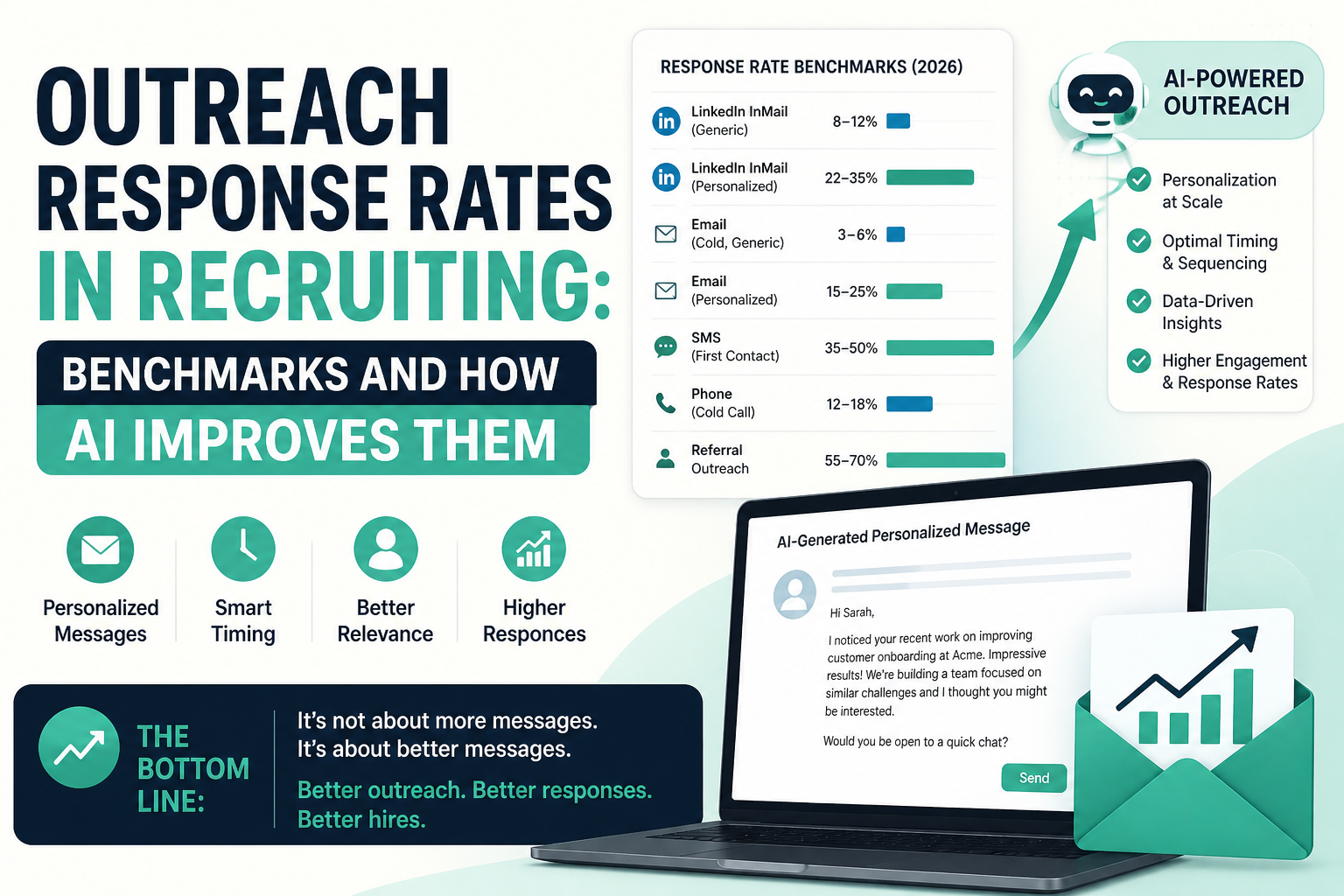
Before you can improve your numbers, you need to know where the baseline sits. Recruiting response rate benchmarks vary significantly depending on the channel, the seniority of the role, the industry, and how well the message is crafted. Here's what current data suggests across the most common outreach channels:
| Channel | Average Response Rate | Top-Performer Benchmark | Notes |
|---|---|---|---|
| LinkedIn InMail (generic) | 13–18% | 30–40% | Highly variable; personalization is the biggest lever |
| LinkedIn InMail (personalized) | 25–35% | 45–55% | Custom first line + role relevance drives lift |
| Recruiter email (cold) | 10–15% | 22–30% | Subject line and sender credibility matter most |
| Email (multi-touch sequence) | 18–25% | 35–45% | Follow-up timing significantly improves conversion |
| Text / SMS outreach | 30–45% | 55–65% | High open rates; must be used carefully and with consent |
| LinkedIn connection request note | 20–30% | 40–50% | Short, personalised notes outperform blank requests |
| AI-assisted personalised outreach | 35–50% | 55–70% | Consistent quality at scale drives higher rates |
These numbers tell a clear story: generic outreach, regardless of channel, performs poorly. The LinkedIn InMails response rate that most recruiters actually see sits in the 13–18% range — meaning more than 80% of your messages go unanswered. That's a significant investment of time with limited return. But the same channel, used with genuine personalisation, more than doubles in effectiveness. The channel itself is rarely the problem.
📊 Key Stats: Candidate Outreach Response Rate in 2026
• Generic LinkedIn InMails average 13–18% response rate across industries.
• Personalised InMails with role-specific context see 25–35% average response rates.
• AI-assisted outreach achieves 35–50% average response — a 2–3x improvement over generic templates.
• 72% of candidates say they ignore outreach that feels templated or mass-sent.
• Follow-up sequences improve total response rates by 30–50% compared to single-touch outreach.
Why Response Rates Are Declining
If response rates are partly a function of message quality, why are aggregate numbers declining even as recruiters become more aware of personalisation? The answer is layered, and it's worth unpacking honestly.
First, the supply of outreach has exploded. LinkedIn now has over 1 billion members, and the recruiter tools available to reach them have become more accessible and affordable. The result is that high-value candidates — senior engineers, experienced product managers, specialists in any in-demand field — are receiving multiple recruiter messages every week. Some receive several every day. Even a well-crafted message competes for attention in a genuinely crowded inbox.
Second, candidates have become more discerning about what's worth their time. A passive candidate who's comfortable in their current role has no urgency to respond. For them to engage, the opportunity needs to feel clearly relevant, the message needs to demonstrate that the recruiter has actually looked at their profile, and the ask itself needs to be low-friction. Any sign that a message was blasted to 500 people signals "not worth my time."
Third, there's a trust deficit. Candidates have been burned. They've responded to outreach only to discover the role was misrepresented, the salary range wasn't real, or the recruiter went quiet after the first call. Word travels fast in professional communities, and that collective experience makes people more cautious about engaging at all.
Finally, outreach fatigue is real. Even candidates who were once responsive have developed habits — filtering, ignoring, archiving — that protect their time. The messages that break through are the ones that feel different: specific, timely, and human.
The Real Driver: Relevance and Personalisation
Every study of recruiter email response rates and InMail performance points to the same variable: relevance. Not just mentioning someone's name, but demonstrating through the message itself that you understand their background, have thought about why this specific role might interest them, and have done the work to connect those dots.
Personalised outreach in recruiting isn't about swapping in a first name and a job title. It's about showing up in someone's inbox with something worth their time. That might mean referencing a specific project they led, a technology shift they'd be well-positioned to work on, a company attribute that aligns with their stated interests, or a career trajectory that makes the opportunity a logical next step.
The challenge is obvious: doing this at scale is genuinely hard. A recruiter managing 20 open roles and working through a pipeline of hundreds of candidates simply cannot research every person deeply before sending a message. The trade-off has historically been personalisation vs. productivity — go deep on a few, or go broad with templates. Neither approach fully works in a competitive talent market.
This is exactly where sourcing outreach strategy has had to evolve. The best recruiting teams today aren't choosing between quality and volume. They're using systems — increasingly AI-powered — that make relevance achievable at scale without requiring a recruiter to spend 30 minutes on every single message.
Response Rate: Generic vs. Personalised Outreach
Illustrative benchmark ranges based on industry data, 2024–2026.
How AI Actually Improves Outreach Performance
The phrase "AI recruiting outreach" gets thrown around a lot, but it's worth being specific about what AI is actually doing in high-performing teams — because the value isn't magic, it's mechanical in the best possible sense.
AI-powered outreach tools work across several distinct layers of the recruiting workflow. At the research layer, AI can analyse a candidate's public professional profile — their experience, skills, tenure patterns, the kind of work they've done, the progression they've made — and extract the specific details that make for a relevant message. This happens in seconds, not minutes, and it means every message can be informed by actual knowledge of the person, not just their job title.
At the message generation layer, modern AI models can draft outreach that incorporates those specific details naturally, in a tone that matches the recruiter's voice, and with the structure that research shows performs best. The output isn't a final message — it's a strong starting point that a recruiter can review, adjust, and send with confidence. In practice, many recruiters using these tools report that they're approving or lightly editing 70–80% of AI-drafted messages rather than rewriting them.
At the sequence layer, AI can manage multi-touch follow-up intelligently — spacing messages appropriately, adjusting cadence based on engagement signals, and flagging candidates who have shown passive interest (like viewing the recruiter's profile) for priority follow-up. This kind of timing intelligence is something a human recruiter managing a large pipeline simply cannot track manually without things slipping through the cracks.
The cumulative effect is substantial. Teams that implement AI-assisted outreach consistently report candidate engagement outreach improvements in the 30–80% range compared to their previous approach. The variation depends on how manual their previous process was and how much they lean into the personalisation capabilities of the tools.
It's also worth noting what AI doesn't do: it doesn't replace the recruiter's judgment. The best outcomes come from teams where recruiters are actively involved in reviewing messages, refining the AI's output based on their knowledge of the role and company, and building the kind of authentic human connection that ultimately closes candidates. AI makes the first touch better; the recruiter makes the rest of the process work.
AI vs Traditional Outreach: A Direct Comparison
If you're weighing whether to invest in AI recruiting outreach tools, here's a grounded comparison of what traditional manual outreach and AI-assisted outreach actually look like across the dimensions that matter most:
| Dimension | Traditional Manual Outreach | AI-Assisted Outreach |
|---|---|---|
| Message quality | High for a small number of candidates; inconsistent at scale | Consistently high across large volumes |
| Personalisation depth | Deep on priority candidates; shallow on the rest | Role-relevant personalisation on every message |
| Time per message | 5–20 minutes for a quality message | 30–90 seconds review and approve |
| Response rate (avg) | 13–25% depending on effort | 35–50% with AI-driven personalisation |
| Follow-up consistency | Often skipped or delayed under workload | Automated, timed, and tracked |
| Scalability | Limited by recruiter bandwidth | Scales with pipeline size |
| A/B testing | Rarely done due to manual effort | Built into most modern platforms |
| Compliance & tone control | Dependent on individual recruiter | Centrally managed with guardrails |
| Analytics & reporting | Manual tracking; often incomplete | Real-time dashboard with channel-level data |
The comparison isn't meant to suggest that AI replaces skilled recruiters — it clearly doesn't. What it does is redistribute where recruiter time and judgment go. Instead of spending three hours crafting and sending 20 messages, a recruiter using AI tools can review and approve 80 messages in the same time, with each one being more relevant and better structured than anything produced under time pressure manually.
Teams evaluating specific platforms often find it useful to compare tools against each other before committing. For example, a detailed look at ninjahire vs linkedin recruiter shows meaningful differences in how personalisation is handled at scale — LinkedIn Recruiter remains dominant for access and reach, but it wasn't built to generate personalised outreach the way dedicated AI tools are. Similarly, comparisons like ninjahire vs converzai help teams understand the specific tradeoffs in automation depth and message quality.
What High-Response Messages Actually Look Like
Theory is useful, but it's more useful to look at what actually works. High-performing recruiter outreach messages share a consistent set of structural characteristics, regardless of channel or role type.
They open with something specific. Not "I came across your profile and was impressed," but something that shows actual familiarity with the person's work. "Your experience leading the migration from monolith to microservices at Acme is exactly the kind of background we're looking for" lands very differently from a generic opener. The specificity signals that this isn't a mass message.
They connect the candidate's background to the opportunity explicitly. Don't make the reader do the work of figuring out why they're being contacted. A sentence or two that draws a clear line between what they've done and why that makes this role relevant to them removes a major friction point.
They include a clear, low-friction ask. "Would you be open to a 15-minute chat?" outperforms "Are you interested in exploring a new opportunity?" which outperforms "Please apply at the link below." The easier the next step, the higher the conversion.
They're short. The single most consistent finding across recruiter email response rate studies is that shorter messages outperform longer ones. A message that can be read in 30–45 seconds is more likely to get a response than a detailed pitch that requires three minutes of reading. If someone needs to know more, they'll ask.
They avoid jargon and corporate language. "We're a fast-paced, innovation-driven organisation looking for a passionate rockstar" tells a candidate nothing meaningful. Plain language that describes the role, the team, and the challenge is more credible and more engaging.
One useful exercise is to audit your last 20 outreach messages against these criteria. Most recruiters find that 60–70% of their messages fail at least two of them — usually specificity and brevity. That's where the improvement opportunity lives.
A/B Testing Outreach at Scale
One of the underutilised levers in recruiting outreach is systematic testing. Most recruiters have intuitions about what works — shorter messages, personalised openers, specific subject lines — but relatively few teams have the infrastructure to test those intuitions rigorously. AI-powered outreach platforms change this.
A/B testing in recruiting outreach works the same way it does in marketing: you run two versions of a message to a split audience, measure the response rate for each, and use the winner going forward. The difference is that in recruiting, your audience is usually smaller and the stakes per candidate are higher, so you need to be thoughtful about how you set up tests.
The variables worth testing first are subject line or opening line (the single biggest lever in cold outreach), message length, the framing of the ask, and the specific elements of personalisation you lead with. Each of these can swing response rates meaningfully, and the winning combination isn't always intuitive — some candidate segments respond better to direct role-focused messages while others respond better to culture and mission framing.
Teams using AI tools for sourcing outreach strategy typically accumulate enough data within three to four months to identify statistically meaningful patterns in what works for specific roles, seniority levels, or candidate profiles. That learning compounds over time: a team that's been systematically testing for a year has a significant performance advantage over one that's been relying on gut feel.
For those comparing AI recruiting tools, platforms like ninjahire vs tenzo ai or ninjahire vs hireez differ meaningfully in their A/B testing capabilities and how deeply they surface message performance analytics. These differences matter when you're trying to build a data-driven outreach programme rather than just sending more messages.
The broader point is that improving recruiter outreach response rates isn't a one-time fix. It's an ongoing process of learning what resonates with your specific candidate audience, testing variations, and continuously refining. Teams that treat outreach as a performance channel — with the same discipline marketers apply to email campaigns — consistently outperform those that treat it as an ad hoc activity.
The Ethics of AI Outreach
Any serious conversation about AI recruiting outreach has to include the ethical dimensions. Not because AI outreach is inherently problematic, but because the capability to send highly personalised messages at massive scale creates real responsibilities — for candidates and for the integrity of the hiring process.
The first consideration is honesty. AI can help a recruiter write a personalised, relevant message — but the message should still accurately represent the role, the company, and the opportunity. Using AI to make a mediocre opportunity sound better than it is will improve your initial response rate and destroy your offer acceptance rate, your employer brand, and your relationship with candidates over the longer term. The point of better outreach is to reach the right people with genuine opportunities, not to manufacture interest in roles that don't stand on their own merits.
The second is transparency about the process. Most candidates don't need to know the mechanics of how a message was drafted — they care whether the role is real, whether the recruiter can have a genuine conversation about it, and whether the opportunity is actually relevant to them. But teams should be thoughtful about not creating a false impression of individual attention when the interaction is heavily automated. The human connection that closes candidates still needs to happen; AI just helps get you to that conversation faster.
The third is data responsibility. AI outreach tools work because they analyse candidate data — work history, skills, professional activity. Teams using these tools need to ensure they're doing so in compliance with applicable data protection regulations (GDPR for European candidates, CCPA for California, and the growing number of equivalents globally) and that they're not using data in ways candidates wouldn't reasonably expect.
Finally, there's the question of volume. Just because you can send 500 personalised messages per day doesn't mean you should. If every recruiter and every company leverages AI to flood the same candidate pools with high-quality outreach, the signal-to-noise problem simply re-emerges at a higher quality level. The most sustainable use of AI in outreach is targeted precision — reaching fewer, more qualified candidates with higher relevance — rather than simply scaling up volume.
Building a High-Performance Outreach System
Getting your recruiting response rates from average to genuinely strong isn't about finding one magic tactic. It's about building a system where every component — sourcing, message quality, sequence timing, follow-up, and analytics — works together. Here's how high-performing teams approach this.
Start with sharper targeting. The biggest response rate gains often come not from better messages but from better lists. Sending a relevant message to a candidate who is genuinely a strong fit for the role will always outperform sending a great message to someone who's only marginally qualified. Invest time in defining the specific criteria — not just skills and experience, but career stage, company context, and the signals that indicate passive openness — before you start reaching out.
Build a message framework, not a template. A template is a fixed text that gets swapped with names. A framework is a structure — opening hook, connection to their background, the opportunity, the ask — that AI can flesh out differently for every candidate. The framework ensures consistency and quality; the AI ensures genuine personalisation within it.
Plan your sequence before you start. Single-touch outreach is significantly less effective than a thoughtfully spaced multi-touch approach. A common high-performing pattern: first message with personalisation, a follow-up 4–5 days later with a new angle or additional context, a final brief message 5–7 days after that. Three touches, spaced appropriately, can lift your total response rate by 30–50% over a single message.
Track and act on engagement signals. Profile views, InMail opens, link clicks — these are signals of passive interest even when someone hasn't replied. High-performing recruiters treat these as warm leads and prioritise follow-up accordingly. AI tools that surface these signals automatically and trigger contextual follow-up make this practical at scale.
Review your analytics weekly. Response rate by channel, by role type, by message version — these metrics tell you what's working and what's not. Teams that review this data regularly and adjust their approach accordingly improve faster than those that set and forget their outreach programmes.
Don't neglect the post-response experience. Your response rate measures how many candidates you engage. What happens next determines whether that engagement converts into hires. Slow follow-up after a response, misrepresented role details, or a poor screening call experience will kill your pipeline even if your outreach is excellent. The outreach system has to connect seamlessly to a candidate experience that earns the trust you've started to build.
Teams evaluating end-to-end solutions sometimes find it helpful to look at newer entrants in the space. A side-by-side like ninjahire vs heymilo can clarify differences in how platforms handle the full candidate journey from initial outreach through to scheduling and engagement — which matters if you want your response rate improvements to translate into actual pipeline results rather than just higher reply numbers.
📊 What High-Performing Outreach Teams Do Differently
• 87% of top-performing recruiting teams use a structured multi-touch outreach sequence.
• Teams with AI-assisted personalisation spend 65% less time per message while achieving higher response rates.
• Recruiters who review outreach analytics weekly see 2x faster improvement in response rates vs those who review monthly.
• Following up on profile views within 24 hours lifts response rates by 40% compared to delayed follow-up.
The Takeaway: Response Rates Are a Skill, Not a Mystery
The recruiters and teams seeing strong outreach response rates in 2026 aren't doing something fundamentally different from what's always worked — they're reaching the right people with genuinely relevant messages, following up appropriately, and continuously refining based on what the data tells them. What's changed is that AI has made it possible to do all of that consistently across a much larger pipeline than any human could manage manually.
The LinkedIn InMails response rate question, the email open rate question, the "why isn't anyone replying to me" question — these all have the same underlying answer: relevance, at the right time, in the right voice, with the right ask. AI doesn't change what works. It makes what works scalable.
If you're still relying on generic templates or single-touch outreach, you're leaving a significant amount of candidate engagement on the table. The benchmarks are clear. The mechanisms are understood. The tools exist. The question is how quickly your team is going to make the shift.
Ready to improve your outreach response rates?
NinjaHire helps recruiting teams send personalised, AI-powered outreach at scale — so you spend less time writing messages and more time having conversations with the candidates who matter. Smarter outreach, better response rates, faster hires.
Try for FreeFrequently Asked Questions
What is a good recruiter outreach response rate?
A "good" recruiter outreach response rate depends on the channel and context, but as a general benchmark, anything above 25–30% for LinkedIn InMails is above average. Top-performing recruiters using personalised, AI-assisted outreach typically see 35–55% response rates. If you're consistently below 15%, it's a strong signal that your messages need more personalisation, your targeting needs to be sharper, or both. Generic templates across any channel tend to produce response rates in the 10–18% range regardless of how much volume you send.
Why do candidates not respond to recruiters?
There are several common reasons candidates don't respond to recruiter outreach. The most frequent is that the message doesn't feel relevant — it reads like a templated mass outreach that was sent to hundreds of people, and the candidate sees no reason to invest time in it. Other reasons include: the role is clearly a poor fit for their background, the message is too long and requires too much effort to read, there's no clear and easy next step, or the candidate has had negative experiences with recruiter outreach before and defaults to ignoring it. Improving relevance and personalisation addresses the majority of non-response situations.
Does AI actually improve recruiter outreach response rates?
Yes — consistently and measurably. AI improves recruiter outreach response rates primarily by making genuine personalisation scalable. Instead of choosing between high quality on a few messages or low quality on many, AI-assisted tools allow recruiters to produce relevant, well-structured messages across their entire pipeline. The research and message drafting that would take a human 10–20 minutes per candidate can be done in under 90 seconds, with output that incorporates specific details from the candidate's professional background. Teams using AI outreach tools typically see a 30–80% improvement in response rates compared to their previous manual approach.
What is the average LinkedIn InMail response rate for recruiters?
The average LinkedIn InMail response rate for recruiters sits between 13–18% for generic outreach, and between 25–35% for personalised messages. LinkedIn's own data has historically reported average InMail response rates around 10–25%, with significant variance based on message quality, the seniority of the target audience, and the relevance of the role. Senior and highly sought-after candidates tend to have lower response rates simply because they receive more outreach volume. Subject line and the first sentence of the message have the largest impact on whether an InMail gets opened and replied to.
How many follow-up messages should a recruiter send?
A three-touch sequence — initial outreach plus two follow-ups — is the most common high-performing pattern in recruiting outreach. The first follow-up should come 4–5 days after the initial message and add new information or context rather than simply repeating the original ask. The second follow-up, 5–7 days after that, should be brief and easy to respond to. Beyond three messages, response rates drop sharply and the risk of negative brand perception increases. The key principle is that each follow-up needs to offer something new — a different angle on the role, a piece of information that might be relevant, or a connection to something in the candidate's recent work — rather than just restating that you'd like to connect.
How can I improve my recruiting outreach response rates quickly?
The fastest improvements in recruiting outreach response rates typically come from three changes: tightening your targeting (only reaching out to candidates who are a genuine fit for the specific role), rewriting your opening line to include something specific about the candidate's background rather than a generic opener, and shortening your messages to under 150 words. These three changes alone can meaningfully lift response rates within weeks. Over the medium term, adopting a structured multi-touch sequence and using AI tools to personalise at scale will compound those initial gains. Reviewing your response rate analytics regularly and testing different message approaches accelerates improvement further.

.jpg)
.png)
