.png)
How to hire remotely across time zones using AI tools

March 15, 2026
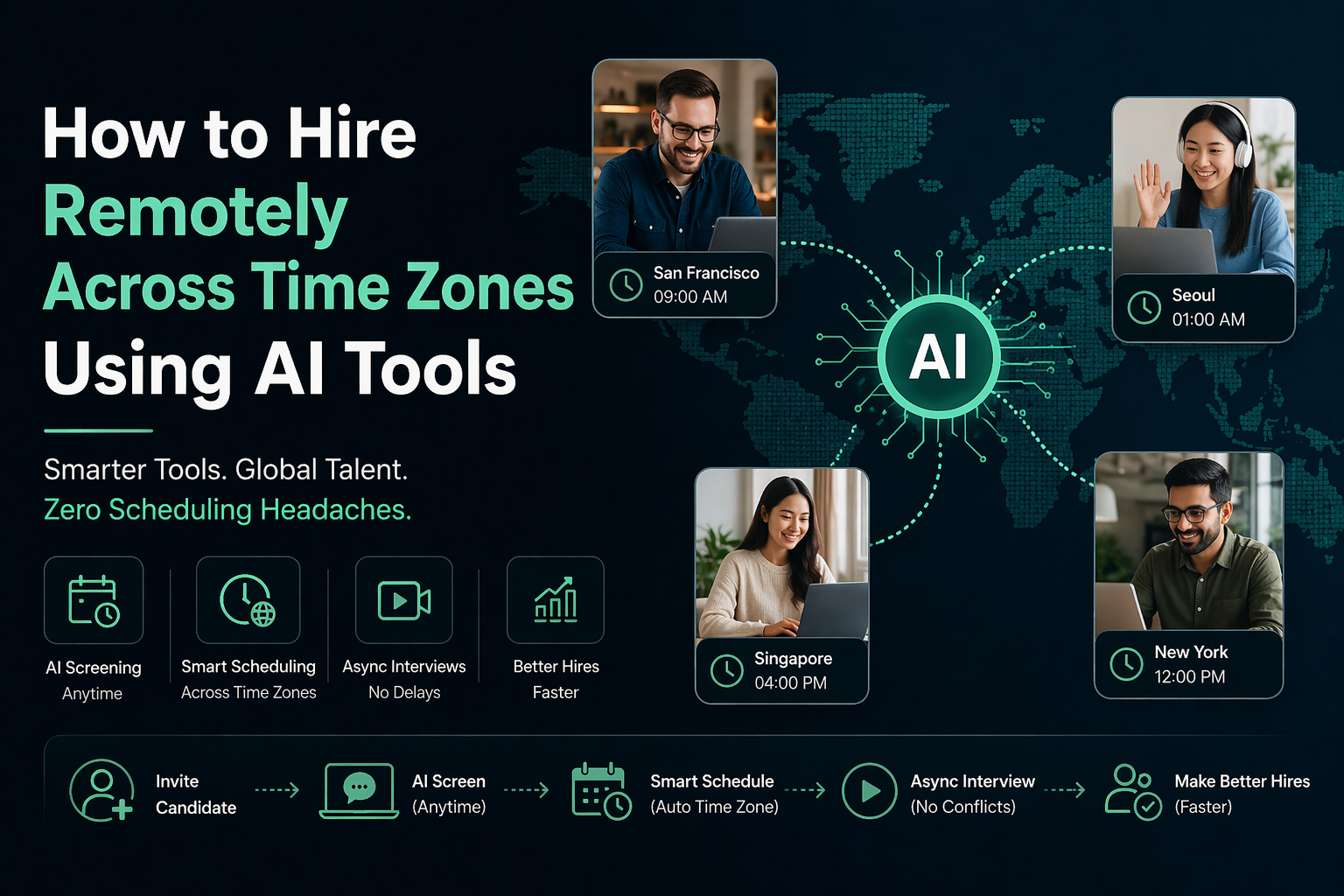
What Is Global Remote Hiring Across Time Zones
Remote hiring across time zones is the process of sourcing, screening, interviewing, and onboarding candidates who live in different geographic regions — often with little to no scheduling overlap with the hiring team. It relies on structured async workflows, AI-powered screening, and automated coordination systems to move candidates through a hiring pipeline without requiring both sides to be available at the same moment.
If your team is in London and your best candidate is in Manila, you are not just dealing with a logistics issue. You are dealing with a structural gap in how traditional hiring was designed. The whole recruitment playbook — phone screens, live interviews, panel rounds — was built for people sitting in the same city, available during the same working hours. Global remote hiring is the discipline of rebuilding that playbook for a world where talent has no geography.
Done well, it dramatically expands the talent pool available to any company. Done poorly, it creates delays, candidate frustration, and a process that quietly filters out excellent people simply because of where they live.
Why Time Zone Hiring Is Structurally Difficult
The core problem is not that time zones exist — it is that most hiring processes are synchronous by default. They assume everyone is available at roughly the same time. The moment you extend hiring beyond one or two time zones, that assumption breaks down, and the whole pipeline starts to slow.
Limited overlap windows. Between the US East Coast and Southeast Asia, there is a window of maybe one or two hours where both parties are in normal working hours. Between Europe and Australia, that window barely exists at all. When every interview requires scheduling into that narrow slot, you are effectively multiplying the number of competing constraints. Recruiting teams burn hours trying to find a time that works, candidates wait days for a reply, and the whole thing moves at the pace of the hardest-to-schedule person in the chain.
Coordination complexity. A five-stage hiring process with a phone screen, technical assessment, hiring manager interview, panel interview, and final round is already complex to manage for a local team. Run it across three continents and you now have to coordinate five separate calendar negotiations, each involving multiple stakeholders in different time zones. One rescheduling request can cascade delays across every subsequent stage. The recruiter becomes a full-time calendar manager rather than a talent evaluator.
Scheduling inefficiency. Most ATS platforms and scheduling tools are calendar-first, not time-zone-aware. They show availability in the recruiter's local time and require manual conversion — which introduces human error. Candidates get invites for the wrong time, show up at the wrong hour, or simply disengage because the process feels disorganized. What looks like a candidate engagement problem is often a scheduling infrastructure problem underneath.
The average global hire takes 33 to 49 days to complete when managed through synchronous scheduling. Teams that switch to async-first workflows with AI screening reduce that to under 15 days — not by rushing decisions, but by eliminating idle wait time between stages.
The Real Cost of Time Zone Coordination
Most hiring teams understand intuitively that time zone scheduling is painful. What they underestimate is how that friction compounds into measurable financial and operational damage. The cost shows up across candidate quality, time to fill, and recruiter productivity — all at once.
| Problem | Impact | Outcome |
|---|---|---|
| Scheduling delays | 3–7 days lost per interview stage waiting for a mutual slot | Time to hire doubles or triples compared to domestic hiring |
| Candidate drop-off | Top candidates abandon processes that take more than 2 weeks to schedule | You lose the best applicants to faster-moving competitors |
| Recruiter overload | Recruiters spend 40–60% of their time on scheduling logistics | Less time spent evaluating fit, writing quality feedback, or improving process |
| Interview no-shows | Global no-show rates are 20–35% higher than domestic hires | Wasted interview slots, reset timelines, team frustration |
| Panel coordination | Getting 3–5 interviewers on one call across time zones is near impossible | Panels get cancelled, delayed, or reduced to the people who happen to be available |
The hiring delay issue is the one most hiring managers focus on, but candidate drop-off is arguably more damaging. Senior engineers, experienced product managers, and specialized operators are not sitting around waiting for your recruiter to find a free slot. They are fielding multiple offers simultaneously. A hiring process that takes three weeks to get through its first two stages is effectively a self-selecting filter for candidates who have no other options. That is not who you want to be hiring.
Recruiter workload is the third leg of this problem. When your recruiters are spending the majority of their time on scheduling logistics, they are not doing the work that actually requires human judgment — evaluating candidates, building relationships, and improving the overall quality of the pipeline. It is expensive to have skilled people doing calendar management. It is even more expensive when they burn out from it.
How Async AI Screening Eliminates Scheduling Pain
Async AI screening is the most practical solution to the time zone problem that has emerged in the last three years, and it works by changing the foundational assumption of the hiring process. Instead of requiring the candidate and the recruiter to be present at the same time, it separates the two completely. The recruiter sets up the screening environment. The candidate completes it when they are ready. The AI evaluates the output. Nobody needs to coordinate.
In practical terms, this means a candidate in Lagos receives an interview link at 9pm their time, completes a 20-minute async voice or video screening at their own convenience, and has their responses evaluated and scored before the recruiter in Amsterdam starts their morning. By the time the recruiter opens their laptop, there is already a shortlist waiting.
The speed improvement is not marginal. Traditional phone screens require 30 to 60 minutes per candidate plus 15 to 20 minutes of prep and scheduling overhead per booking. An async AI screening of 200 applicants can be configured once, deployed immediately, and reviewed in aggregate — typically within 24 to 48 hours of job posting. You are compressing what used to take two to three weeks of recruiter time into a 48-hour automated cycle.
What makes this specifically powerful for global teams is the absence of time dependency. There is no overlap window to find. There is no early morning call that asks someone in Singapore to dial in at 7am. The candidate engages with the process at a time that fits their life, which also tends to produce better-quality responses than a rushed call scheduled at an inconvenient hour.
- Recruiter manually contacts candidates
- Back-and-forth email to find a time
- 30–60 min live phone screen
- Manual notes and scoring after call
- 3–7 days between stages
- High no-show rate across time zones
- AI sends interview links automatically
- Candidate completes on their schedule
- 15–25 min structured async screen
- AI scores and summarizes instantly
- Recruiter reviews shortlist next morning
- Near-zero scheduling friction
It is also worth being direct about what async AI screening is not. It is not a replacement for human judgment in hiring decisions. It is a tool for the top of the funnel — the stage where you are trying to determine whether a candidate meets baseline requirements and is worth investing a senior team member's time. Getting that stage right, quickly and at scale, is what unlocks the rest of the global hiring process.
Designing a Global AI Screening Setup
The difference between an AI screening setup that works globally and one that quietly introduces bias or confusion often comes down to three configuration choices: language, availability, and cultural tone. Most teams get the technology working and skip the calibration work. That is where the problems start.
Language Configuration
A global screening setup needs to be explicit about which languages are supported and which one the role requires proficiency in. If the job requires business-level English and your screening is deployed in English, that is a legitimate design choice — but it needs to be clearly communicated upfront so candidates can make an informed decision about applying. Where roles do not require a specific language, configuring the screening in the candidate's preferred language produces more accurate signal because it removes the cognitive load of working in a second language during an evaluation context.
The practical setup here involves working with your AI screening provider to confirm which languages are natively supported versus transcribed, and what the accuracy tradeoffs are in each case. Not all platforms handle language switching at the same quality level, and the gaps matter when you are evaluating nuanced answers about problem-solving or past experience.
Availability Screening
For roles where working hours overlap genuinely matters — customer-facing roles, real-time collaboration positions, support functions — your screening should include explicit availability questions early in the process. This is not about filtering out candidates from certain geographies. It is about surfacing a practical requirement before a candidate invests significant time in a process they cannot satisfy. Asking a candidate in their first async screening whether they are available to work 6am to 2pm UTC, for example, is more respectful of their time than discovering the misalignment in a final-stage interview.
Cultural Neutrality
AI screening questions need to be reviewed for cultural assumptions before being deployed globally. Behavioral questions written for a Western corporate context can come across as leading, confusing, or irrelevant to candidates from different professional cultures. Phrases like walk me through a time you pushed back on your manager might elicit genuine insight from candidates in environments where that behavior is normalized and valued — and produce confusion or strategic over-explanation from candidates in cultures where hierarchy operates differently. The answer is not to avoid behavioral questions. The answer is to write them clearly, remove idiom, and calibrate the evaluation rubric to focus on the underlying competency rather than the cultural framing of the answer.
Language and Accent Challenges in AI Hiring
AI screening tools that use voice or speech analysis are genuinely useful for global hiring, but they carry a fairness challenge that teams deploying them need to understand clearly. Automatic speech recognition systems are not equally accurate across all accents, dialects, and spoken English variations. A model trained predominantly on American English will transcribe a candidate from Nigeria, India, or rural Scotland with meaningfully lower accuracy than a candidate from New York. That accuracy gap translates directly into evaluation bias if you are not controlling for it.
The practical implication is that AI voice screening evaluations should not be used as a single source of signal for linguistic or communication skills without human review. If a candidate's transcription contains obvious errors caused by accent processing rather than unclear speech, and that transcription feeds into an automated scoring system, you will systematically disadvantage candidates from regions that your AI model was not trained on. That is not a hypothetical risk — it is a documented pattern in multiple independent audits of voice AI systems.
Calibration strategies that work include using text-based async responses as a complement to voice responses, building human review into the scoring process for any candidate who falls near a threshold, running periodic audits of screening outcomes by geography to identify any patterns of disproportionate rejection, and selecting AI providers who publish transparency data on their model's accuracy across language and accent variations. None of this requires abandoning AI screening. It requires using it with awareness rather than deploying it and walking away.
The teams getting this right are treating their AI screening setup as a living system that needs calibration data. They are reviewing false negatives — candidates who were screened out but who, on human review, clearly met the role requirements — with the same rigor they apply to hiring outcomes. That feedback loop is what separates a fair global hiring system from one that slowly degrades in quality while appearing to function.
Compliance in Cross-Border Hiring
Cross-border hiring introduces a layer of legal complexity that most growing companies underestimate until it becomes a problem. The compliance requirements vary significantly by jurisdiction, and the consequences of getting them wrong range from regulatory fines to invalidated employment contracts to reputational damage in the markets you are trying to hire from.
Jurisdiction differences. Employment law is local, even for remote workers. A contractor in Brazil is subject to Brazilian labor law regardless of where the company that hired them is headquartered. The distinction between employment and contracting varies dramatically by country — a structure that is legally clean in the US may constitute disguised employment in France or Germany, with significant penalties. Before building out a global hiring operation, you need a clear map of where you are hiring, what employment structures are permissible in each jurisdiction, and what obligations attach to each structure.
GDPR and data privacy considerations. If you are collecting candidate data from applicants in the European Economic Area, you are subject to GDPR regardless of where your company is based. This has direct implications for how AI screening systems store and process candidate responses. Specifically: you need a legal basis for processing, you need to inform candidates that their data is being processed by AI systems, and you need to be able to respond to Subject Access Requests and deletion requests. Most enterprise AI screening platforms now include GDPR configuration as standard — but you need to verify this rather than assume it, and you need to ensure your data retention policies are configured correctly from the start.
AI hiring regulations. A new layer of regulation is now emerging specifically around AI use in employment decisions. The EU AI Act classifies AI systems used in recruitment and employment as high-risk, which means companies using them within the EU will need to comply with documentation, transparency, and human oversight requirements. New York City passed Local Law 144, which requires bias audits for AI hiring tools used on NYC candidates. Illinois has its own statute on AI video interviews. This is a fast-moving regulatory environment, and the trajectory is clearly toward more requirement, not less. Building compliance capability into your global hiring stack now is significantly cheaper than retrofitting it later.
AI Scheduling for Global Interviews
Async AI screening handles the top-of-funnel problem well. But for later-stage interviews that do require live interaction — technical discussions, cultural fit conversations, final-stage panel rounds — you still need to schedule across time zones. This is where AI scheduling tools close the remaining gap.
Time zone automation. Modern AI scheduling systems do not just find an available slot in two calendars — they surface optimal windows based on each participant's time zone, working hours preferences, and real calendar availability simultaneously. The candidate sees available slots in their local time. The interviewer sees the same slots in their local time. The system handles conversion, buffer time, and confirmation automatically. What used to take three to five emails now takes one link click.
Reduced no-shows. No-shows in global hiring are primarily a communication problem, not a motivation problem. Candidates miss interviews because they had the wrong time in mind, because a calendar invite was sent in the wrong time zone, or because they did not receive a timely reminder. AI scheduling tools that send automated reminders at 24 hours and 1 hour before the interview, with the correct local time clearly stated, consistently reduce no-show rates by 25 to 40 percent compared to manual scheduling. That is not a marginal improvement — it is the difference between a functional pipeline and a broken one.
Improved candidate experience. Candidate experience is a competitive differentiator in global hiring, and it is one that most companies underinvest in. When a candidate in South Korea applies for a role with a company in Germany and receives a beautifully clear interview link that shows available slots in Korean Standard Time, confirms their booking instantly, and sends reminders automatically, that process communicates something about the company before a word has been exchanged in an interview. Compare that to a recruiter sending an Outlook invite with a time zone note buried in the body text, and the difference in first impression is significant.
Async Hiring Beyond Screening
The async model does not have to stop at the initial screening stage. The teams that get the most from global remote hiring are the ones who have rethought the entire candidate journey through an async-first lens — not just the top of the funnel.
Async video interviews. Mid-stage interviews can be run asynchronously using structured video responses, where candidates record their answers to a defined set of questions within a set time limit. This is particularly effective for roles where communication skills, articulation, and presence matter. A senior manager in Buenos Aires can record a 30-minute video interview at 8pm their time, and a hiring manager in Toronto can review it the following morning during their first coffee. The interview captures more signal than a phone screen and requires less synchronous coordination than a live video call. The tradeoff is that it removes the conversational dynamic of a live exchange — which is why it works better as a stage two tool than a final interview format.
Async assessments. Skills-based assessments have always been naturally async — candidates complete a coding test, a writing sample, or a case study in their own time and submit it for review. What AI adds to this process is automated preliminary evaluation. Before a human reviewer opens a take-home project, AI can flag whether the work meets basic criteria, identify any notable strengths or red flags, and produce a structured summary that helps the reviewer focus their attention where it matters. This is not about replacing technical judgment — it is about making the human review process faster and more consistent.
Async onboarding. The async hiring philosophy extends naturally into onboarding. New remote hires who join globally distributed teams are in a structurally different position than office-based employees — they cannot absorb organizational knowledge through ambient exposure and hallway conversation. Structured async onboarding — video walkthroughs of systems, recorded introductions to team members, self-paced learning paths for key tools and processes — produces better outcomes for global hires than forcing them to attend a synchronous orientation that runs during someone else's working hours. It also creates a documented knowledge base that scales as the team grows.
Metrics That Matter in Global Hiring
You cannot improve what you do not measure, and most global hiring operations are running on metrics designed for domestic hiring. The following metrics are specifically relevant to time zone-distributed hiring, and they tend to surface problems that standard hiring metrics miss entirely.
| Metric | What It Measures | Why It Matters |
|---|---|---|
| Schedule-to-Show Rate | Percentage of booked interviews where the candidate actually attends | Low rates indicate scheduling communication failures, often time zone confusion |
| Time to First Screen | Days between application and first screening interaction | High values mean candidates are disengaging before you reach them |
| Async Completion Rate | Percentage of candidates who complete an async screening once it is sent | Measures candidate experience quality and friction in your screening setup |
| Time to Hire by Region | End-to-end hiring time broken down by candidate geography | Reveals which time zones your process is systematically slow in |
| Stage Drop-Off by Geography | Where candidates from different regions exit the process | Identifies whether your process has region-specific friction points |
| Offer Acceptance Rate by Region | Accepted offers as a percentage of extended offers, by geography | Low acceptance in specific regions often reflects compensation or process experience gaps |
The most revealing of these in practice is stage drop-off by geography. Most companies know their overall funnel conversion rates. Very few have broken it down by where their candidates are located. When you do, you typically find that drop-off rates are significantly higher for candidates in regions with difficult scheduling overlap — which confirms that your process is the problem, not the candidates.
Time to first screen is equally telling. For async-enabled pipelines, there is no reason this should be more than 24 to 48 hours after application. For synchronous pipelines with global candidates, it is routinely 5 to 10 days. That gap is the measurement you want to close first, because everything downstream of it depends on it.
Tools for Global Remote Hiring
The global remote hiring stack has matured significantly in the last few years. There is now a reasonably clear set of tool categories that, when combined well, cover the full hiring lifecycle without requiring heavy manual coordination. Here is how to think about each category and what to look for within it.
AI Screening Tools
These handle the top-of-funnel evaluation — voice, video, or text-based async interviews scored and summarized by AI. The key selection criteria are language support breadth, transparency in how scoring works, accuracy auditing capability, and integration with your ATS. Platforms like NinjaHire are built specifically for this use case with global teams in mind, offering async AI screening that handles multiple languages and produces structured candidate summaries that recruiters can act on without having to review raw recordings.
Scheduling Tools
Dedicated scheduling tools that are time zone-aware and support multi-party bookings are essential for later-stage global interviews. Look for tools that support panel scheduling (not just 1:1 bookings), send automated reminders, allow candidates to self-schedule from a curated availability window, and sync reliably with Google Calendar and Outlook. The difference between a good scheduling tool and a basic one is most visible when you are coordinating a five-person panel across four time zones — which is a common situation in later-stage hiring.
Applicant Tracking Systems
Your ATS is the system of record for the entire hiring process. For global hiring, you need an ATS that handles multi-currency compensation, supports multiple languages in job postings and communications, and integrates cleanly with AI screening and scheduling tools rather than treating them as afterthoughts. Greenhouse, Lever, and Workable all have solid international functionality. Smaller teams often find that a lighter ATS combined with strong point solutions for screening and scheduling outperforms a heavyweight all-in-one that does each individual function less well.
Compliance Systems
Employer of Record (EOR) services like Deel, Remote, and Rippling solve the legal employment infrastructure problem for global hires — they handle local employment contracts, payroll, tax compliance, and benefits administration in each country. These are not strictly hiring tools, but they are a prerequisite for sustainable global hiring. Without an EOR or equivalent solution, every new geography you hire in requires significant legal overhead. With one, you can hire in a new country in days rather than months.
Common Mistakes in Global Hiring
Most of the dysfunction in global remote hiring comes from applying domestic hiring logic to an international context and being surprised when it does not work. The following mistakes show up repeatedly across companies at different stages of growth.
Forcing synchronous interviews for every stage. This is the most common and most damaging mistake. Live video interviews are not always the best format for evaluating candidates — they are simply the most familiar one. Requiring a live call for every stage of a global process adds weeks to time to hire, increases no-show risk, and creates a process that disadvantages candidates in difficult time zones. Reserve synchronous formats for the stages where the live conversational dynamic genuinely adds signal — final-round cultural discussions, technical deep-dives, and offers. Use async for everything that does not require it.
Ignoring time zone context in candidate communications. Sending a recruiter email at 9am EST to a candidate who will receive it at midnight says something about how much the company has thought about the candidate's experience. It is a small thing individually, but it compounds. Similarly, sending calendar invites without explicit time zone confirmation, assuming candidates know how to interpret GMT offsets, or sending reminders in your local time rather than the candidate's local time all create friction that the best candidates notice and interpret as signals about how the company operates.
Poor language setup in AI screening. Deploying an AI screening tool globally without configuring it for the languages and communication styles of your candidate pool produces noisy data. Questions written with implicit cultural assumptions, screening deployed only in English for roles that do not actually require English fluency, and AI scoring that penalizes non-native accents all create a funnel that looks objective but is systematically skewed. The fix is not complicated — it requires deliberate configuration, periodic review, and a willingness to treat the screening setup as a product that needs iteration, not a tool you deploy once and forget.
Underinvesting in candidate experience for international applicants. Candidates applying internationally are typically taking a bigger risk than local candidates. They may be dealing with visa considerations, compensation conversion complexity, and uncertainty about whether a foreign company will understand their market context. A hiring experience that feels bureaucratic, slow, or indifferent to their situation causes disproportionate drop-off among exactly the candidates you most want to attract. The investment in a clean, fast, thoughtfully designed process pays back significantly in conversion rates.
Key Takeaway
Time zone hiring is not a coordination problem — it is a process design problem. The companies that hire globally at speed are not doing better calendar math. They have rebuilt their hiring pipeline around async-first workflows and AI screening tools that remove the dependency on synchronous availability entirely. The technology to do this reliably exists today. The only remaining question is whether your process is designed to use it.
Start with the top of the funnel. Replace synchronous phone screens with async AI screening. Measure your time to first screen, your async completion rate, and your drop-off by geography. Use AI scheduling for the live stages that remain. Audit your screening setup for language and cultural calibration. Build compliance infrastructure before it becomes an emergency. The global talent pool is real, it is large, and it is available — but accessing it requires a process that meets candidates where they are, not one that asks them to meet you where you are comfortable.
Start Hiring Globally Without the Scheduling Chaos
NinjaHire gives you AI-powered async screening, time-zone-aware scheduling, and a global hiring workflow that works across every continent — without the coordination overhead.
Try for FreeFrequently Asked Questions
The most effective approach is to move away from synchronous hiring processes and replace them with async-first workflows. Use AI screening tools that candidates can complete on their own schedule, deploy time-zone-aware scheduling for any live interview stages that remain, and measure your funnel by geography to identify where friction is highest. The goal is a process where candidates in any time zone can progress through your pipeline without needing to find a scheduling overlap window with your team.
Async hiring is a recruitment approach where candidates complete screening interviews, assessments, and responses on their own schedule rather than during a live interaction with a recruiter. In practice, this means a candidate receives an interview link, records their responses to structured questions at a convenient time, and has those responses reviewed by an AI system or human recruiter afterward. It removes the need for scheduling coordination at the most time-intensive stages of the funnel.
The core stack for global remote hiring typically includes an AI screening platform for top-of-funnel async evaluation, a time-zone-aware scheduling tool for live interview stages, an ATS that supports international hiring workflows, and an Employer of Record service for compliant local employment. Platforms like NinjaHire handle AI screening specifically for distributed teams. For scheduling, tools that support self-booking with automatic time zone conversion significantly reduce coordination overhead.
Use a scheduling tool that allows candidates to self-select from a curated availability window, where available slots are automatically displayed in the candidate's local time. The candidate books directly, receives confirmation in their time zone, and gets automated reminders. This eliminates the email back-and-forth entirely. For panel interviews with multiple interviewers across time zones, look for scheduling tools that can find optimal overlap windows across multiple calendars simultaneously and surface options that minimize inconvenience on both sides.
The most significant challenges are scheduling friction caused by limited time zone overlap, compliance complexity in cross-border employment, language and cultural calibration in AI screening tools, candidate drop-off from slow or poorly designed processes, and the legal infrastructure required to employ people in multiple jurisdictions. Most of these are process design problems rather than inherent limitations — they can be systematically addressed through async workflows, the right tooling, and investment in compliance infrastructure before hiring at scale.
AI screening can be fair for international candidates when it is configured and audited carefully. The main fairness risks are speech recognition accuracy variation across accents and dialects, cultural assumptions embedded in behavioral questions, and automated scoring systems that have not been validated across diverse candidate populations. Teams using AI screening globally should regularly audit outcomes by geography, use text-based response options where voice accuracy is a concern, and ensure human review is part of the process for any candidates near scoring thresholds.

.jpg)
.png)
