.png)

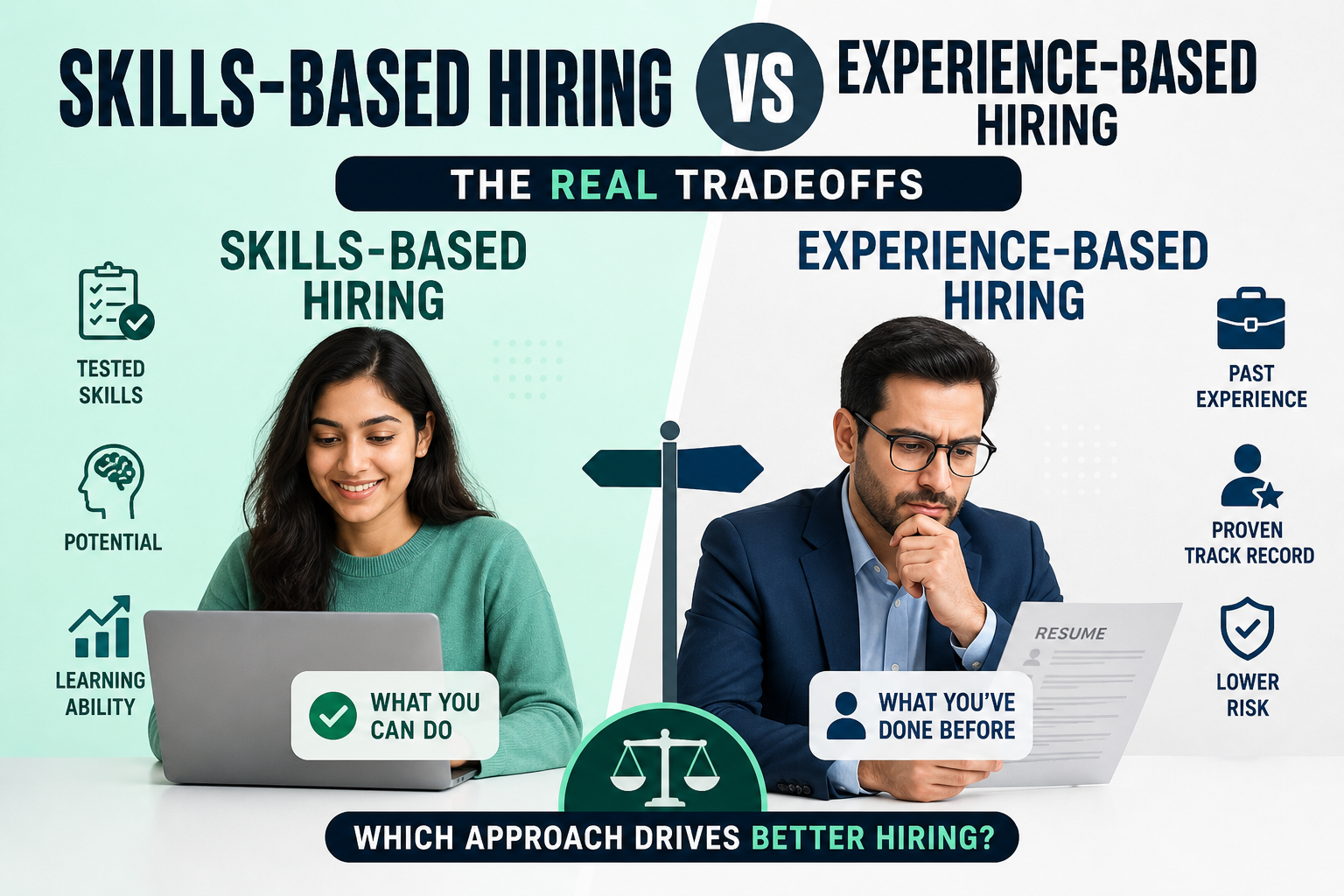
Here is a scenario every talent leader recognizes. Two finalists for a senior product manager role. The first has an MBA from a top school, eight years of experience at brand-name firms, and a CV that reads like a wishlist. The second has no degree, six years of scrappy work at startups, and a portfolio with three products she actually shipped. Who do you hire?
If your gut said "the first one," you are in good company with a lot of large organizations. If your gut said "the second one," you are increasingly in good company with some of the fastest-moving hiring teams in the world. The tension between these two instincts is precisely where the debate between skills-based hiring vs experience-based hiring lives, and it is far more nuanced than either camp typically admits.
This is not a think-piece about disrupting HR or dismantling the resume. It is an honest look at what each approach actually delivers, where each one fails, and how smart hiring teams are threading the needle between them.
Experience-based hiring selects candidates based on credentials, job titles, and years in a role, using past employment history as a proxy for future performance. Skills-based hiring, by contrast, evaluates candidates on demonstrated abilities, assessed through structured tests, work samples, or competency-based interviews, regardless of their formal background. The core difference is what you treat as evidence of capability: a resume, or proof of actual skill.
What Skills-Based Hiring Actually Means in Practice
The phrase gets thrown around loosely, so let us be precise. Competency-based hiring does not mean ignoring all context about a candidate's past. It means shifting the evidentiary standard. Instead of using a prestigious employer or a certain number of years as a stand-in for ability, you design your process to directly observe the skill you need.
A company hiring a data analyst under this model might give every candidate a realistic dataset and ask them to identify three business insights within 90 minutes. A firm hiring a client-facing account manager might run a structured role-play where candidates handle a realistic client objection. The output is evaluated against a defined rubric. The candidate's university, previous employer, and job title are deliberately deprioritized.
Skills-first hiring has gained real momentum over the past few years. Companies like IBM, Apple, Google, and Accenture publicly dropped degree requirements for many roles. Infosys and Wipro in India have piloted large-scale assessments that feed candidates directly into training pipelines, reducing the weight of prior employer prestige. In the UK, the Civil Service Commission has been pushing for "success profiles" over traditional CV screening, particularly for roles below senior grades.
Work sample tests are often the centrepiece of this model. The logic is clean: if you want to know how someone writes code, have them write code. If you want to know how someone structures a proposal, give them a brief and thirty minutes. Research in industrial-organizational psychology has consistently shown that work sample tests are among the strongest predictors of actual job performance, significantly outperforming unstructured interviews and, notably, resume screening.
The Structural Appeal for Employers
Beyond philosophy, there is a practical business case. When you hire based on verified skills rather than credentials, your candidate pool expands dramatically. You pull in career changers, self-taught professionals, candidates from non-traditional educational backgrounds, and people who built their abilities through freelancing or projects rather than full-time employment. In markets like India, where millions of graduates annually come from institutions with wildly varying quality, skills-based screening becomes a way to cut through credential noise rather than be fooled by it.
For roles in tech, marketing, content, finance, and many operational functions, the demand signal for skills-based hiring is now structural, not experimental.
Where Experience Still Has Real Weight
It would be a mistake to treat this as a zero-sum argument where skills win and experience loses. Experience carries information that no 90-minute test can fully replicate.
Think about a Chief Financial Officer role at a company preparing for an IPO. The technical skills of financial modeling, GAAP compliance, investor reporting, and cash flow management can arguably be tested. But what cannot be easily tested is the pattern recognition that comes from having lived through three quarterly earnings cycles, navigated a hostile audit, or managed the dynamics of a board finance committee during a down round. That is experiential knowledge, and it is genuinely hard to simulate.
The same applies in deeply regulated industries. A compliance director at a pharmaceutical company in a market like the US or EU is not just someone who understands regulatory frameworks intellectually. They are someone who knows, from lived experience, what the FDA actually flags during a manufacturing audit, how to manage a response in real time, and which internal escalation paths get things resolved before they become formal issues. A work sample test might identify candidates who understand the rules. It will struggle to surface candidates who have internalized the judgment.
Relationship-Driven and Complex Sales Roles
Enterprise sales is another domain where the experience-based critique of skills-first hiring holds real weight. Selling a $2 million SaaS contract to a Fortune 500 procurement committee is not a skill you can fully assess in an interview exercise. It is built through years of reading rooms, managing multi-threaded relationships, recovering from stalled deals, and understanding the political dynamics inside large organizations. A structured interview can probe for some of these competencies. But a track record of closed enterprise deals at comparable companies is legitimately hard to replicate through assessment alone.
The experience-vs-skills debate often flattens a key distinction: the difference between roles where performance is largely individual and measurable, and roles where performance is fundamentally about navigating complex human and organizational systems over time. Skills-based approaches work best in the former. They are genuinely weaker in the latter.
What the Research Actually Shows
The case for skills-based hiring is not just intuitive. It has a body of evidence behind it, and hiring teams should understand what that evidence actually says, not just the headline version.
of US employers reported using skills-based hiring practices in recent years, up from around 30% just three years prior, according to research from the Society for Human Resource Management.
92%of organizations using structured skills assessments reported that their quality of hire improved, per a TestGorilla global hiring report surveying over 3,000 employers.
5xWork sample tests are roughly five times more predictive of job performance than unstructured interviews, based on meta-analytic research by Schmidt and Hunter that has held up over decades of replication.
The World Economic Forum has estimated that over a billion jobs will require significant reskilling by 2030. In that environment, hiring for what someone knows today rather than what they have done in the past starts to look less like ideology and more like pragmatism.
In India, where the National Employability Report has historically shown significant gaps between degree-level credentials and actual job-readiness, organizations like TCS and Cognizant have substantially invested in their own assessment infrastructure precisely because they cannot rely on the degree as a reliable signal. That is not a values statement about education. It is a calibration response to market reality.
In the UK, a 2023 report from the Institute of Student Employers found that nearly half of graduate employers were placing less emphasis on degree classification than they had five years earlier, with more weight going to demonstrated skills and structured assessments. The shift is visible in hiring data, not just in corporate communications.
Where Skills-Based Hiring Actually Falls Short
Any practitioner who has tried to implement a fully skills-based hiring model knows it is harder than it sounds. There are structural failure modes that get talked about less often than they should be.
Assessment Design Is Genuinely Hard
Building a work sample test that is both realistic and standardized is not a simple task. If the test is too easy, it differentiates nobody. If it is too niche or too similar to internal company processes, it favors candidates who have worked at similar organizations, which defeats part of the purpose. If it is too long, you lose strong candidates who have other options and are not willing to invest three hours in a process they are unsure about.
Many organizations that claim to use skills-based hiring are actually running poorly designed assessments that introduce new biases rather than removing old ones. A take-home coding test that takes six hours screens out candidates with caregiving responsibilities or multiple simultaneous job searches. An open-ended case study with no rubric still defaults to evaluator intuition, which is exactly what structured hiring is supposed to prevent.
It Can Underweight Tacit Knowledge
There is a category of knowledge that lives in the gap between what someone can demonstrate in an assessment and what they actually do on the job. A candidate might pass a customer service simulation with high scores and still struggle with the emotional labor of handling angry clients across a full working day, five days a week. Tacit knowledge, the things you cannot fully write down or test for, is real and matters for a lot of roles.
Volume and Speed Pressures
A well-designed skills assessment takes time to build and time to score consistently. For organizations hiring at volume, particularly in retail, logistics, or BPO environments, the operational overhead of high-quality assessment can be prohibitive without technology support. Many teams cut corners, and a compromised skills-based process often performs no better than the resume screening it replaced.
Legal and Compliance Exposure
In the US in particular, any assessment used in hiring must be validated for job-relevance to survive legal scrutiny under EEOC guidelines. Many small and mid-sized organizations adopt skills assessments without proper validation, which creates risk if the hiring process is ever challenged. The UK's Equality Act raises similar questions around whether assessment design inadvertently disadvantages protected groups. This is not an argument against skills-based hiring, but it is a reason to take assessment design seriously rather than treating it as a quick fix.
A Decision Framework for Real Hiring Teams
Rather than advocating for one model universally, here is a practical lens for deciding which approach fits which situation.
Use Skills-Based Hiring When
The role has clearly definable, testable outputs. Think: software engineer, data analyst, copywriter, financial modeler, UX designer, recruiter, customer support specialist. The candidate pool is large and credential signals are noisy, as is frequently the case in high-volume hiring or markets where degree inflation makes credentials unreliable. You are hiring for a new function or an emerging role where there is no meaningful prior experience to look for. Diversity and inclusion are genuine organizational priorities, not just statements, because skills-based processes consistently broaden the pool when designed well.
Weight Experience More Heavily When
The role involves navigating complex organizational or regulatory environments where judgment comes from pattern recognition built over time. Think: senior legal counsel, enterprise sales director, Chief Medical Officer, supply chain VP for a regulated industry. The consequences of a wrong hire are severe and slow to reverse. You need someone to be effective from week one with minimal ramp time. The role requires established relationships or networks that take years to build and cannot be assessed in an interview.
The Hybrid Signal Model
For most roles above entry level, neither pure approach is optimal. A practical structure is to use a lightweight screening assessment to establish a baseline skills threshold, then use structured competency-based interviews to probe for judgment, learning agility, and role-specific problem-solving. At that stage, relevant experience becomes a contextualizing factor rather than a gating factor. Has this person solved a version of the problem we have? That is the right question. Not: have they done exactly this job at a similar company?
How AI Is Changing the Economics of This Debate
The skills-vs-experience debate has been running for a decade. What has genuinely shifted in the last two to three years is the role of AI in recruitment screening, and it changes the calculus in ways that are worth understanding clearly.
Traditional ATS systems screening resumes are experience-based by design. They look for job titles, company names, years of tenure, and keywords from the job description. They automate a process that was already biased toward credentials. Applying AI to resume screening does not solve that problem. It scales it.
The more meaningful shift is in AI-powered pre-employment assessment platforms that can deliver adaptive, job-relevant assessments at scale, then score them consistently against validated rubrics. This addresses the core operational objection to skills-based hiring: that it is too slow and resource-intensive to run well at volume. An automated hiring software platform that can screen two thousand candidates with a validated assessment in the time it would take a recruiter to review three hundred resumes changes what is operationally feasible.
AI is also beginning to enable more sophisticated analysis of work samples. Natural language processing tools can evaluate written assessments for coherence, depth of reasoning, and domain knowledge, not just surface-level keyword matching. Video interview analysis, used carefully and with appropriate validation, can support structured scoring at scale. These tools are not infallible, and the bias risks of AI in hiring are real and documented. But the direction of travel is toward making high-quality skills-based assessment more accessible, not less.
The Screening Cost Equation
One reason organizations default to experience-based filtering is pure efficiency. Reading a resume takes thirty seconds. Evaluating a work sample takes fifteen minutes. At a hundred applicants, that difference is manageable. At five thousand applicants, it is operationally impossible without technology.
AI candidate screening tools are closing that gap. When a pre-employment assessment platform can automatically score a coding test, a writing sample, or a structured situational judgment questionnaire, the cost of skills-based screening at scale drops dramatically. That is the structural shift that makes skills-first hiring viable as a default approach rather than an exception.
For organizations in India managing high-volume campus hiring, or US tech companies receiving thousands of applications for engineering roles, or UK firms scaling their graduate intake, this is less a philosophical shift and more a practical unlocking. The technology now supports what the research has long recommended.
Building a Hybrid Hiring Model That Actually Works
The honest synthesis of this debate is that the best hiring systems combine elements of both approaches in a deliberate sequence, rather than treating skills and experience as mutually exclusive signals.
A model that works in practice typically looks something like this. At the top of the funnel, use a structured pre-employment assessment to establish a minimum skills threshold. This can be automated, kept short (ideally under thirty minutes), and designed to be role-relevant without requiring insider knowledge. This is where you expand the pool by not filtering on credentials before you have any evidence of capability.
At the middle stage of the process, use structured competency-based interviews. These are not unstructured conversations. They are designed question sets, scored against defined criteria, that probe for how candidates have approached specific problems in the past. The STAR format is well known, but what matters more than the format is the consistency: every candidate is asked the same questions and scored on the same dimensions. This is where experience becomes relevant again, but as a source of examples rather than as a gatekeeping criterion.
At the final stage, for senior roles, a business case exercise or a structured stakeholder conversation can surface the kind of judgment and communication skill that neither the assessment nor the interview fully captures. At this point, a candidate's track record is genuinely informative context.
What this model avoids is the cognitive bias that makes traditional hiring so unreliable: letting a prestigious employer or an impressive title create a halo effect that carries someone through a process they never had to demonstrate competence in. It also avoids the naive version of skills-based hiring where a single test score becomes the only thing that matters, stripping out all the contextual judgment that good hiring requires.
Getting Buy-In Internally
One of the underappreciated challenges in moving toward a hybrid or skills-first model is internal change management. Hiring managers who have spent their careers using experience as their primary filter often resist assessment-heavy processes, not because they are wrong about everything, but because the new process asks them to defer more to structured data and less to their own read of a candidate. That is a real loss of autonomy, and it feels threatening.
The teams that navigate this best tend to involve hiring managers in the design of the assessment itself. When a hiring manager has helped define what a strong work sample response looks like, they are far more likely to trust the scores it produces. That co-ownership changes the dynamic from "HR is forcing a process on me" to "we built this together."
The Practical Takeaway
Here is where this lands, practically.
If you are running a hiring process that still begins with resume screening and unstructured interviews, you are not making evidence-based decisions. You are making bias-based decisions with the appearance of rigor. The research on this is not ambiguous. Resumes predict performance poorly. Unstructured interviews predict it only marginally better. The tools that actually work, work samples, structured assessments, competency-based interviews with scoring rubrics, are well understood and increasingly accessible.
The shift toward skills-first hiring is not about ideology or trend-chasing. It is about improving the quality of the signal you are using to make expensive, consequential decisions. A bad hire at a mid-level role costs between one and three times annual salary when you factor in recruiting costs, onboarding, lost productivity, and the inevitable re-hire. That is not a rounding error. It is a business problem with a known, addressable cause.
At the same time, treating skills-based hiring as a universal solution ignores real constraints. Some roles genuinely reward accumulated experience in ways no assessment can capture. Some organizations lack the infrastructure to design and validate assessments properly. Some markets and legal environments create compliance requirements that demand careful implementation.
The sophisticated position is not to pick a side. It is to understand what each approach actually measures, where each one breaks down, and how to design a process that uses the right signals in the right sequence. That requires some investment in assessment design, some discipline in how interviews are conducted, and increasingly, some thoughtful use of AI-powered tools to make structured hiring scalable.
Organizations that figure this out will not just make better hires. They will build candidate pipelines that their competitors are systematically excluding, and that competitive asymmetry compounds over time.
Ready to hire on skills, not just credentials?
See how AI-powered screening can help you find the right candidates faster, with less bias and better outcomes.
Try AI-powered skills-based hiring for free
.jpg)
.png)
