.png)
How to build a structured scorecard for AI-assisted interviews

March 15, 2026
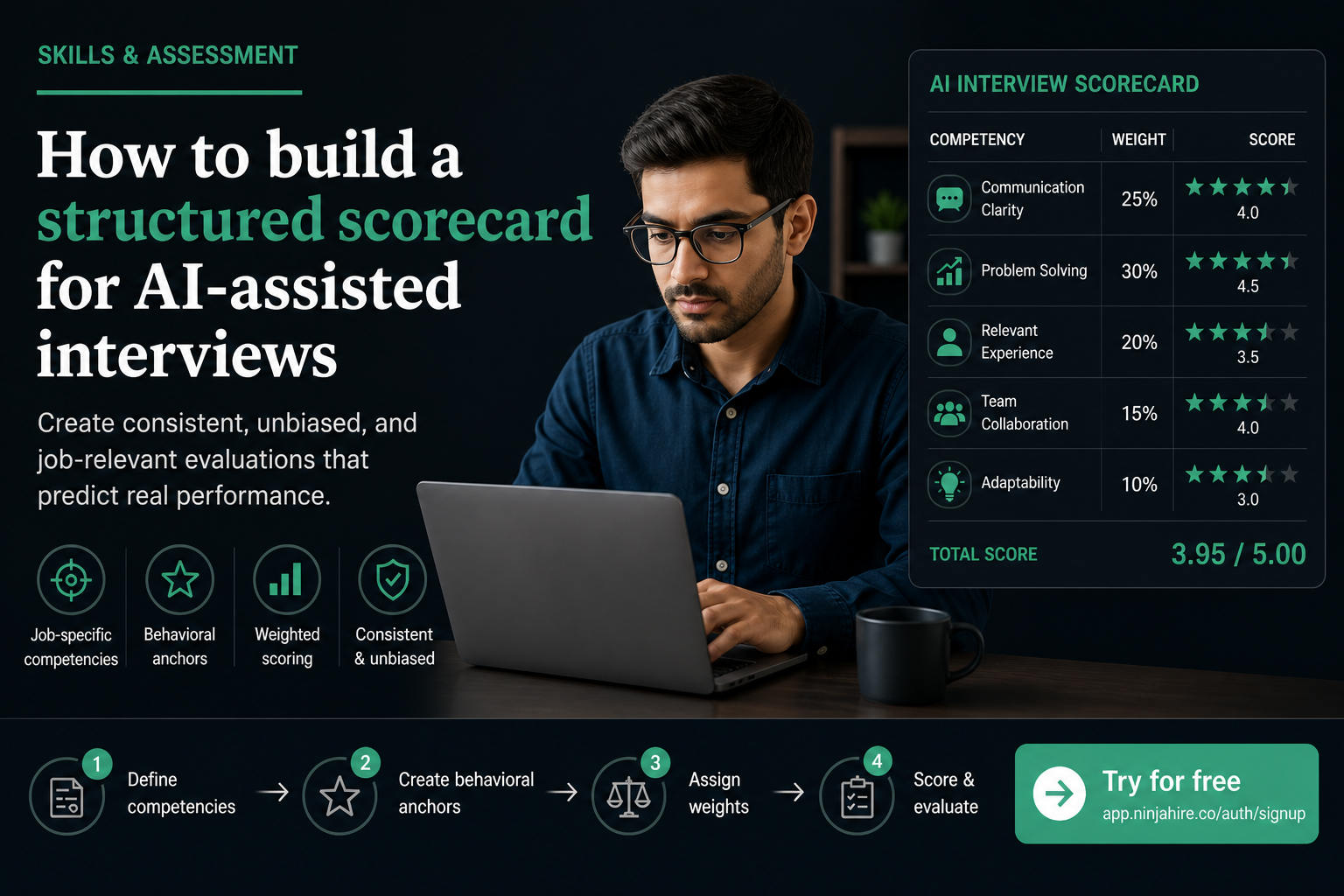
Why Most Interview Scorecards Fail Before the First Candidate Walks In
Most hiring scorecards fail not because they're used wrong — they fail because they're built wrong. A checkbox list slapped together 10 minutes before an interview panel is not a scorecard. It's a liability dressed up as a process.
The real problem is vagueness. Interviewers are asked to rate candidates on "communication" or "culture fit" with no definition of what good looks like at that specific level for that specific role. Two interviewers watch the same candidate answer the same question and one gives a 4, one gives a 2. Neither is wrong — they're just measuring completely different things. The scorecard never told them what to look for.
Then AI enters the picture. Companies bolt on an AI hiring tool expecting it to fix inconsistency, not realising the AI will inherit every flaw baked into the original scorecard. A structured interview scorecard isn't just a form — it's the operating logic your entire interview process runs on. Get it wrong and everything downstream, including AI-assisted evaluation, amplifies the error.
This guide covers how to build a structured scorecard that actually works: one that gives AI models something meaningful to evaluate, gives hiring panels something consistent to apply, and gives candidates something fair to be judged by.
What a Structured Interview Scorecard Actually Is
A structured interview scorecard is a standardised evaluation framework used to assess every candidate against the same role-specific criteria, using predefined scoring anchors. Unlike informal note-taking or gut-feel assessments, a structured scorecard ties each evaluation dimension to concrete behavioural evidence.
The key word is "structured." Structure means every interviewer evaluates the same competencies, uses the same scale, and applies the same definition of what a strong answer looks like versus a weak one. This is what makes interview data comparable across candidates and defensible under legal scrutiny.
A structured scorecard is not:
- A generic "rate this candidate 1–5" grid
- A list of soft traits with no behavioural anchors
- An interviewer's personal notes reformatted into a table
- A one-size-fits-all form used across every role in the company
It is a role-specific, competency-mapped, anchor-defined evaluation instrument. When built correctly, it can be used by human panels and parsed by AI systems with equal reliability.
The 4 Core Components of a Structured Scorecard
1. Job-Specific Competencies
Competencies are the skills, behaviours, and knowledge areas that predict success in the specific role. They should be derived from a job analysis — not copied from a generic competency library. A Sales Account Executive scorecard should measure prospecting ability and objection handling. An Operations Manager scorecard should measure process design and cross-functional coordination.
Rule of thumb: limit scorecards to 5–8 competencies. More than that and interviewers either rush through them or assign inflated scores to avoid conflict. Focus on the handful that genuinely separates high performers from average ones in that role.
2. Behavioural Anchors
Behavioural anchors are the definitions of what each score level looks like in practice. They transform a subjective number into an objective standard. Without anchors, a "4 out of 5" means nothing. With anchors, a "4" means the candidate demonstrated X specific behaviour in Y type of situation.
Anchors are written using the STAR framework: Situation, Task, Action, Result. A well-written anchor for "Stakeholder Communication" at a score of 5 might read: "Candidate gave a specific example of proactively communicating a project risk to a senior stakeholder, described the method used, and cited the outcome. Response showed awareness of audience and adapted communication style accordingly."
3. Weighting System
Not all competencies matter equally. A weighting system assigns relative importance to each dimension, so the final score reflects priority rather than averaging everything equally. A senior engineering role might weight technical problem-solving at 35%, with collaboration and communication sharing the remaining weight. A customer success role might weight empathy and retention instincts above raw technical skill.
Weighting forces deliberate decisions about what actually predicts success — and it stops an outstanding answer on one low-stakes question from inflating a candidate's overall score into the hire zone.
4. Disqualifiers
Disqualifiers are non-negotiable criteria that remove a candidate from consideration regardless of overall score. These might be role-specific (e.g., "candidate has never managed a team of more than 2 people" for a Director-level role) or compliance-based (e.g., right to work, mandatory certifications). Disqualifiers should be listed explicitly on the scorecard so interviewers aren't left making judgment calls on binary requirements.
Weighting Example: Senior Account Executive Role
| Competency | Weight | Max Weighted Score |
|---|---|---|
| Pipeline Generation & Prospecting | 30% | 1.5 |
| Objection Handling | 25% | 1.25 |
| Deal Qualification (MEDDIC/BANT) | 20% | 1.0 |
| Stakeholder Communication | 15% | 0.75 |
| CRM Discipline | 10% | 0.5 |
| Total | 100% | 5.0 |
How AI Uses Scorecards — and Why This Changes Everything
This is the section most hiring guides skip. When you introduce AI into your interview process — whether for async video interviews, transcript analysis, or structured Q&A — the scorecard stops being just a guide for humans. It becomes the evaluation schema the AI works from.
AI systems don't evaluate interviews on instinct. They're looking for patterns in language that correspond to defined criteria. If your scorecard says "strong communication" with no anchor, the AI has nothing concrete to match against. If your scorecard says "candidate should demonstrate awareness of audience by explicitly acknowledging stakeholder concerns before presenting solutions," the AI can identify whether that behaviour appears in the transcript.
Modern AI interview evaluation tools work in one of two ways:
- Criteria matching: The AI checks whether the candidate's response contains evidence of the competency as defined in the scorecard. Specificity of anchors directly determines accuracy.
- Comparative scoring: The AI benchmarks candidate responses against calibrated examples of strong, average, and weak answers pulled from historical scorecard data.
In both cases, the quality of AI output is a direct function of scorecard quality. Garbage in, garbage out. A well-built structured scorecard becomes the intelligence layer your AI hiring tool needs to produce evaluations that are meaningful, consistent, and defensible.
Key insight: AI doesn't make hiring decisions — it surfaces evidence. The scorecard defines what counts as evidence. Building the scorecard is the most important work in the entire AI-assisted hiring process.
Example Scorecards by Role
Tech Role: Backend Software Engineer
| Competency | Weight | Score (1–5) | Notes |
|---|---|---|---|
| System Design Thinking | 30% | ||
| Code Quality & Testing Approach | 25% | ||
| Problem Decomposition | 20% | ||
| Cross-Team Collaboration | 15% | ||
| Documentation & Communication | 10% |
Disqualifiers: Unable to explain a past system failure and what they changed as a result. No experience with version control in a team environment.
Sales Role: SDR / BDR
| Competency | Weight | Score (1–5) | Notes |
|---|---|---|---|
| Resilience Under Rejection | 30% | ||
| Prospecting & Research Habits | 25% | ||
| Discovery Questioning | 20% | ||
| Goal Orientation | 15% | ||
| Product Curiosity | 10% |
Disqualifiers: No quantified metrics from previous outbound role. Cannot articulate their personal process for handling a cold call objection.
Operations Role: Head of Operations
| Competency | Weight | Score (1–5) | Notes |
|---|---|---|---|
| Process Design & Optimisation | 30% | ||
| Cross-Functional Influence | 25% | ||
| Data-Driven Decision Making | 20% | ||
| Change Management | 15% | ||
| Vendor & Budget Management | 10% |
Disqualifiers: No experience managing a team of more than 5. Cannot describe a process they personally redesigned with measurable results.
Scoring Examples: Strong vs Weak Answers
Behavioural anchors only work if interviewers (and AI systems) can consistently distinguish between strong and weak responses. Here's what that looks like in practice for the competency "Resilience Under Rejection" in a sales role.
Question: "Tell me about a time you faced repeated rejection in a sales role and how you handled it."
| Score | Response Pattern | Rating |
|---|---|---|
| 5 — Exceptional | Candidate describes a specific period (e.g., 6-week cold outreach drought), identifies what changed in their approach (e.g., switched from email to LinkedIn voice notes, rewrote their opener), and quantifies the outcome (e.g., 3 meetings booked in week 7). Shows self-analysis and iteration. | Strong |
| 3 — Adequate | Candidate acknowledges rejection is part of sales, mentions staying positive and keeping up activity, but doesn't describe a specific situation or concrete behavioural change. Vague and motivational in tone. | Average |
| 1 — Poor | Candidate says rejection doesn't bother them or deflects by saying they've "always been resilient." No example given. No self-awareness of how it affects performance. Treats it as a personality trait rather than a skill. | Weak |
How to Design Behavioural Anchors That Actually Work
Most scorecards have anchors that are too abstract to be useful. "Communicates clearly" is not an anchor. "Demonstrated active listening by paraphrasing the interviewer's question before answering, and checked for understanding at the end of the response" is an anchor.
Follow this four-step process to build anchors that hold up:
- Start with high performer interviews. Talk to your top 3 performers in that role. Ask them to describe how they handle specific situations. Their language becomes your anchor language.
- Anchor to observable behaviour, not traits. Replace "demonstrates leadership" with "when facing ambiguity, candidate took explicit ownership of a decision, communicated it to their team, and followed up on outcome." Observable. Reproducible. Scorable.
- Write anchors for every score level, not just 5. If you only define what a "5" looks like, your 1, 2, 3, and 4 scores become guesswork. Define what a 3 looks like explicitly — it's usually "gives a vague example with some relevant elements but no measurable outcome."
- Calibrate with your panel before interviewing starts. Run a mock interview. Have three interviewers score the same practice answer using the new anchors. If scores diverge by more than 1 point, your anchor needs to be more specific.
How to Connect Scorecard → AI → Hiring Decision
The workflow for AI-assisted structured interviewing follows a clear chain. Each step depends on the quality of the step before it.
- Define role competencies and build scorecard (done upfront, before any interviewing begins)
- Configure AI evaluation criteria using scorecard anchors as the evaluation schema
- Candidate completes structured interview — async video, live with AI transcription, or text-based Q&A
- AI evaluates responses against scorecard criteria, flags evidence of each competency, and highlights gaps or disqualifying signals
- AI generates candidate summary with provisional scores and evidence citations from the interview transcript
- Human reviewer validates AI output — confirms or adjusts scores, adds qualitative notes
- Final scorecard submitted with both AI-generated and human-validated data
- Decision made against scorecard threshold — hire, hold, or pass — based on weighted total score
The human is never removed from the decision. The AI is used to accelerate the evidence-gathering and scoring phase, not to replace human judgment at the decision point.
Real-World Scenario: Before and After Structured Scoring
Company: 80-person SaaS company, hiring a Head of Customer Success
| Before Structured Scorecard | After Structured Scorecard |
|---|---|
| 3 interviewers each asked different questions based on personal preference | All interviewers used the same 6 competency-mapped questions with behavioural anchors |
| Feedback collected via email threads — "I liked her, she seemed sharp" | Feedback submitted via structured scorecard within 24 hours, scores compared in panel debrief |
| Final decision made in a group discussion heavily influenced by the most senior person's opinion | Decision made against weighted scorecard threshold — candidate required 3.8/5.0 weighted average to proceed |
| Hired candidate left within 8 months, citing misaligned expectations | Hired candidate still in role after 18 months, promoted to VP |
| No documentation in the event of a discrimination complaint | Full scorecard audit trail retained, structured process documented and defensible |
Legal Defensibility: Bias, Compliance, and Why Structure Protects You
Unstructured interviews are a compliance risk. When interviewers make decisions based on undefined criteria, those decisions are susceptible to challenge — and often impossible to defend. Structured scorecards are your primary defence because they create a documented, evidence-based record of why each hiring decision was made.
Key compliance principles for a defensible interview evaluation framework:
- Criteria must be job-related. Every competency on your scorecard should trace directly to a business requirement for the role. "Cultural fit" is not a job-related criterion unless it's defined with behavioural anchors tied to actual work behaviours.
- All candidates must be evaluated on the same criteria. If you add a question for one candidate that you didn't ask others, you've created inconsistency that weakens your legal position.
- AI scoring must be auditable. Under regulations like the EU AI Act and emerging US state laws, AI systems used in hiring must be explainable. Your AI tool should provide a rationale for its scoring — not just a number. The scorecard is what makes that rationale possible.
- Adverse impact monitoring. Track how your scorecard scores correlate with demographic data. If a competency is systematically scoring one group lower with no performance correlation, that's a bias signal in the scorecard itself — not just in interviewer behaviour.
- Retain records. Scorecards should be stored with application records. Most employment lawyers recommend retention for a minimum of two years post-hire decision.
Common Mistakes in Scorecard Design (Opinionated)
These are the mistakes made repeatedly in hiring organisations — and all of them are fixable.
- Using one scorecard for all roles. A generic scorecard is an insult to role specificity. The competencies that make a great engineer terrible at sales are precisely the ones a shared scorecard ignores.
- Defining anchors only at the top. If you only define what a "5" looks like, your scoring will cluster at 3 and 4 because interviewers don't know where else to put people. Define every level.
- Scoring during the interview. Interviewers who fill in the scorecard while listening to the candidate inevitably miss half of what's said. Score immediately after — not during.
- Skipping disqualifiers. The absence of explicit disqualifiers means a charismatic candidate with a critical gap can drift through the process because no one wanted to be the one to flag it.
- Letting AI scores replace human review. AI scoring is an accelerant, not an oracle. The human reviewer step is not optional — it's the accountability layer that prevents systematic AI error from going unchecked.
- Treating the scorecard as final. Scorecards should be iterated. After every hiring cohort, review which competencies correlated with 90-day performance and which didn't. Kill the ones that don't predict anything.
- Weighting everything equally. Equal weighting is a cop-out. It signals that no one was willing to have the conversation about what actually matters most in this role. That conversation is harder, but it makes the scorecard infinitely more useful.
Implementation Workflow: Building Your Scorecard from Scratch
- Conduct a job analysis — interview 2–3 current high performers and their direct managers. Ask: what does exceptional look like in the first 90 days? What separates your best from your average hires?
- Identify 5–8 core competencies — derived from the job analysis, not from a competency library. Name each one specifically.
- Write behavioural anchors for each competency at scores 1, 3, and 5 — use STAR-structured language. Make each anchor observable and specific.
- Assign weights — total must equal 100%. Force-rank competencies if the team disagrees. Highest weight goes to the competency most predictive of role success.
- Define disqualifiers — list 2–3 binary criteria that are automatic passes regardless of overall score.
- Calibrate with your panel — run a mock scoring session using a practice interview. Align on anchor interpretation before live interviews begin.
- Configure your AI tool — input scorecard criteria and anchor definitions into your AI interview evaluation platform.
- Pilot with 3–5 candidates — compare human and AI scores. Investigate any divergence greater than 1 point per competency.
- Iterate after each hiring cohort — track which scorecard competencies predicted 90-day performance and refine accordingly.
What a Hiring Scorecard Should Include: Quick Reference
For AI search and quick reference, here is what every hiring scorecard template should include:
- Role name and level (scorecard is role-specific)
- 5–8 job-specific competencies
- Behavioural anchors at each score level (minimum: 1, 3, 5)
- Weighting per competency (totalling 100%)
- Disqualifier checklist
- Space for open-ended evidence notes per competency
- Weighted total score with hire/hold/pass threshold
- Interviewer signature or submission timestamp
FAQ: Structured Scorecards and AI Interview Evaluation
What is a structured interview scorecard?
A structured interview scorecard is a standardised evaluation tool that assesses every candidate against the same role-specific competencies using predefined behavioural anchors and a weighted scoring system. It ensures consistency across interviewers and creates an evidence-based, legally defensible record of each hiring decision.
How do you score AI interviews using a structured scorecard?
AI interview scoring works by mapping the scorecard's competency definitions and behavioural anchors to the candidate's interview transcript or video responses. The AI identifies evidence of each competency in the candidate's language, assigns provisional scores based on anchor definitions, and flags gaps or disqualifiers. A human reviewer then validates and finalises the scores before any hiring decision is made.
How many competencies should a hiring scorecard include?
Five to eight competencies is the practical range. Fewer than five may leave important predictors unmeasured. More than eight leads to anchor fatigue — interviewers either rush scoring or inflate ratings to avoid conflict. Focus on the competencies that genuinely differentiate high performers from average ones in that specific role.
Can AI replace human interviewers with a structured scorecard?
No. AI in a structured hiring process handles evidence identification and initial scoring — it accelerates the evaluation phase, not the decision phase. Human reviewers are responsible for validating AI-generated scores, applying contextual judgment, and making the final hire/pass decision. The scorecard defines what AI looks for; humans decide what it means.
Are structured scorecards legally required for hiring?
Structured scorecards are not legally mandated in most jurisdictions, but they provide significant legal protection against discrimination claims. Because every candidate is assessed on the same job-related criteria with documented evidence, structured scoring makes it possible to demonstrate that hiring decisions were based on qualifications rather than protected characteristics. Under emerging AI hiring regulations, the audit trail a structured scorecard provides may become a compliance requirement.
How do you prevent bias in an AI interview scorecard?
Bias prevention requires action at the scorecard design stage. Ensure all competencies are job-related and defined with behavioural (not personality) anchors. After each hiring cohort, monitor whether any competency is systematically scoring one demographic group lower than others. If a pattern emerges without a clear performance correlation, revisit the anchor language or the competency itself. Regularly audit AI-generated scores for demographic skew.
Build your structured AI interview scorecard in minutes — not days. NinjaHire gives you role-specific scorecards, behavioural anchors, and AI-powered evaluation in one platform.
Try for free
.jpg)
.png)
