Vibe Recruiting: From Hiring Intent to Qualified Shortlists

October 30, 2026
A practical guide to translating hiring goals into sourcing criteria, candidate evidence and recruiter-reviewed shortlists.
What Is Vibe Recruiting?
Vibe recruiting is an emerging, outcome-led approach to recruiting in which a hiring team explains the work a person must deliver, defines the evidence and constraints that matter, and uses AI to help carry those requirements through sourcing and evaluation. Recruiters review the evidence, investigate gaps and retain responsibility for candidate and hiring decisions.
It is not a recognised hiring standard or a replacement for structured assessment. Its value depends on how clearly the hiring intent is defined and how carefully AI-generated results are checked.
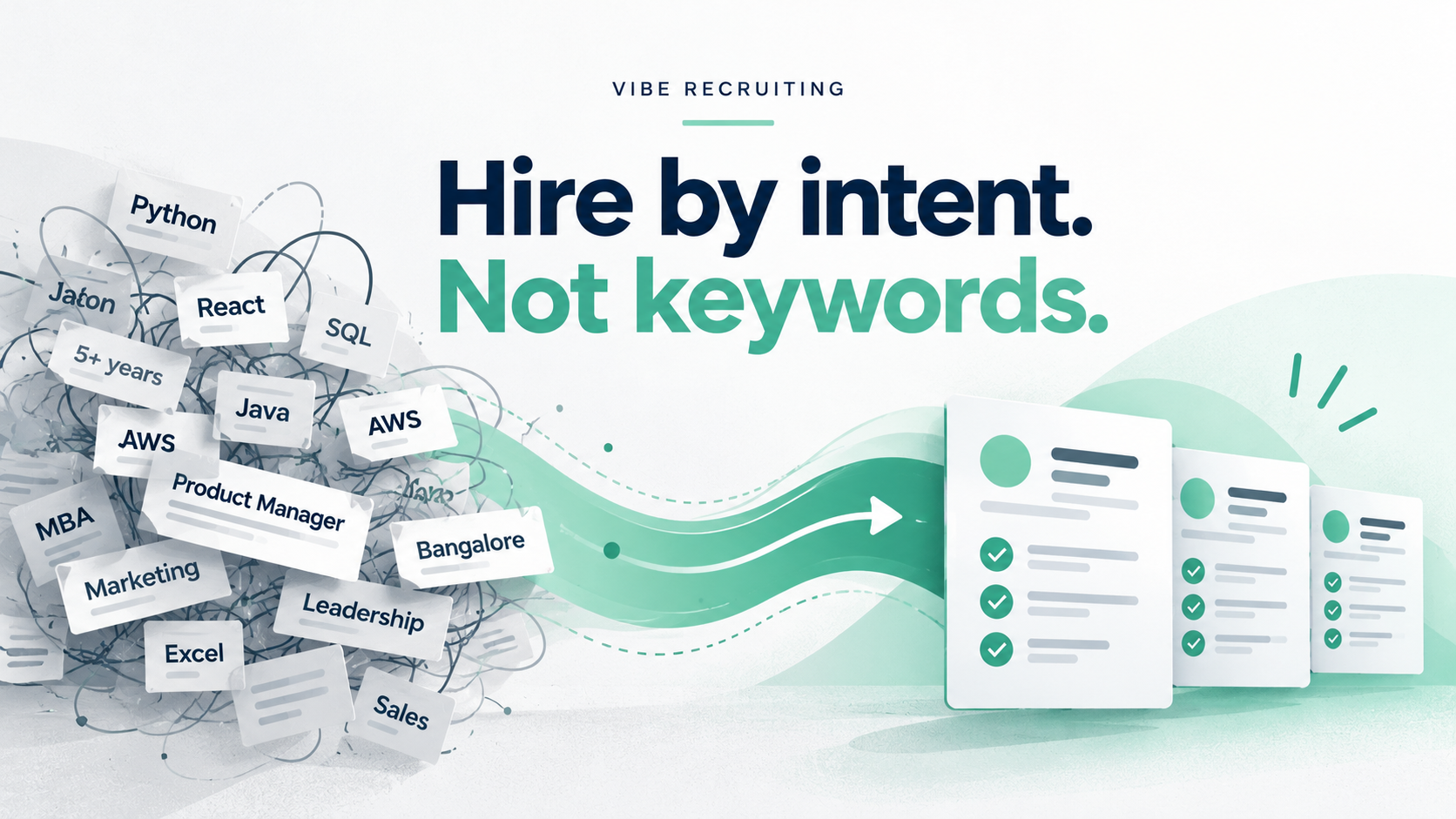
Most recruiting briefs begin with a job title, a list of skills and a set of preferred credentials. Those details help define a search, but they do not always explain what success in the role looks like. A person may use different language to describe relevant experience, while a profile that repeats the right keywords may still provide little evidence of the work required.
Vibe recruiting puts the intended outcome at the centre of the process. The hiring manager defines the responsibilities, essential requirements and acceptable evidence. AI can help interpret the brief, retrieve potential candidates, organise information and suggest refinements. The recruiter checks whether the results actually support the hiring need.
In this guide
Where Did the Idea of Vibe Recruiting Come From?
The term draws on the idea of vibe coding, which became widely discussed in 2025. In that approach, a person describes the software outcome they want in natural language and an AI system helps produce or modify the code. The person still needs to review the result, test it and correct errors.
Vibe recruiting applies a similar idea to parts of the hiring workflow. Instead of manually translating every hiring requirement into separate searches and instructions, a recruiter can describe the role, the outcomes expected and the constraints that cannot be relaxed. AI can help convert that brief into sourcing and evaluation steps.
The analogy has limits. Recruiting decisions affect people's access to employment, so a plausible answer or a fluent explanation is not enough. Candidate information must be handled responsibly, requirements must be job-related, and assessment decisions need accountable human review.
There is no single formal definition of vibe recruiting. Some discussions use the term for broader AI-orchestrated hiring, while others focus on a way of specifying hiring problems, workflows, acceptance tests and guardrails. This article uses it in the narrower, practical sense of intent-led recruiting supported by AI and governed by human review.
What Vibe Recruiting Means in Practice
Vibe recruiting begins with the hiring outcome rather than the search interface. The team first agrees on what the person must do, which requirements are essential, what evidence would demonstrate relevant experience and what information remains uncertain.
AI can then assist with activities such as expanding role language into related skills and titles, finding profiles across approved sources, comparing experience with the agreed criteria, identifying missing information and preparing a shortlist for review. The system should not silently invent requirements or treat an inferred qualification as a proven fact.
The business problem, responsibilities, outcomes, essential requirements and constraints are defined by the hiring team.
AI helps translate the brief into search concepts and retrieve candidates from permitted, relevant sources.
Candidate information is organised against the approved criteria, with evidence, gaps and assumptions kept distinct.
A recruiter checks the shortlist, follows up on uncertainty and decides which candidates should progress to structured assessment.
This is different from hiring by intuition. The word vibe should not encourage recruiters to choose candidates because a profile feels right. The approach should make the hiring brief more explicit and make the reasoning behind a shortlist easier to inspect.
Intent-based recruiting starts with better questions
A useful hiring brief answers five questions before sourcing begins:
- What must the person deliver? Describe the work and expected outcomes, not just the job title.
- What experience is essential? Separate genuine requirements from preferences that can be learned.
- What evidence would support a match? Identify projects, responsibilities, results, tools or domain experience that can be checked.
- What constraints apply? Record location, work authorisation, schedule, compensation range and other legitimate role requirements.
- What needs human confirmation? Identify details that cannot be reliably established from a profile or public record.
How Does a Vibe Recruiting Workflow Work?
An AI recruiting workflow can connect role clarification, candidate sourcing, evaluation and recruiter review. The exact level of automation varies by tool. A useful workflow keeps the original hiring intent visible at every stage and makes it possible for a recruiter to correct the process.
- Define the hiring outcome. The hiring manager explains the responsibilities, expected results, essential requirements and constraints. The recruiter confirms that the brief is specific enough to evaluate.
- Translate the brief into criteria. The team turns the outcome into job-related skills, relevant experience, acceptable alternatives and evidence requirements. Preferences are labelled separately from non-negotiables.
- Source candidates. AI-assisted search can interpret related job titles, skills and experience descriptions, then retrieve profiles from connected ATS or CRM records and approved external sources. Search rules and data permissions still apply.
- Evaluate the available evidence. Candidate information is compared with the agreed criteria. A useful output distinguishes direct evidence from inferred fit and missing information.
- Refine the search and ranking. Recruiters review weak matches, identify gaps in the results and adjust the search without quietly lowering essential requirements.
- Review the shortlist. A recruiter checks the evidence, investigates concerns, confirms candidate interest and decides who should move to a structured conversation or assessment.
What should each stage produce?
| Stage | Useful output | Human checkpoint |
|---|---|---|
| Role definition | Approved outcomes, constraints and essential requirements | Hiring manager confirms the brief |
| Criteria design | Search concepts and an evidence rubric | Recruiter checks job relevance and feasibility |
| Candidate sourcing | Profiles with source and available information | Recruiter checks source quality and duplicates |
| Candidate evaluation | Evidence, gaps and questions to verify | Reviewer challenges assumptions and unsupported claims |
| Shortlist review | Prioritised candidates ready for contact or assessment | Recruiter approves progression and owns the decision |
The workflow is only useful if the team can trace a recommendation back to the requirement it is meant to satisfy. A candidate score without supporting evidence is difficult to challenge and should not be treated as a hiring decision.
Vibe Recruiting vs Traditional Recruiting vs AI-Assisted Recruiting
These terms describe different ways of organising work, and they should not be treated as interchangeable. Traditional recruiting often relies on recruiters to manage each step. AI-assisted recruiting adds tools to individual tasks. Vibe recruiting, as used in this guide, describes an outcome-led way of coordinating several tasks while retaining explicit human control.
| Dimension | Traditional recruiting | AI-assisted recruiting | Vibe recruiting |
|---|---|---|---|
| Starting point | Job description and vacancy details | A task or recruiter instruction | Hiring outcome, constraints and evidence |
| Search | Keywords, Boolean strings and filters | May add semantic search or profile matching | Search is guided by the approved hiring intent |
| Evaluation | Recruiter reviews profiles and applications | AI may summarise or rank information | Evidence is checked against explicit criteria |
| Workflow | Manual handoffs between activities | Some tasks are automated | Connected steps with feedback and approval points |
| Human role | Runs and manages most activities | Uses and reviews AI assistance | Defines intent, challenges output and owns decisions |
Vibe recruiting does not make Boolean search obsolete. Exact-match filters remain useful for requirements such as a mandatory licence, a specific certification or a technology that is genuinely essential. Semantic retrieval can help find equivalent experience described in different language. A balanced sourcing process can use both.
Autonomous recruiting is related but not identical. It usually describes software that can execute multiple recruiting tasks with limited intervention. Vibe recruiting describes how a team expresses and governs the hiring objective. An autonomous system could operate within an intent-led workflow, but autonomy alone does not establish candidate quality or fairness.
Practical Example: From a Hiring Brief to a Recruiter-Reviewed Shortlist
Consider a staffing agency recruiting a payments engineer for a client. The first brief says the client needs a senior engineer with payments experience, strong backend skills and experience working in a regulated environment. That is a useful starting point, but it leaves important questions unanswered.
Step 1: Clarify the work
The recruiter asks the hiring manager what the person will own during the first six months. The manager explains that the engineer will design and maintain transaction services, investigate payment failures, work with risk and compliance teams, and improve service reliability.
The recruiter records the difference between essential and preferred requirements. Production experience with transaction systems may be essential. Experience with one specific payment gateway may be preferred if comparable systems experience is acceptable.
Step 2: Define evidence before searching
| Requirement | Evidence to look for | What should not be assumed |
|---|---|---|
| Transaction systems | Ownership of payment, settlement or transaction processing services | A keyword mention proves hands-on ownership |
| Backend engineering | Examples of designing, building or operating backend services | A senior title proves the required technical depth |
| Reliability | Incident response, monitoring, resilience or performance work | Working at a large company proves reliability experience |
| Regulated environment | Relevant work with audit, risk, security or compliance controls | Any financial services role involved the same controls |
Step 3: Search beyond exact wording
The sourcing brief can include related terms such as transaction processing, payment orchestration, settlement systems and financial infrastructure. These terms broaden discovery, but each result still needs to be checked against the actual responsibilities. A profile that mentions payments but does not describe relevant engineering work should not be treated as a confirmed match.
Step 4: Separate evidence from uncertainty
Suppose one profile describes building transaction APIs and improving service reliability, but does not mention settlement systems. The recruiter can mark backend and reliability experience as supported, while recording settlement experience as unverified. The system should not fill that gap by inference.
Step 5: Make the next action clear
The shortlist should show why each person is being considered, which requirements are supported, what needs confirmation and which questions to ask. The recruiter can then contact the candidate, validate interest and use a structured technical assessment to evaluate the work itself.
What this example demonstrates: AI can help organise discovery and evaluation, but the quality of the result depends on the brief, the candidate data, the evidence rubric and the review process. This is an illustrative workflow, not a customer case study or a claim of measured hiring improvement.
Where AI Recruiting Workflows Can Fail
An AI recruiting workflow can produce a polished shortlist and still miss the hiring requirement. The risks usually arise when the brief is vague, source data is incomplete, the evaluation method is not checked or reviewers rely too heavily on a score.
1. The brief contains vague requirements
Terms such as excellent communication, culture fit or strong background are difficult to evaluate consistently. Replace them with observable, job-related behaviours and evidence. For example, specify the stakeholder groups the person must work with and the communication responsibilities involved.
2. Similar wording is mistaken for relevant experience
A profile may contain the right terms without demonstrating the required work. Conversely, a qualified candidate may describe comparable experience using different language. Use keyword and semantic search as discovery methods, then assess the evidence against the approved criteria.
3. Missing information is treated as a negative signal
Profiles are incomplete records. A candidate may have relevant experience that is not described publicly. The workflow should distinguish not found from not qualified. Where a requirement is important, ask the candidate or verify it through an appropriate assessment.
4. Ranking creates false confidence
A numerical score can make an uncertain judgement look precise. Before using a ranking, ask what data was evaluated, how criteria were weighted, whether the score can be explained and how reviewers can correct an error. A ranking is a prioritisation aid, not proof of suitability.
5. Automation increases the impact of a flawed rule
If an inaccurate criterion is applied across hundreds of profiles, the error can affect many candidates. Keep approval checkpoints around role criteria, screening questions, outreach and progression decisions. Review a sample of rejected profiles as well as shortlisted candidates.
6. Candidate data is used without adequate controls
Recruiting teams should understand where candidate information comes from, what permissions and contractual terms apply, how long information is retained and who can access it. Data protection obligations depend on the jurisdictions and sources involved. Confirm the rules that apply to the actual hiring process rather than assuming that publicly visible information can be used without limits.
Why Human Oversight Matters in Vibe Recruiting
Human oversight is meaningful only when a person has the information, authority and time to challenge the system. Asking a recruiter to approve a ranked list without showing the supporting evidence is not an adequate review process.
Research on human interaction with algorithmic recommendations has found that recommendations can influence decisions, including when participants are told that the recommendations are low quality or unimportant. This is one reason a human reviewer should not be treated as an automatic safeguard against bias.
Research comparing language-model resume ratings with human ratings has also found that the two are not interchangeable. Model scores should therefore be validated for the intended task and should not replace structured assessment.
Build review into the process
- Before sourcing: Confirm that each requirement is relevant to the role and that preferences are not being treated as mandatory criteria.
- During sourcing: Check the sources, search coverage, duplicate handling and whether candidate records are current enough for the intended use.
- At shortlist review: Inspect the evidence for each criterion, identify inferences and record what remains unknown.
- When rejecting candidates: Review a sample of excluded profiles to identify suitable people who may have been missed.
- During assessment: Use consistent, job-related questions and rating standards. The U.S. Office of Personnel Management describes structured interviews as a method built around predetermined questions and common rating standards.
- At the decision stage: Keep candidate progression and hiring decisions with accountable people.
For staffing agencies, this also protects the client relationship. Recruiters need to explain why a candidate is being presented, what has been verified and what still needs to be discussed. A shortlist that cannot be explained is difficult for a client to trust.
How to Implement Vibe Recruiting: A Practical Pilot
Start with one requisition rather than changing the entire recruiting operation. Choose a role with a clear hiring manager, an agreed assessment process and enough candidate activity to compare the current workflow with an AI-assisted approach.
- Record the baseline. Measure the current time from approved brief to shortlist, recruiter review effort, number of profiles assessed and proportion of presented candidates accepted for interview.
- Write an outcome-led brief. Document the work to be delivered, essential requirements, acceptable alternatives, constraints and evidence expected for each criterion.
- Agree on a review rubric. Define what counts as supported evidence, what is unknown and what needs direct candidate confirmation. Get approval from the hiring manager before sourcing.
- Run the AI-assisted workflow. Keep a record of sources searched, search refinements, candidate matches, exclusions and human corrections.
- Review both included and excluded candidates. Check whether the shortlist is supported by evidence and whether suitable profiles were missed.
- Compare results with the baseline. Use the same definitions and measurement period. Do not attribute an improvement to AI if the role, market conditions or recruiter team changed at the same time.
- Decide whether to expand. Continue only if the workflow improves a meaningful operational measure without weakening evidence quality, fairness, candidate experience or human accountability.
Vibe recruiting pilot scorecard
Track these measures before and during the pilot. Set targets only after establishing a baseline for the role and process.
| Measure | How to calculate or review it | Why it matters |
|---|---|---|
| Qualified candidate rate | Candidates meeting the approved essential criteria divided by candidates reviewed | Shows whether sourcing is reaching relevant people |
| Evidence completeness | Shortlisted profiles with evidence recorded for each essential criterion | Shows whether the shortlist can be explained |
| Shortlist acceptance | Presented candidates accepted for interview by the client or hiring manager | Connects sourcing output with downstream review |
| Missed candidate rate | Suitable candidates found in a sample of excluded profiles | Checks whether search or ranking is too restrictive |
| Recruiter review time | Time spent validating, correcting and preparing candidate recommendations | Shows the real workload, not just automated task time |
| Rubric consistency | Agreement between reviewers applying the same criteria | Checks whether the evaluation method is clear |
| Candidate response rate | Responses divided by candidates contacted | Helps assess outreach relevance and candidate experience |
| Time to reviewed shortlist | Elapsed time from approved brief to recruiter-approved shortlist | Measures the speed of the complete process |
Do not judge the pilot only by how quickly profiles appear. A faster shortlist that contains unsupported matches or excludes suitable candidates is not a successful outcome. Evaluate speed alongside evidence quality, reviewer corrections and downstream acceptance.
How Ninjahire Supports an Intent-Led Recruiting Workflow
Ninjahire describes an AI recruiting workflow that connects candidate discovery, outreach, screening and recruiter review. These capabilities can support parts of an intent-led process, provided the team defines the requirements and checks the output at the appropriate stages.
For candidate discovery, Ninjahire AI Sourcing combines talent rediscovery from connected ATS and CRM systems, the Ninjagraph professional-profile graph and supported external sourcing channels. The available sources, profile fields and contact enrichment depend on the customer's plan and integration configuration. This is relevant when a recruiting team wants to search its existing talent pool before expanding to external sources.
After sourcing, the Ninjahire Autonomous AI Recruiter is described as coordinating candidate sourcing, multichannel outreach, initial screening and recruiter-ready shortlist preparation. Recruiting teams configure the requirements and screening criteria, review the results and retain final decision authority.
Where an initial voice conversation is part of the process, Ninjahire AI Phone Screening describes structured phone interviews based on configured questions and scoring criteria. Recruiters should review the transcript, responses and screening summary in context rather than treating a score as a final assessment.
Ninjahire also describes Hanzo as an email-based workflow that accepts a role brief and constraints, runs sourcing strategies, evaluates and refines results, applies rubric-based ranking and returns fit evidence and concerns for recruiter review. This is a first-party product description. The workflow should be evaluated in a live demonstration against the team's own requirements; this article does not present it as an independently tested product benchmark or a customer outcome.
Questions to ask in a product evaluation: Which candidate sources are included in the plan? Can the team edit and approve the criteria? Can reviewers see the evidence behind a match? How are missing or conflicting details shown? Can recruiters inspect rejected candidates? What actions require approval, and how are candidate data permissions handled?
See how intent-led sourcing fits your recruiting workflow
Review how Ninjahire connects candidate rediscovery, external sourcing, outreach and screening. Evaluate the workflow against one live requisition and the criteria your team already uses.
Explore Ninjahire AI SourcingFrequently Asked Questions About Vibe Recruiting
Is vibe recruiting a recognised recruiting methodology?
No. Vibe recruiting is an emerging term with more than one interpretation. In this article, it refers to an outcome-led approach in which people define hiring intent and evaluation criteria, while AI assists with parts of the workflow under human review.
How is vibe recruiting different from AI recruiting?
AI recruiting is a broad term for using artificial intelligence in recruiting activities such as sourcing, matching, outreach and screening. Vibe recruiting describes a way of expressing and governing the hiring objective so that AI-assisted tasks remain connected to the required outcome and evidence.
Does vibe recruiting replace Boolean search?
No. Boolean search and exact filters remain useful for specific requirements. Intent-led recruiting can combine them with semantic retrieval and evidence review to find relevant experience expressed in different language.
Is vibe recruiting the same as autonomous recruiting?
No. Autonomous recruiting refers to systems that execute multiple tasks with varying levels of independence. Vibe recruiting refers to an intent-led way of defining and reviewing recruiting work. An autonomous recruiting system can be used within an intent-led process, but autonomy does not prove accuracy or suitability.
Can AI make the final hiring decision?
An AI-generated ranking or shortlist should not be treated as a final hiring decision. Recruiters and hiring managers should check evidence, correct errors, assess candidates consistently and retain responsibility for progression and hiring decisions.
How can staffing agencies use vibe recruiting?
Staffing agencies can begin by translating a client brief into clear outcomes, essential requirements and evidence standards. AI can assist with searching ATS records and external sources, organising candidate evidence and preparing shortlists. Recruiters should validate interest, confirm missing information and explain each recommendation to the client.
How should a team measure whether vibe recruiting works?
Compare the pilot with the existing workflow using qualified candidate rate, shortlist acceptance, evidence completeness, missed candidate rate, recruiter review time, rubric consistency, candidate response rate and time to reviewed shortlist. Measure quality and accountability alongside speed.
Research and Further Reading
The following external sources inform the definitions, workflow discussion and responsible assessment guidance in this article. Vendor descriptions are identified as such and should not be read as independent product testing.
- Joveo: What Is Vibe Recruiting?
- Lou Adler Group: The Vibe Recruiting Model
- Muhammed Shaphy: Vibe Recruiting, Where AI Meets Hiring Intelligence
- LinkedIn Engineering: Semantic Search, Retrieval and Ranking for Hiring Assistant
- Anthropic: Building Effective Agents
- AAAI: Research on Human Responses to AI Recommendations in Hiring
- U.S. Office of Personnel Management: Structured Interviews
- NAACL 2025: Research Comparing Human and Language-Model Resume Ratings
- TypeSafe Documentation: Scoring Primitive