
Turning an ATS into a Revenue Engine: A Staffing Agency Success Story
November 5, 2026

How a staffing agency rethought the way it used its applicant tracking system, bringing candidate rediscovery, recruiter workflows and commercial visibility closer together.
The opportunity behind ATS optimization for staffing agencies
An applicant tracking system can hold years of candidate relationships, screening history and recruiter knowledge. But that information only creates business value when teams can find the right people, verify their current fit and connect them to live client requirements.
In this Ninjahire case study, we explain how our recruitment and technology approach addressed a familiar operating challenge: recruiters were working hard to fill new roles while relevant candidate history inside the existing ATS was not consistently part of the search process.
For a staffing agency, an ATS is more than a place to store resumes. It is a record of candidate relationships built through applications, conversations, interviews, submissions and previous assignments. Yet when a new job order arrives, recruiters can still find themselves starting from external sourcing, even when the database may contain people worth reconsidering.
Our team approached the problem as an ATS optimization and recruitment workflow challenge, not simply a request to add another software layer. We looked at how candidate information moved from the database into recruiter action, how the team assessed relevance, and where manual steps interrupted the journey from job order to client submission.
The business challenge: an active recruiting team, an underused candidate database
The agency had already invested time and money in building its candidate database. Recruiters had worked on multiple requisitions, screened applicants, spoken with potential candidates and developed knowledge about people who might suit future roles. The challenge was making that accumulated information consistently useful when a new requirement came in.
As we mapped the workflow, we focused on operational friction points that can prevent a staffing agency ATS from delivering its full value:
- Candidate history was difficult to activate. Previous applicants, silver medalists and candidates considered for similar roles were not always surfaced at the start of a new search.
- External sourcing could become the default. Recruiters might begin a fresh search before checking whether relevant people were already recorded in the ATS.
- Search depended heavily on exact wording. A candidate could describe comparable work using different job titles, skill terms or project language.
- Candidate records needed context. A profile alone did not always show the previous stage, reason for non-selection, last interaction or whether the person might still be interested.
- Follow-up activity varied by recruiter. Re-engagement could depend on individual memory and available time instead of a consistent process.
- Operational activity was not always connected to commercial outcomes. Leadership needed a clearer way to understand whether database reuse contributed to submissions, interviews and placements.
These issues are not solved by database size alone. A large ATS can still be difficult to use if records are inconsistent, search is disconnected from job requirements or recruiters do not have a repeatable way to review and re-engage suitable candidates.
Our starting principle: Do not assume the agency needs to replace its ATS before understanding what is limiting its value. First identify what the existing system contains, how recruiters use it and where better search, matching, workflow design or integration can make a measurable difference.
How our recruitment and technology team diagnosed the problem
We began with the recruiting process rather than a feature checklist. Our experienced recruitment specialists considered how a desk works under client deadlines. Our technical team examined how candidate information, search logic and workflow steps could support that work.
We mapped the path from job order to submission
We examined the sequence followed after a client requirement was received: role clarification, candidate search, profile review, contact, screening, submission and follow-up. This helped identify where the team repeated work or moved between systems without a clear handoff.
We reviewed how the existing ATS was being searched
We considered whether recruiters searched historical candidates early enough, which fields were useful, how job titles and skills were represented, and whether the search process could recognise related experience rather than relying only on exact phrases.
We considered record quality and candidate history
Candidate data is only useful when it is sufficiently accurate and interpreted in context. We looked at duplicate handling, missing information, last-contact dates, previous outcomes and the distinction between an old match and a currently available candidate.
We identified where recruiter judgement was essential
A system can identify a potential match, but it cannot safely assume that a candidate is still interested, available, eligible or suitable for a new role. We separated discovery and prioritisation tasks from decisions that require recruiter verification.
We defined what success should mean
Rather than treating the number of profiles found as the only measure, we established a broader measurement model. It connected candidate rediscovery to recruiter review, candidate response, client submission and placement outcomes. More search results do not automatically mean more qualified submissions or revenue.
The solution we designed: from candidate storage to an active recruiting workflow
Our approach connected five areas that are often managed separately. The objective was to make the existing candidate database easier to use, while preserving recruiter control over candidate evaluation and communication.
1. Make ATS candidate rediscovery an early step
We designed the workflow so that a new client requirement could trigger a review of relevant candidates already in the ATS before external sourcing became the automatic first move. The search considered role requirements and candidate history, helping recruiters revisit previous applicants, strong finalists and people who may fit a related opening.
This is not a rule to contact every old record. A historical match is a lead for review. Recruiters still need to check the current requirement, previous interactions, data freshness, candidate interest and applicable contact permissions.
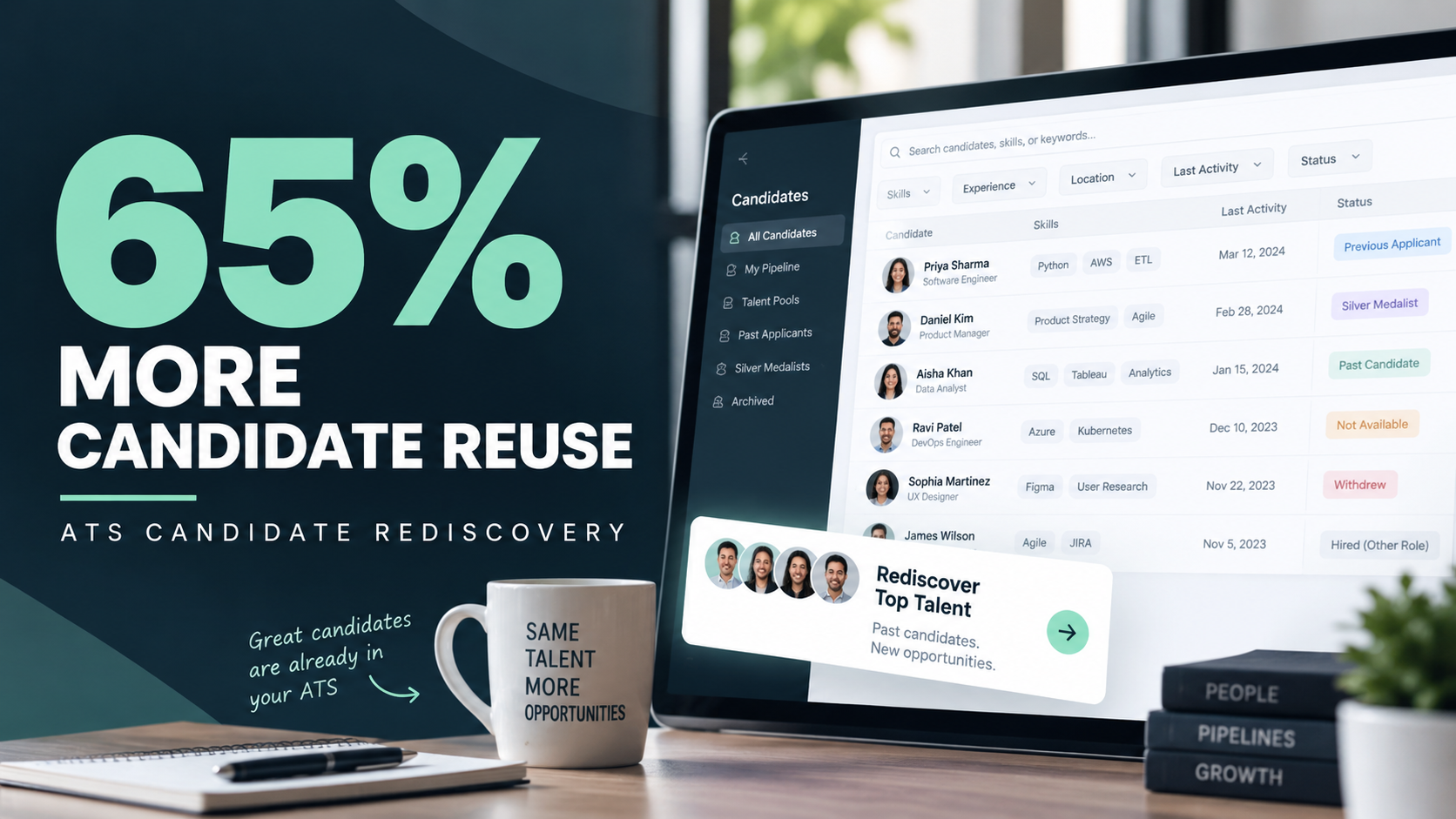
For a deeper look at the mechanics and a separate measured engagement, see our ATS candidate rediscovery case study, which reports a 65% increase in candidate reuse. That figure belongs to that specific case study and is not presented as the result of this broader engagement.
2. Match against the work, not only the words in a resume
Exact keywords are useful when a requirement is mandatory, but they can miss candidates who describe comparable experience differently. We focused the matching process on the relationship between the role brief and evidence in the candidate record, including relevant skills, responsibilities, domain exposure and experience.
The review also needed to distinguish between evidence that was present, information that was inferred and details that remained unknown. This makes it easier for a recruiter to challenge a weak match, ask a targeted question or refine the search without lowering essential requirements.
3. Give candidate history a role in the decision
A candidate record should not be treated as a static resume. Previous submissions, interview stages, recruiter notes and reasons a person did not progress can provide useful context. We made that history part of the review process so recruiters could decide whether re-engagement was appropriate and avoid repeating conversations without understanding what had happened before.
Candidate rediscovery is particularly relevant to staffing agencies that work repeatedly across similar job families. Our separate candidate rediscovery implementation covering 12,000 historical candidates explores how a more deliberate search process can surface talent that would otherwise remain buried in an ATS.
4. Connect sourcing with candidate engagement
Finding a potentially relevant profile is only the beginning. The next step is to establish whether the person is contactable, interested and available. We considered how outreach and follow-up could become more consistent without making candidate communication feel repetitive or impersonal.
Messages should reflect the role and the candidate's relevant background. Where a recruiter or system cannot verify a detail, it should ask rather than imply. Contact activity should respect the agency's permissions, communication preferences and applicable privacy requirements.
5. Make workflow performance visible
We treated measurement as part of the solution rather than a reporting task added later. The agency needed to distinguish between candidates discovered, candidates reviewed, candidates contacted, candidates who responded, candidates submitted and placements made. These stages reveal where value is being created and where the workflow still needs attention.
Clarify the role, business need, essential criteria and delivery constraints.
Search existing candidate records and surface people whose history may fit the requirement.
Compare candidate information with role criteria and separate verified evidence from unknown details.
Review history, confirm current interest and availability, then conduct the required screening.
Submit qualified candidates and track interviews, placements and commercial contribution.
How our team implemented the changes
Implementation required more than connecting a tool to an ATS. The workflow had to reflect how recruiters work, how the agency stores candidate information and how client requirements are prioritised. We structured the work around a controlled sequence so each stage could be checked before it influenced the next.
- Workflow discovery. We mapped the existing process with the people who used it, documenting how requisitions were opened, candidates were found, records were reviewed and submissions were made.
- ATS and data assessment. We reviewed available data fields, record consistency, duplicate risks, historical activity and integration requirements. The exact scope depends on the ATS and the access permitted by the agency.
- Role and matching criteria. We translated job requirements into clear criteria, separating mandatory conditions from preferences and identifying what evidence could reasonably be found in candidate records.
- Rediscovery workflow configuration. We defined how existing candidates would be surfaced for new requirements, how candidate history would be considered and where recruiter review was required.
- Engagement and screening handoffs. We mapped the next actions after a potential match, including candidate contact, interest confirmation, screening and submission preparation.
- Recruiter validation. Recruiters reviewed sample results, flagged irrelevant matches and identified missing context. We used this feedback to refine the workflow rather than assuming an initial configuration would be correct for every role.
- Measurement and iteration. We defined stage-level measures and reviewed where candidates progressed or dropped out. This created a basis for improving search quality, adoption and commercial reporting.
Our recruitment specialists brought practical knowledge of sourcing, candidate conversations and client expectations. Our technical specialists focused on data connections, matching logic and repeatable workflows. A technically functional integration can still fail if it adds steps that recruiters cannot use during a busy hiring day.
What the optimized staffing agency ATS workflow looks like
The operational change is easiest to understand by comparing the old starting point with the intended process after optimization.
| Recruiting stage | Common fragmented process | Optimized workflow |
|---|---|---|
| New job order | Recruiter moves directly to external sourcing | Role criteria are clarified and existing ATS records are considered first |
| Candidate discovery | Search depends heavily on memory, exact terms or separate tools | Relevant historical records are surfaced for recruiter review |
| Candidate evaluation | Profile review may lack consistent evidence criteria | Candidate evidence is compared with approved role requirements |
| Candidate contact | Follow-up depends on individual routines | Contact and follow-up steps are more consistent and context-aware |
| Screening | Information may be gathered in different formats | Screening follows role-specific questions and recruiter checkpoints |
| Client submission | Limited visibility into source and candidate progress | Candidate source and progression can be tracked through the workflow |
| Performance review | Activity counts may dominate reporting | Review connects rediscovery, response, submission, interview and placement measures |
The goal is not to eliminate external sourcing. It is to make sourcing decisions more deliberate. If the ATS does not contain a suitable candidate, the team should move quickly to external channels. If a relevant candidate is already in the database, the agency should have a reliable way to find and assess that person first.
Measuring ATS ROI: from database activity to business impact
One of the most important parts of ATS optimization is agreeing on what the agency means by return on investment. A higher number of candidate records viewed is not the same as a higher number of placements. A faster shortlist is useful only if candidate relevance and client acceptance remain strong.
We recommend measuring the full path from database search to commercial outcome. The following scorecard can help staffing agency owners, operations leaders and recruitment directors assess whether an ATS is contributing more value.
| Metric | How to measure it | What it tells leadership |
|---|---|---|
| ATS rediscovery rate | Relevant existing candidates surfaced per requisition | Whether historical candidate data is being used |
| Candidate reuse rate | Define and track the share of submissions or hires sourced from existing ATS records | How much recruiting activity comes from the agency's own database |
| Rediscovery-to-contact rate | Rediscovered candidates contacted divided by candidates reviewed and approved for contact | Whether surfaced candidates are actionable |
| Candidate response rate | Responses divided by delivered, eligible outreach messages | Whether engagement is relevant and well timed |
| Time to shortlist | Elapsed time from approved job order to recruiter-reviewed shortlist | Whether the process supports faster delivery |
| Client submission acceptance | Submitted candidates progressing to interview divided by candidates submitted | Whether candidate quality aligns with client requirements |
| Placement contribution | Placements attributable to rediscovered candidates under a defined attribution rule | Whether reuse contributes to hiring outcomes |
| External sourcing cost | Relevant sourcing expenditure per placement or qualified submission | Whether internal candidate reuse changes channel economics |
| Recruiter capacity | Time spent on repeatable tasks and active requisitions per recruiter | Whether recruiters have more time for candidate and client work |
| Revenue and gross margin | Revenue and gross margin from attributable placements, less relevant delivery and technology costs | Whether operational improvement creates commercial value |
Measurement note: This case study does not publish a client-specific revenue uplift, placement increase, cost reduction or time-saving percentage because those figures were not supplied as verified results for this engagement. We have deliberately kept the implementation narrative separate from results reported in other Ninjahire case studies.
What the wider staffing market tells us
The commercial case for better database use is supported by wider industry evidence. StaffingHub's January 2026 Sourcing Effectiveness Benchmark Report analysed 88,000 placements and surveyed 29 staffing agencies and 1,500 job seekers. It reported that ATS and CRM rediscovery accounted for an average 16.4% of placements in its dataset. The report also found that 57% of surveyed agencies planned to expand rediscovery and 83% reported using AI or automation in sourcing.
These are findings from that report's sample, not a guaranteed benchmark for every staffing agency. They show why ATS and CRM rediscovery deserves to be treated as a sourcing channel with its own performance measures. Read the StaffingHub Sourcing Effectiveness Benchmark Report.
What a revenue-engine model actually requires
There is a useful distinction between finding a candidate and generating revenue from a candidate. A profile must be relevant to a live requirement, reviewed by a recruiter, contactable, interested, available and suitable for client assessment. It then needs to progress through the agency's submission and placement process.
Tracker's published Elevation Recruitment Group story provides an external example of the commercial potential of a well-used recruitment database. Tracker reports that 40% of the agency's revenue came from candidates already in its database. That is a result from a different agency and a different technology implementation, not a Ninjahire result. It illustrates why database utilisation can be a meaningful commercial measure. Read the Elevation Recruitment Group case study.
What other staffing agencies can learn from this approach
For an agency considering ATS optimization, the first step does not need to be a platform replacement. It can begin with a structured review of the system and the way recruiters use it every day.
- Audit before you add. Understand what candidate data, search capabilities and integrations are already available before buying another database or tool.
- Make rediscovery part of the process. Check relevant ATS records early for every new requirement, while keeping external sourcing available when internal records do not produce suitable candidates.
- Keep criteria tied to the job. Define essential requirements and acceptable alternatives with the hiring manager. Do not let an opaque score replace recruiter evaluation.
- Review candidate history. Check prior interactions, previous outcomes and data freshness before re-engaging someone.
- Measure progression, not just activity. Track the journey from candidate surfaced to contacted, screened, submitted, interviewed and placed.
- Protect candidate trust. Use appropriate data access, retention and communication practices. Confirm the lawful basis and permissions relevant to the agency's jurisdictions and systems.
- Build adoption with recruiters. Involve the people using the workflow, gather feedback and refine the process around real desk requirements.
How Ninjahire helps staffing agencies get more from recruiting technology
Ninjahire brings recruitment workflow knowledge and recruiting technology together. Our focus is not to add automation for its own sake. It is to help staffing teams identify where candidate discovery, engagement and screening can become more connected, more consistent and easier to measure.
For agencies looking to improve the first stage of the process, Ninjahire AI Sourcing supports candidate discovery and rediscovery workflows. This is relevant when recruiters need to look across existing talent records and supported sourcing channels rather than repeatedly rebuilding a candidate pool from scratch.
Once candidates are identified, the Ninjahire Autonomous AI Recruiter can support connected recruiting activities such as outreach and early-stage screening, subject to the configured workflow and plan. The purpose is to reduce repetitive coordination while keeping recruiters involved in candidate review and progression.
For structured early conversations, Ninjahire AI Phone Screening can support role-specific screening workflows. Recruiters should still review the information gathered, verify important details and make progression decisions using the agency's agreed assessment process.
Technology is only one part of the work. A successful implementation also depends on understanding the agency's recruitment model, candidate data quality, client expectations, recruiter adoption and the measures leadership uses to evaluate performance. That is why our approach combines recruitment expertise with technical implementation and continuous workflow refinement.
Find more value in the candidate database you already have
If your recruiters are repeatedly sourcing externally while relevant candidate history sits unused in your ATS, it may be time to review the workflow. Ninjahire can help your team assess candidate rediscovery, sourcing, outreach and screening opportunities against your current recruitment process.
Explore Ninjahire AI SourcingFrequently asked questions about ATS optimization for staffing agencies
What is ATS optimization for staffing agencies?
ATS optimization is the process of improving how a staffing agency uses its applicant tracking system for candidate search, rediscovery, data quality, recruiter workflows, communication and reporting. The aim is to make existing recruitment information more useful for live requisitions and measurable hiring outcomes.
How can staffing agencies increase ROI from their ATS?
Agencies can improve ATS ROI by using historical candidate data more consistently, improving search and matching, reviewing data quality, standardising candidate re-engagement and measuring how candidates progress to submissions and placements. ROI should include relevant technology and operating costs, not just activity gains.
How does candidate rediscovery help staffing agencies?
Candidate rediscovery searches an agency's existing ATS or CRM for people who may fit a new client requirement. It can reduce the need to start every search from external sources, but each historical candidate still needs current review, interest confirmation and screening.
Can an ATS become a revenue-generating asset?
An ATS does not generate revenue simply by storing candidate records. It can contribute to revenue when recruiters can find relevant candidates, verify their fit and interest, present them to clients and progress them through to placements. Agencies should measure that contribution using defined attribution rules.
How can staffing agencies reduce external sourcing costs using an ATS?
Start by checking the existing database for relevant candidates before launching every external search. Track how many rediscovered candidates are qualified, contacted, submitted and placed. External sourcing remains necessary when the internal database does not contain a suitable or available candidate.
Which ATS metrics should staffing agency leaders track?
Useful measures include candidate reuse rate, rediscovery-to-contact rate, response rate, time to shortlist, client submission acceptance, placements from existing candidates, recruiter review time, external sourcing cost and attributable revenue or gross margin.
Does ATS optimization mean replacing the current system?
No. Optimization can begin with workflow changes, better use of existing search capabilities, data cleanup, integrations or carefully selected automation. Replacement should be considered only when the current system cannot support essential operational, reporting, integration or compliance requirements.
How long does ATS optimization take?
There is no universal timeline. The scope depends on the ATS, data quality, integration access, workflow complexity, security review and the number of teams involved. A focused assessment and controlled pilot can help an agency understand the work before expanding it.
Research and supporting references
External benchmarks and competitor examples below are included for market context. They are not Ninjahire customer results.
Other insights
Continue reading












Subscribe to our newsletter
Want to stay up to date with news and updates about our product? Subscribe.
© Copyright 2026