
Agent Memory in AI Recruiting: How AI Agents Retain Context Across Different Job Mandates
Discover how AI agent memory, candidate rediscovery and context retrieval can support recruiting workflow continuity across multiple job requisitions.
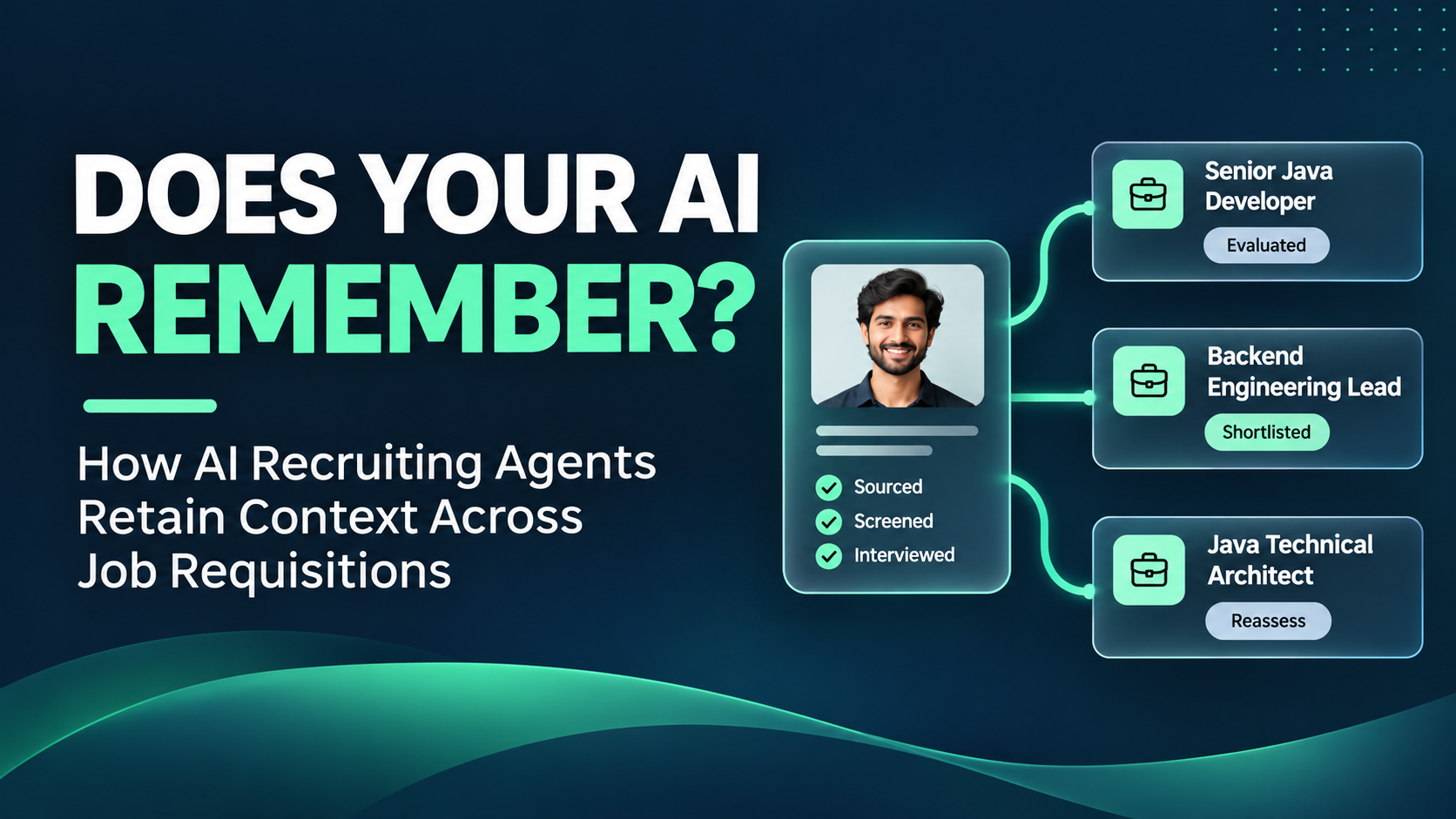
A technical explainer on how AI agent memory, candidate rediscovery and multi-agent orchestration support workflow continuity across multiple job requisitions, and what enterprise teams should verify before adopting them.
Why Recruiters Rebuild Context on Every Job Requisition
A staffing agency recruiter who opens a third Java requisition in one week is rarely starting from zero, but the work often feels that way. The candidate screened for another client in March sits in the applicant tracking system with a resume and a stage. What the recruiter learned about that person, including confirmed skills, rate expectations, notice period and the reason an earlier submission stalled, is spread across notes, call recordings and one colleague's memory. AI agent memory is the capability that lets software agents retain and reuse that kind of context across tasks, and it has become a practical question for recruitment operations rather than a research curiosity.
The cost appears in several places. Sourcing history is repeated because nobody can quickly tell which profiles were already reviewed. Previous communication is invisible to the next recruiter, so candidates answer the same opening questions twice. Screening outcomes stay attached to the requisition that produced them and rarely resurface for a similar role. Recruiter feedback lives in email threads. When a client changes a requirement mid-search, for example moving from Java 8 to Java 17 with cloud-native experience, earlier evaluations become partly stale and nothing marks which parts.
This report explains what agent memory means in recruiting, how it differs from candidate search, retrieval and workflow state, how those pieces can coordinate across sourcing, outreach and screening, and what enterprise buyers should verify. It also keeps general architecture concepts separate from what NinjaHire documents about its own product, because the two are easy to blur.
HOW TO READ THIS REPORT
Sections on memory, retrieval, orchestration and data layers describe general AI architecture, supported by the external documentation cited. Statements about NinjaHire are limited to capabilities described on its public product pages. NinjaHire's public documentation does not describe a dedicated persistent agent-memory engine, and this report does not claim one.
What Is AI Agent Memory in Recruiting?
AI agent memory in recruitment is the ability of a software agent to retain relevant information from earlier work, such as candidate interactions, screening outcomes and recruiter corrections, and retrieve it when a later task needs it. It differs from a candidate database because retained information is selected, dated, updated and supplied to the agent as usable context.
Five terms are often used as if they meant the same thing. They do not, and the differences matter when a vendor says its agents remember candidates.
| Concept | What it holds | How long it lasts | Recruiting example |
|---|---|---|---|
| Working memory (short-term context) | Information inside the model's current prompt or session | One task or conversation | A screening agent tracks a candidate's last few answers during a call |
| Persistent memory (long-term context) | Information deliberately kept after a task ends | Across sessions and requisitions, until updated or deleted | A confirmed notice period and relocation preference from an earlier call |
| Context retrieval | The selection of stored items to supply for the current task | Per task | Pulling only Java-relevant screening evidence for a Java requisition |
| Workflow state | Where a process stands: statuses, pending steps, approvals | Life of the workflow | Contacted, awaiting reply, screen scheduled |
| Historical candidate information | Resumes, notes, stages and feedback in an ATS or recruiting CRM | Years, owned by the system of record | Prior applications and interview scorecards |
These concepts are related but separable. A recruiting CRM can hold excellent historical data and no agent memory. A workflow engine can track state reliably without retaining anything about a candidate between requisitions. Agent memory is the layer that decides which earlier information is worth keeping, keeps it current, and makes it available at the right moment.
General pattern for illustration. It is not a description of any specific product, including NinjaHire.
How Does Persistent Memory Work in AI Agents?
Most designs keep working context small and store durable information outside the model, then retrieve selected items when a task needs them. The model does not remember between calls on its own. Memory is an application layer that writes, selects and updates information around the model.
That layer is what the industry means by AI agent context retention, and managing it is the core of context management in AI agents. Conceptually it runs through six steps.
- Context collection. The system captures candidate answers, call outcomes, recruiter edits and status changes as the agent works.
- Information storage. Selected items are saved with their source, date and scope, rather than dumping whole transcripts into one pile.
- Context retrieval. When a new task starts, the system searches stored items for those related to the candidate and the task.
- Relevance ranking. Retrieved items are ordered and trimmed so the prompt receives what matters, not everything that exists.
- Context updating. New information that contradicts stored information replaces or flags it, and items past their useful life expire.
- Task execution. The agent acts on the assembled context, and the outcome becomes input for the next collection step.
Short-term context versus longer-term retained information
Short-term context is whatever fits in the model's active prompt. It is fast and precise but disappears when the session ends, and a long conversation can push early details out of view. Longer-term retained information lives outside the model, survives restarts and can be shared across sessions. The trade-off is that someone must decide what to keep, how it ages and who may read it.
Where retrieval-augmented generation fits
Google Cloud describes retrieval-augmented generation as combining information retrieval systems with generative models, so that facts from external data are supplied to the model as part of its input. RAG is a retrieval technique. Memory adds the decisions around it: what to keep, how to update it and when to forget it.
Cloudflare draws a similar line in its Agent Memory announcement. It describes a managed service that extracts information from agent conversations and recalls it later, separate from its AI Search product, which finds results across files. Its design includes a profile, described as an isolated memory store that can be shared across sessions, agents and users, with operations to ingest, remember, recall, list and forget. The service was announced as a private beta in April 2026. That is Cloudflare's architecture, and it says nothing about how any recruiting product is built.
A useful way to keep the terms apart: agent memory holds what the agent learned, external knowledge sources hold material the agent can consult, and workflow state holds where the process currently stands.
Why Candidate Rediscovery Alone Is Not Enough
AI candidate rediscovery evaluates people already stored in an ATS or recruiting CRM against the criteria of a new job requisition, using skills and context rather than exact keywords, and surfaces the strongest matches for review. It returns candidates. It does not, by itself, carry an understanding of what happened with them before.
Vendors implement ATS candidate rediscovery differently. Ashby's documentation describes AI Talent Rediscovery as identifying strong candidates already in its database for open roles, available on its Plus and Enterprise plans. Gem's help center says its AI Rediscovery analyzes past applications, sourcing activity and engagement history to rank candidates, and shows prior interview scorecards on the profile. Greenhouse's Past candidates tab in Talent Matching takes a third route: it uses filters instead of AI match scores and does not re-parse past resumes.
All three help with the first problem, finding the person. The harder problem is what the next stage of the workflow does with that person's history.
Four different problems that get called rediscovery
Finding a candidate's resume is a search problem. Retrieving historical candidate information, such as stage history and notes, is a records problem. Understanding previous screening outcomes means reading evidence and judging how reliable and how old it is. Reassessing the candidate for a different role means testing that evidence against new requirements, because a strong Java developer for a contract role is not automatically a fit for an architect requisition. Candidate history management, and the candidate intelligence built on it, has to cover all four, not only the first.
| Dimension | Traditional ATS search | AI candidate rediscovery | Context-aware recruiting workflow | Persistent multi-agent memory (where implemented) |
|---|---|---|---|---|
| Question answered | Which records match these keywords or filters? | Who in our database fits this role? | What do we already know about this person, and what is still missing? | What should every agent know, and who may see it? |
| Typical input | Keywords, tags, stages | Job criteria in natural language | Job criteria plus prior records and statuses | Interactions and outcomes written back over time |
| Output | List of records | Ranked candidates with reasons | Candidate, relevant history and open gaps | Selected context supplied to the next task |
| Prior screening evidence | Visible only if a recruiter opens the notes | Used if the tool reads scorecards or notes | Surfaced at the relevant stage with its date | Retained as items, updated over time |
| Reassessment for a new role | Manual | Evaluated against new criteria | Evaluated, with stale items marked for revalidation | Depends on retrieval and ranking design |
| Context across agents | None | Usually none | Handoff records between stages | Shared store, if designed and permitted |
| Main risk | Stale tags and missed matches | Treating a good match as a verified fit | Gaps between connected systems | Leakage across clients and stale facts |
How does AI recruiting software remember candidate history?
Usually it does not remember in the sense of an agent keeping its own notes. It reads the history that already exists in the connected ATS or CRM, interprets it for the current requisition, and writes new outcomes back to that record. The distinction matters because a record that was never updated cannot be retrieved, however good the search is.
Rediscovery still cuts repeated sourcing, because the effort already spent finding, screening and submitting a person stays usable. The condition is freshness. People change employers, rates and locations, so an old record is a lead to refresh, not a verified fact.
Rediscovery answers who may fit. Memory answers what is already known about them and how reliable it is.
How NinjaHire Connects Candidate Sourcing, Outreach and Screening
NinjaHire is an autonomous AI recruiting platform for staffing agencies, RPO providers and corporate talent acquisition teams. This section sticks to what its public product pages describe, and it is where AI recruiting workflow automation and agentic AI recruiting become concrete: a requisition moves through connected agents rather than through separate tools.
Sourcing: ATS and CRM rediscovery, NinjaGraph and external sources
NinjaHire's AI sourcing workflow searches the connected ATS or CRM first, then expands through NinjaGraph, which its pages describe as external professional-profile coverage, and then to supported job boards depending on plan and connected accounts. Contact enrichment is attempted before outreach. NinjaGraph is documented as a talent discovery source. It is not documented as a memory store for agents, and this report does not treat it as one.
Outreach, screening and AI interviewing
The autonomous AI recruiter page describes three coordinated AI recruitment agents for sourcing, outreach and screening, with results and context passed between stages. Candidate engagement runs through email, SMS and AI phone workflows, with other channels depending on configuration, and follow-ups stop when a candidate replies or opts out. The AI screening agent conducts phone, video and web interviews against per-job rubrics and knockout questions, personalizes questions from the candidate's resume, and produces scored results with transcripts. The AI phone screening agent handles outbound calls and inbound callbacks, and follows up by SMS or email when a candidate misses a call.
Results and transcripts are described as syncing to candidate records in supported ATS platforms. The integrations page lists staffing systems such as Bullhorn and JobDiva alongside Greenhouse, Lever and Workday, and available read and write operations vary by integration. Recruiters can run workflows in Autopilot or human-in-the-loop mode, with approval checkpoints set by the team.
| Documented NinjaHire capability | Related concept in this report |
|---|---|
| ATS and CRM rediscovery | Historical candidate information and context retrieval |
| NinjaGraph profile discovery | External knowledge source, not agent memory |
| Per-job rubrics and knockout questions | Mandate-level information |
| Phone, video and web screening with transcripts | Source of screening evidence that a memory layer could retain |
| Results synced to candidate records in supported ATS platforms | Write-back to the system of record |
| Autopilot and human-in-the-loop modes | Approval gates in workflow state |
| Results and context passed between agent stages | Agent handoff |
Left column: NinjaHire public product pages. Right column: general architecture concepts, not statements about NinjaHire's implementation.
How AI Recruiting Agents Handle Multiple Job Requisitions
Yes, provided the system separates what belongs to the candidate from what belongs to each requisition and client. Agents can reuse verified candidate facts across requisitions, but each role needs its own criteria, questions, evaluation and submission decision.
Consider an illustrative scenario, not a customer case, of the kind AI recruiting software for staffing agencies has to handle. In one week an agency opens three requisitions: Client A needs a Senior Java Developer on contract, Client B needs a permanent Backend Engineering Lead, and Client C needs a Java Technical Architect. Candidate M, a backend engineer with nine years of Java and Spring Boot, was screened in the spring for an unrelated requisition and appears in rediscovery for all three.
Illustrative scenario. Information flows down from the candidate layer, never sideways between clients.
How to reuse candidate data across multiple job mandates
For Client A, the earlier call already confirmed Java and Kafka, so a workflow with usable context treats those as dated evidence and spends the new screen on contract rate and onsite constraints. For Client B, nothing in the history shows team leadership, so leadership scope needs a fresh question. For Client C, architecture experience is thin in the record, so the candidate is worth contacting but needs new evidence before submission. The same person produces three different next steps, and that is the point of recruitment workflow continuity: the system knows which parts of the past still apply.
Verified skills, employment history, previous screening evidence, earlier interactions and stated preferences can all inform later requisitions, with preferences and anything older than a few months flagged for revalidation. Job requirements, screening questions, client preferences, commercial terms, confidential client feedback and submission decisions stay specific to their mandate. A client's confidential feedback stays attached to that client. Agency staff may see it under their own permissions, but it is not carried into another client's evaluation or submission by default.
How Multi-Agent Orchestration Maintains Recruiting Workflow Continuity
Agents share information through structured handoffs, a common workflow state, or a shared memory store, and these are different mechanisms. Passing a result from one agent to the next does not create persistent memory, and running several agents does not by itself mean they share any context.
Multi-agent orchestration assigns specialized agents to distinct tasks and coordinates them. Google Cloud's agentic design guidance notes that multi-agent systems need precise access controls for each specialized agent and an orchestration design that keeps communication between agents reliable. Those are exactly the properties that persistent context across AI agents depends on.
Conceptual workflow. Whether agents also share a persistent memory store depends on the implementation.
What a handoff should carry
Take a sourcing agent that shortlists a Java engineer. A useful handoff gives the outreach agent the candidate identifier, the criteria matched, the evidence behind each match, contact status and any opt-out flag. Outreach returns the reply, channel preference and scheduling outcome. Screening receives the confirmed interest and the requisition rubric, and returns a transcript, scores and knockout flags. The recruiter sees a single status for the candidate rather than three separate logs.
How to prevent context loss in AI workflows
Context is lost at boundaries: between agents, between tools and between recruiters. Structured fields beat free text for anything a later stage depends on. Every stage should record why a candidate moved forward, not only that they did. Failures need explicit handling, for example a bounced email or a missed call should create a flagged retry state, not a silent gap. Approval gates belong wherever a decision is consequential, which is why the human-in-the-loop model matters for staffing, where a recruiter remains accountable to the client. NinjaHire documents passing results and context between stages. How that context is stored is not published, so buyers should ask.
Candidate Memory vs Mandate Memory vs Client Memory
Each layer has a different owner, lifespan and sharing rule. Candidate facts can often be reused, mandate details apply to one requisition, and client information must stay inside that client's boundary. Mixing them is how an agent leaks a rate, a preference or a confidential opinion into the wrong place.
Skills, verified experience, employment history and candidate preferences. Reusable across requisitions when dated and revalidated.
Job description, screening criteria, client requirements and requisition status. Scoped to a single requisition, and screening scores belong here.
Client-specific preferences, commercial terms, confidentiality rules and access permissions. Isolated per client.
| Information | Layer | Reuse across requisitions | Revalidate before reuse | Isolation requirement |
|---|---|---|---|---|
| Skills confirmed in screening | Candidate | Yes | Check the date and version | None beyond candidate privacy |
| Employment history | Candidate | Yes | If older than a few months | None beyond candidate privacy |
| Rate, location and notice preferences | Candidate | Conditional | Yes, they change often | None beyond candidate privacy |
| Contact history and opt-outs | Candidate | Yes | Always honor the latest status | Opt-outs apply everywhere |
| Screening answers (evidence) | Candidate | Conditional | Yes, against new criteria | Scores stay with the mandate |
| Job description and requisition status | Mandate | No | Not applicable | Scoped to one requisition |
| Screening questions and knockout rules | Mandate | No | Not applicable | Scoped to one requisition |
| Submission decision | Mandate | No | Not applicable | Scoped to one requisition |
| Client hiring preferences | Client | Same client only | Yes | Hidden from other clients |
| Bill rates and margin | Client | No | Not applicable | Strictly isolated |
| Confidential client feedback | Client | Same client only | Sometimes | Never visible to another client |
| Access permissions | Client | Enforced on every retrieval | Not applicable | Applied before ranking |
The enterprise implication is that permissions must be enforced at retrieval time, before ranking, not after the agent has already read the information. A shared candidate layer is valuable, but it raises policy questions about which facts the agency owns, which belong to a client and what a candidate has consented to. Those answers should be written down before any agent is allowed to reuse data across clients.
What Enterprise Teams Should Evaluate in AI Agent Memory Systems
Ask where information is stored, who can retrieve it, how long it lives, how it is corrected and how every use is recorded. A demonstration that shows memory working is not evidence that it is governed.
These questions are where AI data governance and recruitment data security become specific, and they apply to any vendor, not only NinjaHire.
| Area | Question to put to the vendor |
|---|---|
| Data permissions | Are permissions checked at retrieval time, and who configures them? |
| Client-level data isolation | Can one client's feedback or terms ever reach another client's workflow, and how is that tested? |
| Candidate privacy | What candidate data is retained, and how are consent and opt-outs enforced across requisitions? |
| Information retention | How long is retained context kept, and can the period be set per client? |
| Deletion policies | Does a deletion request remove retained items as well as the source record? |
| Audit trails | Can you see which stored items informed which agent action? |
| Outdated information | How are stale facts flagged, expired or replaced? |
| Human review | Which decisions require recruiter approval, and can recruiters correct stored information? |
| Explainability | Can a recruiter see why a candidate was ranked or advanced? |
| Integration reliability | What happens when an ATS sync fails, and are read and write scopes documented? |
| Access control | Is access role-based, and are agents themselves limited to what they need? |
On the NinjaHire side, public pages describe human-in-the-loop operation, recruiter-set approval checkpoints and opt-out handling in outreach, and the company publishes an AI bias audit report for its screening models. Buyers should still request written answers on retention, deletion and isolation for their own configuration. This report makes no claim about security certifications or compliance status, and those should be verified directly with the vendor.
AI Agent Memory vs RAG vs Traditional ATS
No. An ATS stores records, RAG retrieves source material to ground a model's answer, and agent memory retains and updates information learned from earlier work. They are often combined, but each solves a different problem.
| Component | What it is | Best used for | Limitation |
|---|---|---|---|
| Traditional ATS | System of record for applications, stages and compliance | Tracking candidates and requisitions reliably | Stores data without interpreting its relevance |
| Recruitment CRM | Relationship and pipeline system for prospects and talent pools | Nurturing candidates before and after a role | Depends on recruiters keeping records current |
| Retrieval-augmented generation | Technique that supplies retrieved source material to a model | Grounding answers in documents and records | Does not decide what to retain or how it ages |
| Working memory | The model's current prompt and session | Reasoning through the task in front of it | Limited in size and lost when the session ends |
| Persistent memory | Information kept across sessions and tasks | Carrying learned context into later work | Needs rules for updating, deletion and access |
| Workflow state | Status and next steps of a running process | Coordinating stages, retries and approvals | Says where a process is, not what was learned |
RAG and agent memory overlap technically, because a memory system often uses retrieval to read what it stored. They are not interchangeable, because RAG answers which source material is relevant while memory answers what should be kept from earlier work. Cloudflare's separation of search from memory in its documentation follows the same logic. For a deeper look at where records-based systems fall short, see NinjaHire's research on agentic recruiting versus traditional ATS.
Business Value for Staffing Agencies
They reduce repeated work: fewer duplicate searches, fewer repeated questions and fewer lost details between recruiters, so existing candidate records produce more of the shortlist.
Practical benefits for AI recruitment automation fall into a few groups. Existing ATS and CRM records get used before new sourcing spend, and rediscovery becomes more relevant when it reads criteria instead of keywords. Continuity between tasks improves because a screening result reaches the next stage without anyone copying it. Manual information gathering drops when prior evidence is already attached to the candidate. Evaluations become more structured, since each requisition is scored against its own rubric. Visibility improves because recruiters can see which candidates were contacted, what they replied and how they screened. The overall effect is recruiter workflows that spend less time reconstructing history. Work that makes manual coordination visible is a useful starting point for sizing that effect.
No ROI or productivity figures are claimed here, because they vary by agency and data quality. A better approach is to set baselines first, as described in how staffing agencies build predictable recruiting operations, then track time to submit, duplicate outreach, repeated screening questions and the share of requisitions that start with qualified rediscovered candidates.
How NinjaHire Helps Recruiting Teams Move Beyond Repetitive Manual Work
For staffing agency owners, recruitment operations leaders and enterprise talent acquisition teams, the commercial question is how many hours go into work that has already been done once. NinjaHire's autonomous AI recruiting platform addresses that through connected capabilities: rediscovery in the existing ATS or CRM, sourcing beyond it, multichannel outreach and AI screening that reports back to the candidate record. The aim is to make relevant information available at the right stage of the hiring workflow, not simply to find more candidates.
The strongest way to evaluate that is with a live requisition. Open a second, similar requisition and look at what carries forward from the first, what the screening agent asks again, what gets flagged for revalidation, and where a recruiter can approve or correct. Those observations show how continuity works in practice and which parts of the memory concepts in this report apply to your configuration.
Bring two overlapping job requisitions and an example ATS workflow to a demonstration, and see how NinjaHire handles sourcing, outreach and screening across both.
Book a NinjaHire DemoFrequently Asked Questions About AI Agent Memory
Agent memory is a mechanism that lets an AI agent keep and reuse information beyond a single prompt.
The model itself is stateless between calls, so memory is built around it: information is captured, stored, retrieved when relevant and updated or removed over time. It can cover facts, past events, preferences and instructions.
They store selected information outside the model and retrieve it when a later task needs it.
Some systems save whole transcripts, others extract structured facts. Either way, the agent receives only the retrieved portion in its prompt, so remembering is a design choice about what to store, how to find it and when it expires.
Persistent memory is information an agent retains across sessions, restarts and tasks instead of only within one conversation.
It usually lives in an external store with rules for writing, updating and deletion. Short-term context, by contrast, disappears when the session or prompt ends.
It evaluates candidates already in your ATS or CRM against a new job requisition's criteria and surfaces the best matches.
Tools differ: some score candidates with AI, others filter on stage, scorecards and tags. Recruiters should still check recency and confirm interest before outreach or submission.
Yes, when candidate, mandate and client information are kept in separate layers.
Agents can reuse verified candidate facts for several requisitions, while criteria, screening questions, client feedback and submission decisions stay scoped to each role. Every candidate should be reassessed against each new requirement.
RAG retrieves information from a knowledge source to ground a model's answer, while memory also decides what to keep, update and forget.
Memory systems often use retrieval to read what they stored, so the two overlap technically. RAG asks which source material is relevant. Memory asks what should be retained from earlier work.
Through structured handoffs, shared workflow state or a shared memory store, depending on how the system is built.
Handoffs pass specific results forward, workflow state tracks status, and a shared store lets agents read earlier information. Each has different privacy and accuracy consequences, so buyers should ask which one a vendor actually uses.
Scope every read and write by client and mandate, and enforce permissions before retrieval, not after.
Separate stores or tags, role-based access, audit logs and human review of submissions all help. Test with deliberate edge cases, such as one candidate appearing on requisitions for two competing clients.
Usually yes, as stage history, notes, emails and scorecards, though completeness depends on the system and on recruiter habits.
The data is stored, not interpreted. An ATS does not decide which earlier interaction matters for a new requisition, and incomplete notes mean important context never reaches the record.
No. It automates repeatable steps while recruiters own relationships, judgment and final decisions.
Sourcing, outreach and first-round screening can be automated and handed to a recruiter for review. Negotiation, client advice and hiring decisions, with the compliance duties attached, remain human responsibilities.
Other insights
Agent Memory in AI Recruiting: How AI Agents Retain Context Across Different Job Mandates










Subscribe to our newsletter
Want to stay up to date with news and updates about our product? Subscribe.
© Copyright 2026